 By st20113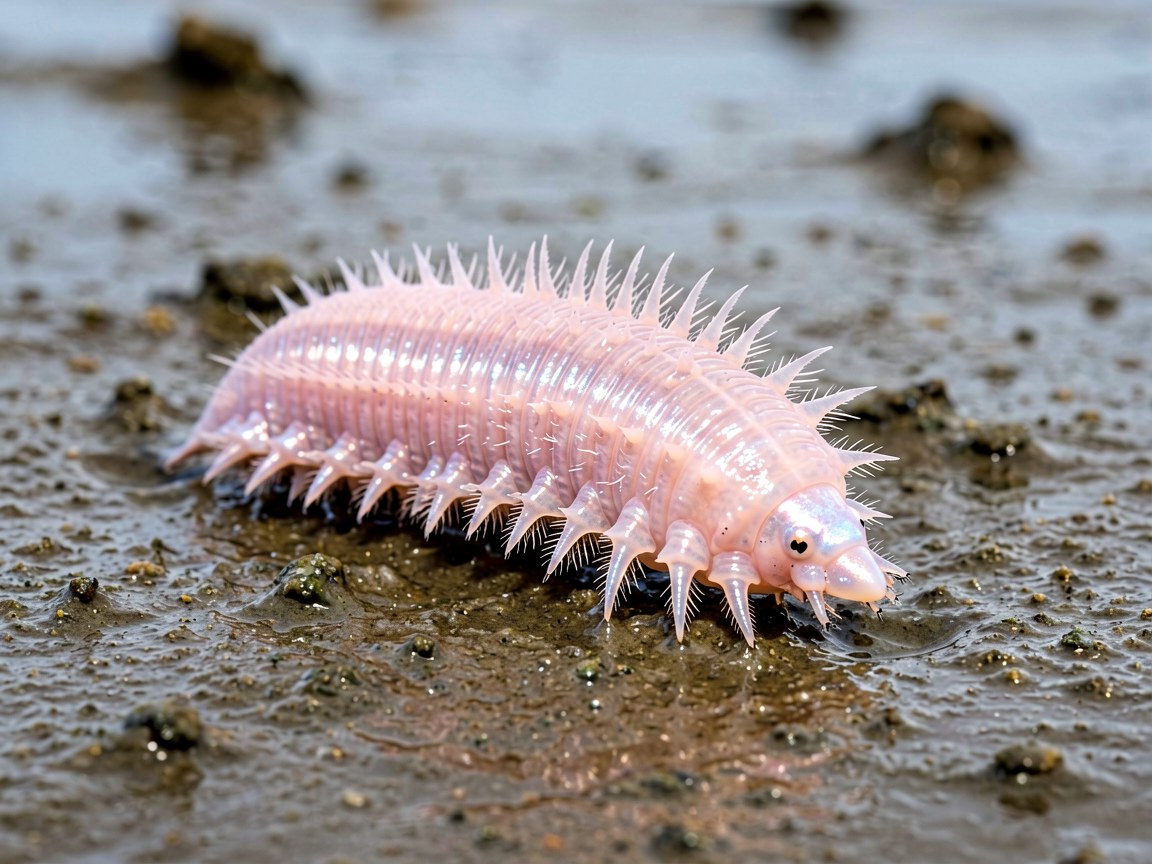
Nephtys hombergii | Catworm
Introduction
The catworm (Nephtys hombergii) is a large, active, muscular bristle worm of sandy and muddy shores, and one of the most important predators of the sediment-dwelling animals of European estuaries and coastal seas. It is a handsome animal in a brutal sort of way: a long, stout, pinkish or greyish body with an iridescent sheen, a small head with a pair of stout jaws that can be thrust right out to seize prey, and, along each side, a row of fleshy, paddle-like appendages fringed with bristles. It burrows through the sediment with remarkable speed, and it is one of the most valuable of all baits for sea angling, prized for its toughness and for the way it stays on the hook. The name comes from the paired, cat-like structures on the head, or from the way the eversible proboscis looks rather like a set of claws.
Taxonomy
Nephtys hombergii is an annelid worm, a member of the class Polychaeta, the bristle worms, and it belongs to the family Nephtyidae, a group of active, burrowing, predatory worms found in sediments worldwide. The genus is named after Nephtys, an Egyptian goddess, and the specific epithet honours the Dutch naturalist Jan Homberg. Members of the family are sometimes known as the catworms or the nephthyid worms, and they are distinguished from other polychaetes by the shape of the head, by the powerful, eversible, muscular pharynx armed with a pair of stout jaws, and by the structure of the parapodia, where the two lobes are widely separated and the branchiae, or gills, are characteristically coiled and turned inward. It is a polychaete rather than an earthworm or a leech, but it is an annelid in the same broad group as Lumbricus terrestris, sharing the fundamental segmented body plan, though the two could hardly live more different lives.
Physical Characteristics
The body is long, stout, and somewhat flattened, tapering gently at both ends, and it can reach twenty centimetres or more in length, though most animals are rather smaller. It is made up of a great many similar segments, each of which is subdivided by fine secondary rings, and the whole body is firm, muscular, and rather rigid in comparison with a soft-bodied worm. The colour is a pale pinkish, flesh-coloured, or greyish, sometimes with a greenish or brownish tinge, and the surface has a distinct, silvery or pearly iridescence, particularly in the living animal. The head is small and pointed, with a pair of very small antennae and a pair of short, stout palps, and with no eyes visible externally. The most remarkable structure is the proboscis, or pharynx, which can be everted — turned inside out and thrust out — through the mouth to expose a pair of large, dark, curved, fearsome jaws at the tip, together with a circlet of soft papillae. Along each side of every segment there is a pair of fleshy, biramous parapodia, each with two widely separated lobes fringed with fine bristles, and with a small, coiled, inwardly directed gill between them.
Habitat
It lives in sand, muddy sand, and mud, from the middle of the shore down to depths of several hundred metres, and it is particularly characteristic of sheltered, soft, organically enriched sediment: estuarine mudflats, muddy creeks, harbour basins, and the softer grounds of the shallow sublittoral. It burrows actively through the sediment rather than living in a permanent tube, and it leaves a temporary, fluid-filled burrow behind it as it goes. It tolerates a wide range of salinities and survives in quite low oxygen conditions, which allows it to live in enriched mud where many other animals cannot. The species is distributed in the north-eastern Atlantic from Norway and the North Sea south to Iberia and into the Mediterranean, and it is common around all the coasts of Britain and Ireland in suitable sediment, often at high density.
Diet
The catworm is an active predator and a scavenger. It hunts through the sediment for other animals — other worms, small crustaceans such as amphipods and young shrimps, small bivalves, and the larvae of various creatures — and it seizes them by thrusting out its proboscis and gripping them with the two curved jaws, then withdrawing the proboscis and drawing the prey into the mouth. It also feeds on carrion and on any soft-bodied animal it can overcome, and where prey is scarce it will take organic detritus from the sediment. Its speed and the power of its jaws make it the top invertebrate predator in many soft-sediment communities, and dense populations can have a significant effect on the numbers of the smaller animals living in the same mud. In turn it is an important food for wading birds, which probe for it in the mud at low tide, and for flatfish and other bottom-feeding fish, which take it when the tide is in.
Reproduction
The sexes are separate, and the males and females look much alike. Reproduction is seasonal, with spawning generally in spring and summer, and the eggs and sperm are released into the sea, where fertilisation takes place. The eggs develop into a trochophore larva and then into a veliger-like larva which spends a period in the plankton, though the planktonic phase is not long, and the young settle into the sediment while still quite small. This limited planktonic stage means that dispersal is restricted and that local populations can be rather distinct, but it also allows the species to colonise new areas of suitable mud reasonably quickly. The worms probably live for three or four years, and like many polychaetes they are able to regenerate lost segments, so that specimens with a partly regrown tail are common — the result of an encounter with a bird that got the tail end and nothing else.
Conservation
The species is common, widespread, and not threatened, and it is one of the most abundant and ecologically important animals of estuarine and coastal soft sediment. Its abundance and its tolerance of low oxygen and of moderate organic enrichment make it a standard component of soft-bottom communities and one of the species most often recorded in sediment surveys; where conditions are very poor it is among the last of the larger animals to disappear, and where conditions improve it is among the first to return. Its main vulnerabilities are the physical destruction of sediment habitat by dredging, capital dredging for ports and marinas, and aggregate extraction, along with the effects of severe pollution and of hypoxia. Collection for angling bait is on a modest scale and is not generally regarded as a threat at the population level, though heavy digging can disturb the sediment community.
Fun Facts
- It can thrust a proboscis right out of its mouth, tipped with a pair of large curved jaws, to seize prey.
- Digging for these worms as fishing bait is a traditional occupation on many muddy estuaries.
- The body has a distinct silvery or pearly iridescence, particularly when alive.
- It burrows through the sediment rather than living in a permanent tube.
- Birds often take only the tail end, and the worm can simply regenerate the lost segments.