 By st20113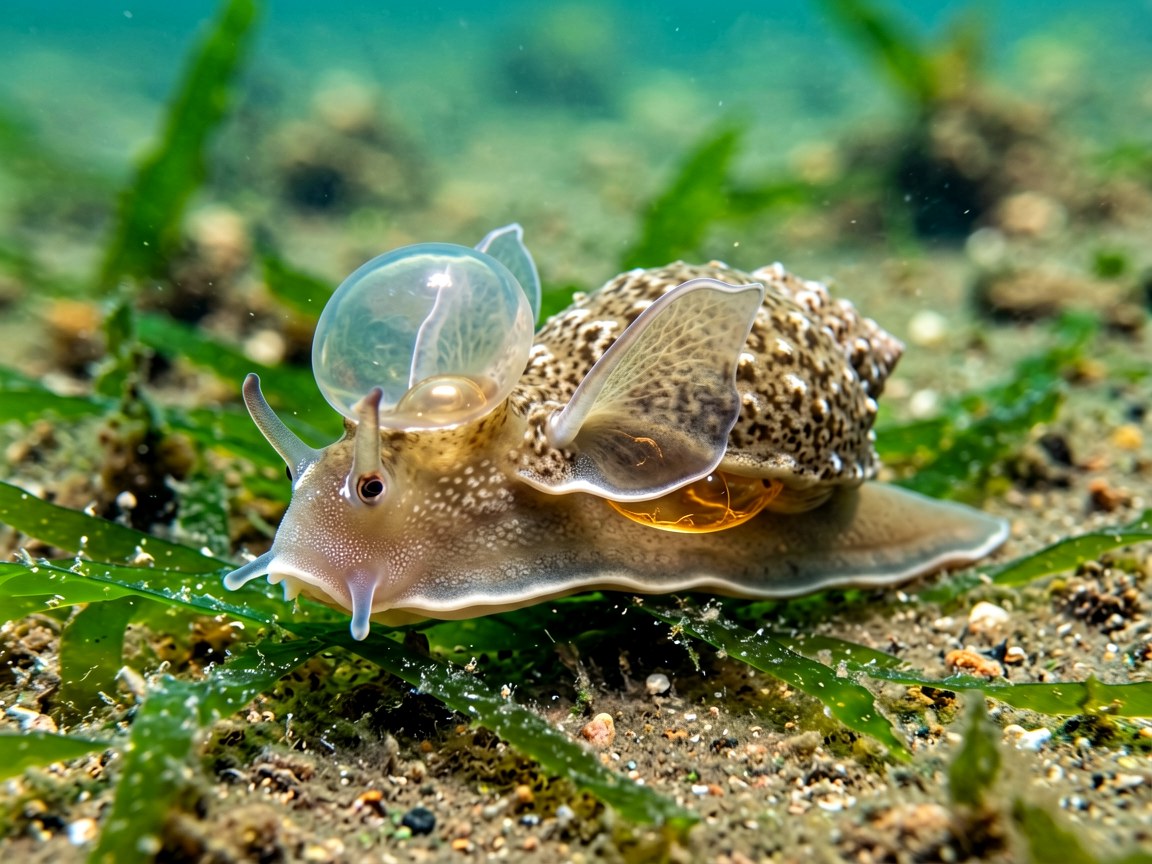
Akera bullata | Bubble Sea Hare
Introduction
The bubble sea hare (Akera bullata) is a curious, soft-bodied sea snail with a shell so thin and delicate that it is almost completely hidden inside the animal, which is why it looks at first glance more like a sea hare or a sea slug than a snail. It is a squat, smooth, olive-brown to greyish animal with a rounded, almost transparent head shield and a large, fleshy, flattened tail, and it lives in shallow, weedy, sheltered water where it grazes on the fine algae growing on mud, eelgrass, and seaweed. Disturbed, it can swim with a slow, undulating flapping of its large lateral lobes, and when handled it releases a purple fluid in the manner of the true sea hares. It is one of only a handful of shelled “sea hares” in northern waters and represents an interesting halfway stage between an ordinary shelled snail and a completely shell-less sea slug.
Taxonomy
Akera bullata is a gastropod mollusc and a member of the order Aplysiida, the sea hares and their relatives, and it is placed in the family Akeridae. The group was formerly known as the Anaspidea, meaning “without a shield”, though that name is misleading here, since the animal has a well-developed head shield. The genus name comes from the Greek for “wingless” or possibly from a kind of shellfish, and the specific epithet bullata means “bubble-like” or “inflated”, a reference to the rounded, thin, bubble-like shell. It is the only species of its family in northern European waters, and it is the sole British representative of a group that is otherwise almost entirely tropical and warm-temperate. It is a snail rather than a sea slug, but it is a mollusc in the same broad group as Octopus vulgaris, and it shares with that animal a soft, active, rather opportunistic way of life quite unlike that of a typical shelled snail.
Physical Characteristics
The animal is soft, smooth, and rather shapeless-looking, typically three to six centimetres long when crawling, with a broad, oval body that is rounded in front and drawn out behind into a long, fleshy, flattened tail. The head is expanded into a broad, rounded, shield-like disc with a slightly notched front edge, and at the sides of the body there are two large, fleshy, wing-like lobes, the parapodia, which fold up over the back when the animal is at rest and can be flapped in a slow, undulating rhythm when it swims. The colour is variable: usually olive-brown, greenish-brown, or greyish, often mottled or speckled with darker and paler markings, sometimes with a faint pattern of fine white or dark dots, and the head shield and the tail are often paler and more translucent. The eyes are minute and set deep in the skin of the head shield. The shell is the surprising part: it is thin, fragile, translucent, amber-coloured, and bubble- or ear-shaped, with a very large, open last whorl and a tiny spire, and it is completely enclosed within the mantle so that only the sheen of it can be seen through the skin of the back.
Habitat
It lives in shallow, sheltered, soft-bottomed or weedy situations: muddy and sandy creeks and estuaries, sheltered bays, eelgrass beds, muddy pools among rocks, and the sheltered shallows of sea lochs, often in quite brackish water and in places with a good deal of fine sediment and decaying weed. It is rarely found on open, wave-exposed coast. It lives on and among the algae and eelgrass it feeds on rather than burrowing, though animals are often half-hidden in soft mud or among the bases of weed. The species occurs in the eastern Atlantic from Norway and the Baltic south to the Mediterranean and north-west Africa, and it is found around most of the coasts of Britain and Ireland, though it is local and easily overlooked because of its retiring habits and its resemblance to the muddy ground it lives on.
Diet
It is a herbivore, grazing the fine film of algae, diatoms, and bacterial and organic material that coats the surface of mud, of eelgrass leaves, and of larger seaweeds, and it also feeds directly on the softer green and red algae themselves, particularly the delicate filamentous and sheet-like forms that grow in sheltered, nutrient-rich water. It feeds with a radula, the toothed ribbon common to almost all molluscs, drawing it back and forth over the surface and scraping off the film; the gut is long and adapted to dealing with large quantities of low-quality plant material mixed with sediment. Because it lives in sheltered, often turbid water where fine sediment settles on every surface, much of what it takes in is inorganic, and the animal passes a great deal of mud through its gut. Its soft body and its habit of living among weed make it vulnerable to fish, and like the true sea hares it defends itself by releasing a purple or whitish fluid from a gland in the mantle when it is disturbed.
Reproduction
The bubble sea hare is a hermaphrodite, as are the other members of its order, and individuals mate in chains or groups, each acting as a male to the one in front and a female to the one behind, with sperm transferred directly and stored until the eggs are ready. Spawning takes place in spring and summer, and the eggs are laid in a long, tangled, gelatinous string or ribbon, usually coiled loosely and attached to eelgrass, seaweed, or stones in shallow water. The string contains very large numbers of tiny eggs, each in its own capsule within the jelly, and the whole mass is often so tangled that it looks like a knot of coarse, pale thread. Development includes a veliger larva that swims and feeds in the plankton for a period before settling and metamorphosing into a small snail. The adults die after spawning, and the planktonic stage is the means by which the species disperses to new stretches of suitable sheltered coast.
Conservation
The species is local rather than abundant and is not considered globally threatened, but it is a species of sheltered, soft, weedy shallows — exactly the kind of habitat most affected by coastal development, dredging, marina construction, and the general loss of sheltered muddy creeks and eelgrass beds. Eelgrass, in particular, has declined dramatically in many parts of Europe over the last century, and with it the associated fauna. Pollution, nutrient enrichment, and the disturbance of fine sediment by boats and by dredging all degrade its habitat. Because it is inconspicuous and lives in places that are awkward to survey, it is probably under-recorded, and verified records are valuable. Its presence is a reasonable indicator of the quality of sheltered, muddy, weedy shallows, and it is one of the more interesting animals to be found in such places.
Fun Facts
- It has a shell, but it is so thin and transparent that it is hidden inside the animal’s body.
- When disturbed it releases a purple fluid, just like the true sea hares.
- It can swim by slowly flapping the large fleshy lobes along the sides of its body.
- It is a hermaphrodite and mates in chains, each animal acting as both male and female at once.
- It is the only member of its family in northern European waters.