 By st20113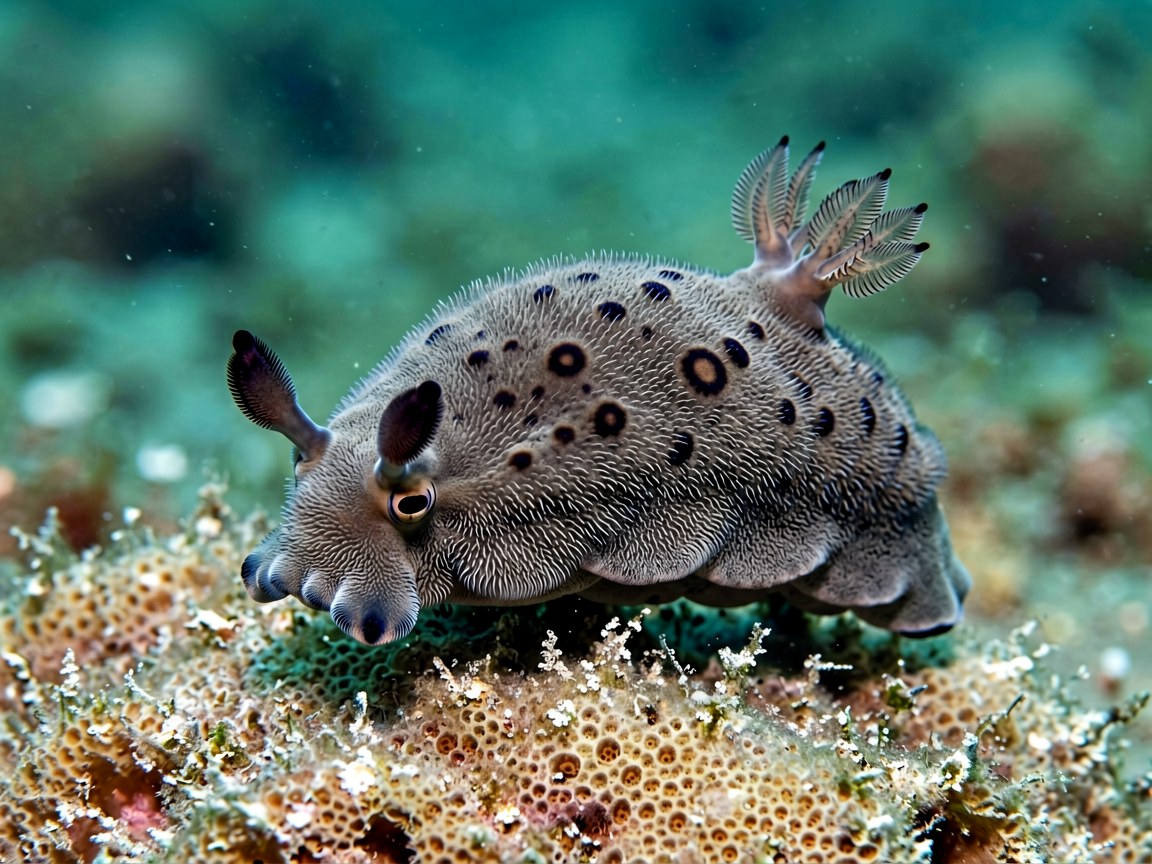
Jorunna tomentosa | Downy Jorunna
Introduction
The downy jorunna (Jorunna tomentosa) is a modest but distinctive sea slug of rocky shores and shallow water, a squat, oval, velvety animal whose whole back is covered in a dense, short, felt-like pile that gives it a soft, almost suede appearance and provides both its common and its scientific name. The ground colour is usually a dull greyish, yellowish, or brownish, marked with scattered dark spots and rings, and the two pairs of head tentacles and the feathery gills at the rear are typically tipped or ringed with the same dark pigment. It is not one of the brilliantly coloured nudibranchs that attract attention, but it is widespread, often locally common, and reliably found by anyone searching among its food — the sponges it feeds on, which it also uses to make itself distasteful to predators.
Taxonomy
Jorunna tomentosa is a gastropod mollusc and a member of the order Nudibranchia, the sea slugs, within the family Discodorididae, a large group of dorid nudibranchs characterised by a flattened, oval body with a smooth or textured back and a retractile crown of gills at the rear. The genus name Jorunna is of uncertain origin, possibly a personal name, and the specific epithet tomentosa means “covered with dense, matted hairs”, the botanical term for a felted surface, which is exactly what the animal’s back looks like. Its relatives include several similar, mostly warm-water discodorids, many of which are also sponge feeders. It is a mollusc in the same broad group as Octopus vulgaris, though the relationship is distant: the octopus is a cephalopod in which the shell has been lost entirely and the foot modified into arms, while this is a snail in which the shell has been lost and the body flattened into a creeping sole.
Physical Characteristics
The body is oval, plump, and rather convex above, typically up to about four centimetres long, with a broad, flat, muscular foot beneath that extends slightly beyond the mantle at the sides. The whole upper surface is covered with a dense pile of very short, fine, close-set papillae, giving it the matte, velvety, felted texture from which it takes its name; this covering feels slightly sticky and picks up fine sediment, so animals often look dusted or dirty. The colour is variable but usually dull: greyish-white, cream, pale yellow, fawn, or brownish, with scattered dark brown or blackish spots and small ring-like markings arranged in a rough pattern, and often with a paler line down the middle. The head carries a pair of short, stout, finger-like oral tentacles and, above them, a pair of rhinophores — the club-shaped, ridged, chemosensory organs typical of dorid nudibranchs — which are usually dark-tipped and can be retracted into pockets. Towards the rear of the back stands a cluster of five to nine simply branched, feathery gills arranged in a rosette around the anus, and these too can be withdrawn into a pocket when the animal is disturbed.
Habitat
It lives on rocky shores and in shallow sublittoral water, down to depths of around fifty metres, and it is found under stones, in crevices, on the undersides of boulders, among seaweed holdfasts, on vertical rock faces, and on any hard surface where encrusting sponges grow. It is most often encountered on the lower shore and just below it, and it is frequently found directly on the sponge it is eating, where its colouring and texture make it surprisingly inconspicuous. It tolerates a fairly wide range of conditions and occurs on both exposed and sheltered coasts. The species is distributed in the eastern Atlantic from Norway and the British Isles south to the Mediterranean and north-west Africa, and it is found all around the coasts of Britain and Ireland, though it is more frequently recorded in the south and west.
Diet
The downy jorunna is a specialist sponge feeder. It feeds by rasping at the surface of encrusting sponges with its radula, a ribbon of small, hooked teeth that scrapes away the soft tissue and leaves a visible grazing mark, and different populations and individuals show preferences for different sponge species — the breadcrumb sponge and various thin, encrusting forms are among those recorded. Because sponges are defended by a formidable chemistry of their own, and often by skeletons of mineral spicules, few animals can eat them, and the nudibranch has turned this to its advantage: it is able to tolerate the sponge’s compounds, and it sequesters some of them in its own tissues and uses them for its own defence. This is why the animal is usually left alone by fish and crabs despite being soft-bodied, slow, and entirely without a shell or any other physical protection.
Reproduction
Like all nudibranchs, it is a hermaphrodite, and each individual possesses both male and female reproductive organs. Two animals mate reciprocally, positioning themselves side by side and exchanging sperm, which is stored internally and used later to fertilise the eggs; self-fertilisation does not normally occur. Spawning takes place in spring and summer, and the eggs are laid in a broad, ribbon-like, gelatinous mass, usually attached in a neat spiral or a series of folds to a stone, a shell, or the sponge on which the adults are feeding. Each ribbon contains very large numbers of tiny eggs. The larvae that hatch are veligers, which spend a period swimming and feeding in the plankton before they settle onto suitable ground and metamorphose into small slugs. The planktonic stage is the main means by which the species disperses and finds new patches of sponge, and it explains why populations can appear and disappear from a site from year to year. Adults are thought to live for about a year.
Conservation
The species is widespread and not considered threatened, and it is one of the more frequently recorded nudibranchs in British and Irish waters, though it is probably under-recorded because it is dull-coloured and often hidden beneath stones and among sponges. Its fortunes are tied to those of the encrusting sponge communities it depends on, which need clean, hard surfaces with enough water movement to keep them free of sediment. Increased turbidity and sedimentation from construction, dredging, and run-off, nutrient enrichment that favours smothering algae, and physical disturbance of the seabed all reduce its habitat, and oil spills and chemical contamination are damaging to all nudibranchs. Because it is a specialist feeder on particular sponges, it cannot easily switch to alternative food, and it is therefore a reasonably sensitive indicator of the condition of rocky and sponge-dominated seabed.
Fun Facts
- The back is covered in a dense, short, felt-like pile, which is what “tomentose” means.
- It feeds on sponges and steals their chemical defences to make itself distasteful to predators.
- The feathery gills at the rear and the rhinophores on the head can both be withdrawn into pockets.
- It is a hermaphrodite, and pairs exchange sperm rather than one acting only as male or female.
- The eggs are laid in a broad, gelatinous ribbon, usually wound in a spiral and stuck to the sponge or stone.