 By st20113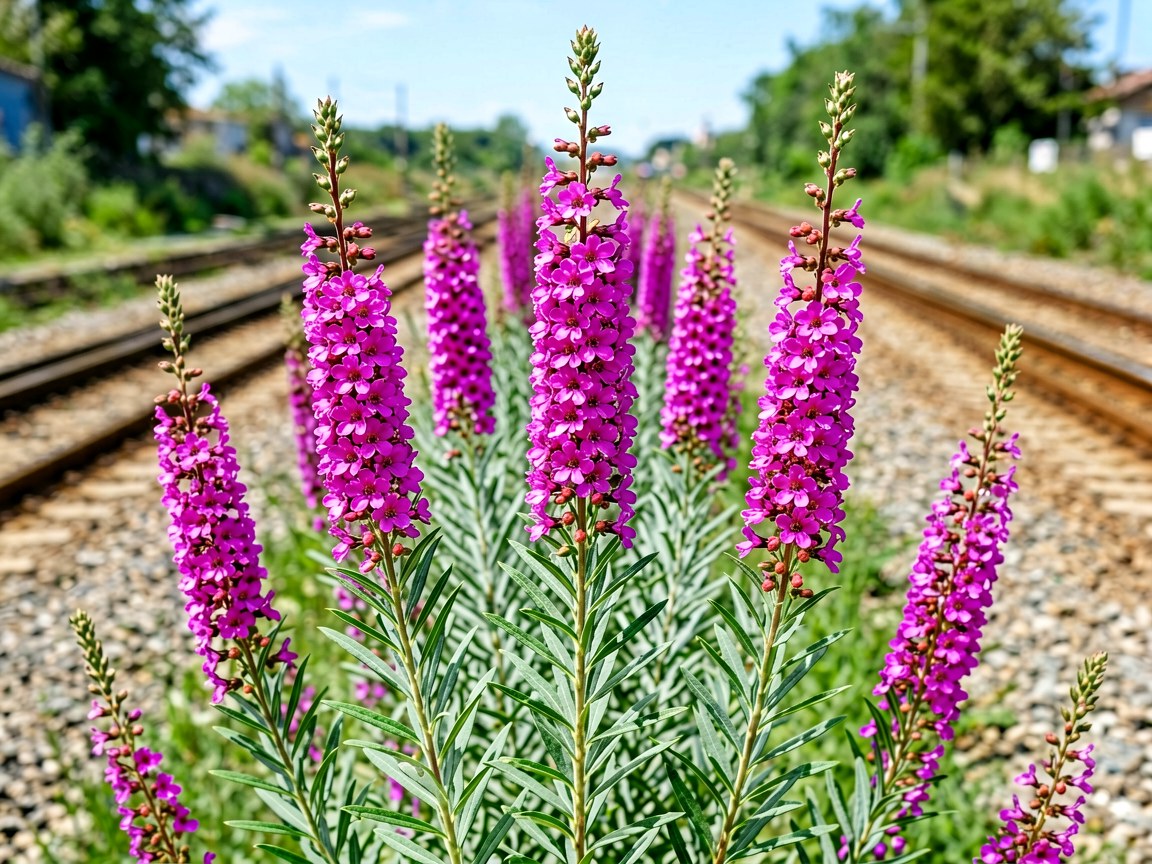
Epilobium angustifolium | Rosebay Willowherb
Introduction
Rosebay willowherb (Epilobium angustifolium), known in North America as fireweed, is the tall, spectacular plant with narrow willow-like leaves and long spires of vivid pinkish-purple flowers that colours railway embankments, cleared woodland, roadside verges, and burnt ground in high summer. It is one of the most successful colonisers in the European flora: it spreads by wind-blown seeds that travel for miles, it grows from a creeping rootstock that allows a patch to expand indefinitely, and it thrives on freshly disturbed, bare, nutrient-flushed ground. The name fireweed is well earned, for it is famously among the first plants to appear on ground cleared by fire, and in Britain it became a familiar sight on the bomb sites of the Second World War. Its other great trick comes later in the season, when the seed pods split to release masses of white silky fluff that drift across the countryside like late summer snow.
Taxonomy
Epilobium angustifolium belongs to the family Onagraceae, the willowherb or evening primrose family, a group of around six hundred species that includes the evening primroses, the fuchsias, and the numerous smaller willowherbs. It is by far the largest and most striking of the European willowherbs, and it is sometimes placed in a genus of its own, Chamerion, as Chamerion angustifolium, on account of differences in the flower structure, the arrangement of the leaves, and the absence of the lobed stigma found in Epilobium proper; both names are in use. The specific epithet angustifolium means “narrow-leaved”. As a green plant it depends on Photosynthesis, and it is a fast-growing, sun-loving species that puts most of its resources into rapid vertical growth and into enormous quantities of seed rather than into long-lived woody tissue.
Physical Characteristics
The plant is a tall, erect, usually unbranched perennial, sixty centimetres to two metres high, rising from a stout, extensively creeping, fleshy rhizome that can spread several metres through the soil. The stems are round, smooth, often reddish, and usually unbranched, though damaged plants branch freely. The leaves are numerous, alternate, lance-shaped and pointed, five to twenty centimetres long, with a conspicuous, pale, wavy midrib and prominent, looping veins that run almost to the margin; they are dark green above and distinctly grey-green and slightly downy beneath, and they have been compared to the leaves of a willow, which is the source of the English name. The flowers are showy, two to three centimetres across, arranged in a long, tapering, many-flowered spike at the top of the stem: each has four broad, spreading, rose-purple to deep pink petals, four narrow, purplish sepals, eight stamens, and a long, four-lobed, white stigma that projects well beyond them. The flowers open from the bottom of the spike upward over several weeks. The fruit is a long, narrow, four-sided pod, four to eight centimetres long, which splits lengthwise when ripe to release a great many tiny seeds, each with a tuft of long, white, silky hairs.
Habitat
It grows on open, disturbed, sunny ground: railway embankments and cuttings, roadside verges, cleared and burnt woodland, forestry clearfells, waste ground, gravel pits, building sites, hedgebanks, riverbanks, gardens, and rough grassland. It favours moist but well-drained, moderately fertile, often slightly acidic soils and open situations, and it is intolerant of heavy shade and of dense competition from tall grass. The species has a wide circumpolar distribution through the temperate and boreal northern hemisphere, across Europe, Asia, and North America, and it is common and often abundant throughout most of Britain and Ireland, though it is less frequent in the extreme north and west. It is equally at home in the mountains and at sea level, and it often forms extensive, almost pure stands.
Diet
Rosebay willowherb is a vigorous autotroph, and its success rests on doing everything quickly. It grows fast, flowers profusely, and produces enormous numbers of seeds, and it supports this effort with a deep, fleshy, creeping rhizome that stores carbohydrate and allows the plant to send up new shoots over a wide area in the following spring. Because it colonises bare, recently disturbed ground, it is adapted to soils in which nutrients have been released by burning, clearing, or excavation and in which competition is absent, and it is a heavy feeder while it lasts. The rhizome also allows it to survive fire, cutting, and burial. As the ground closes over and other plants move in, the willowherb usually declines, since it cannot compete in closed vegetation; a stand is often spectacular for a few years and then thins out as scrub or coarse grass takes over. It is not a strong competitor in the long term, but it is superb at arriving first.
Reproduction
The flowers open from June to September and are strongly protandrous: the stamens mature and shed their pollen before the stigma of the same flower becomes receptive, which encourages cross-pollination. The plant is a rich source of nectar and is worked intensively by bees — honeybees, bumblebees, and many solitary species — and by hoverflies, butterflies, and moths, and it is particularly valued by beekeepers because it produces a good surplus of honey in a good year. The pollen is distinctive, being blue-grey and held together in sticky masses. Once fertilised, the long pods develop and split to release the cottony seeds, which are carried extraordinary distances by the wind; the fluff is a familiar sight in late summer, drifting over waste ground and collecting in drifts against fences. The plant also spreads vegetatively, and this is usually the means by which an established patch enlarges, since the branching rhizome can extend a metre or more in a season and produces new aerial shoots along its length.
Conservation
The species is abundant, widespread, and not threatened; if anything it is one of the plants that has gained most from human activity over the last two centuries. It spread dramatically in Britain during the twentieth century, colonising railway land, bomb sites, and cleared ground, and it is now one of the commonest tall herbs of disturbed land. It is valued as a nectar plant and as a colonist that stabilises bare ground, and it is sometimes sown in revegetation schemes. Where it is unwanted, as in gardens and in some forestry and conservation situations, it is difficult to control, because fragments of the rhizome left in the ground regrow readily and because the seeds arrive continuously from elsewhere. Its presence is a reliable indicator of disturbed, open, moderately fertile ground rather than of any particular quality of habitat.
Fun Facts
- In North America it is called fireweed, because it is among the first plants to colonise burnt ground.
- The ripe seed pods split to release masses of white silky fluff that drift for miles on the wind.
- It spread dramatically across Britain on the bomb sites and railway land of the twentieth century.
- Beekeepers value it highly, since it yields a good crop of honey from a single species.
- A single patch may be one plant, spread by a creeping underground rhizome that can run for several metres.