 By st20113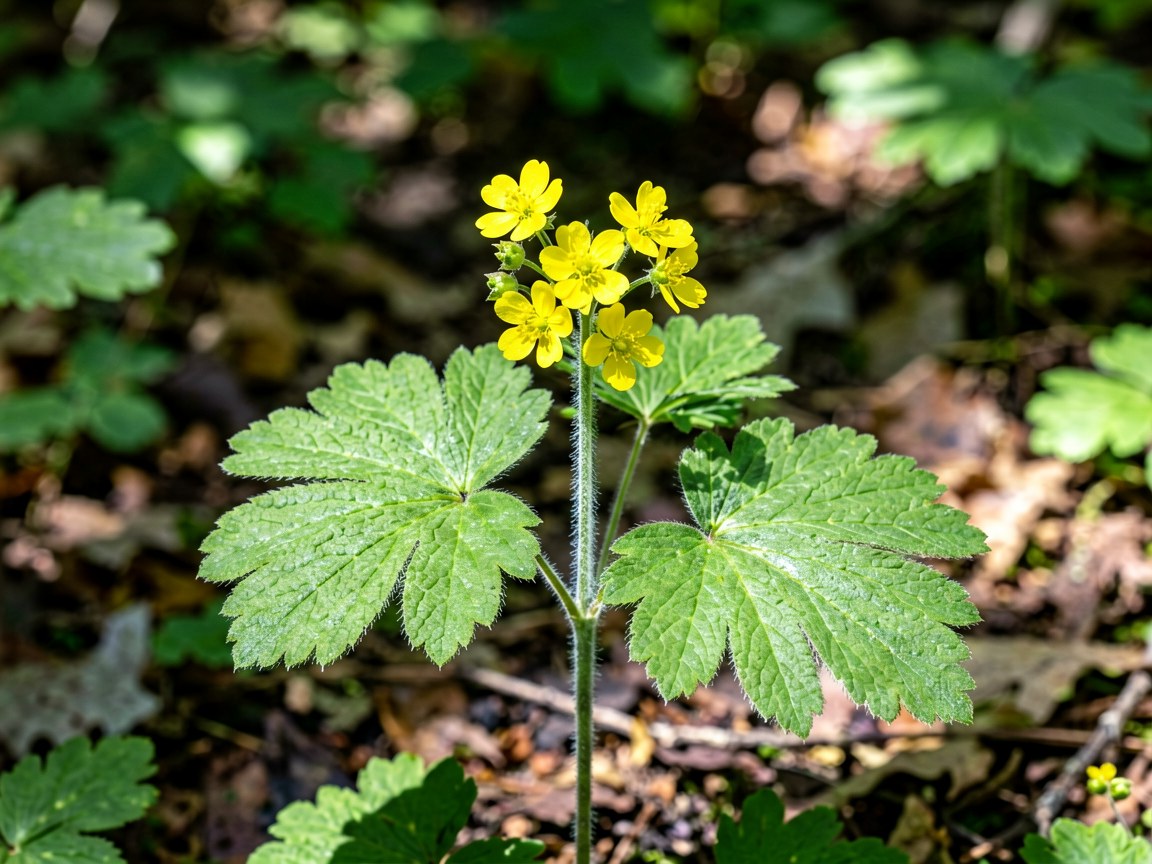
Geum urbanum | Wood Avens
Introduction
Wood avens (Geum urbanum) is an unassuming plant of shady hedgerows and woodland edges, a modest perennial with small, upright, yellow, five-petalled flowers followed by the oddest seed heads: little round, bristly, reddish-brown burrs that catch on clothing and animal fur with remarkable tenacity. It is also one of the old herbal plants of Europe. Its root smells strongly of cloves when freshly dug — the source of its older name, herb bennet, from the Latin herba benedicta, the blessed herb — and it was once used to flavour ale, to keep moths from linen, and to ward off evil. The plant is easy to overlook in flower, but the little hooked burrs are distinctive, and once noticed they are never forgotten.
Taxonomy
Geum urbanum belongs to the family Rosaceae, the rose family, and to the genus Geum, the avens, a group of about fifty species of mostly perennial herbs found through the temperate regions and in the Andes. Its relatives include the water avens Geum rivale, with nodding bell-shaped flowers of dull orange-pink, and the many large-flowered garden avens of hybrid origin. The genus is characterised by the persistent, hooked or feathery styles that remain on the fruit and give the seed heads their distinctive appearance. The specific epithet urbanum means “of towns” or “of cultivated places”, a slightly misleading reference to its habit of growing near habitation rather than to any preference for urban ground. As a green plant it depends on Photosynthesis, and like most woodland-edge perennials it does the greater part of its growing early in the year, before the trees above it come fully into leaf.
Physical Characteristics
The plant is a slender, upright, shortly hairy perennial, usually twenty to sixty centimetres tall, arising from a short, thick, creeping rhizome. The basal leaves are pinnate, with a large, rounded, three-lobed or five-lobed terminal leaflet and two to six much smaller pairs of side leaflets, all coarsely and irregularly toothed; they are bright green and softly hairy on both sides, and they form a loose rosette. The stem leaves are much smaller, usually of three leaflets only, with a pair of large, leafy, deeply toothed stipules at their base that are one of the recognition features of the species. The flowers are small, eight to fifteen millimetres across, borne in loose, few-flowered, open clusters on slender stalks. Each has five spreading, rounded, bright yellow petals, five green sepals that turn back as the flower opens, and a dense central cluster of numerous stamens and carpels. The fruit is the striking part: a small, round, bristly head of numerous one-seeded achenes, each retaining the long, persistent style, which is jointed and hooked near the tip so that the whole head comes away in the fur of a passing animal. Flowering runs from May to September.
Habitat
It grows in woodland, at woodland edges and in rides and clearings, in hedgerows, on shady banks, in scrub, on waste ground, and along the edges of paths and roads, and it is particularly characteristic of the damper, shadier, more enriched ground of lowland hedgerow and secondary woodland. It prefers moist, moderately fertile, neutral to base-rich soils and partial to full shade, and it tolerates a good deal of disturbance, which is why it turns up in churchyards, in gardens, and along the bases of walls. Native across most of Europe and into western and central Asia, and introduced in North America and elsewhere, it is common and widespread throughout Britain and Ireland, though it thins out in the far north and in the wettest western districts.
Diet
Wood avens is autotrophic, photosynthesising in the broad basal leaves that spread out close to the ground in early spring, at the season when light still reaches the woodland floor in quantity. It grows rapidly at that time, flowers, and then largely dies back above ground after seeding, surviving the winter as a short rhizome with a rosette of leaves. It is a moderately demanding plant, favouring enriched soils and responding well to the nitrogen that accumulates where leaf litter breaks down or where hedgerow and waste ground are enriched by human activity. It associates with arbuscular mycorrhizal fungi in the soil, which assist with the uptake of phosphorus. Its other significant investment is chemical: the roots and rhizome contain eugenol, the compound responsible for the scent of cloves, together with tannins and bitter principles, and these are thought to defend the underground parts against insects, nematodes, and the fungi of the soil.
Reproduction
The flowers open from May onwards and are visited by a range of small insects — solitary bees, hoverflies, and flies — which come for the modest supply of nectar and for pollen; the flowers are open and simple in structure, with no specialised mechanism. The plant is capable of self-pollination but insect visits improve seed set considerably. Once fertilised, the carpels develop into the hooked achenes already described, and it is dispersal that makes the species interesting. Each seed carries a long style with a hooked lower portion, and the whole seed head, or individual seeds from it, detach easily and catch in the fur of mammals, in the feathers of birds, and in human clothing; this external transport, known as epizoochory, is what allows a plant with no means of active dispersal to move about the landscape. The seeds are also eaten and distributed by some birds. Vegetative spread occurs slowly by means of the short, branching rhizome, so plants often occur in small patches. Seedlings establish best on bare or lightly disturbed ground, which is why the plant is so often found on hedge banks, along the edges of paths, and in the shaded corners of gardens where soil has been turned over. Once established, a plant can persist for many years, since the rhizome is sturdy and survives both drought and the shade of a closed canopy by simply waiting for better conditions.
Conservation
The species is common, widespread, and not threatened, and it is one of the more adaptable plants of woodland edge and hedgerow, tolerant of shade, disturbance, and a wide range of soils. It has probably benefited from the creation of hedgerows and secondary woodland and from the general enrichment of lowland ground. Its declines, such as they are, follow the destruction of hedgerows and of old woodland, and the conversion of rough, shady, semi-natural ground into intensively managed farmland or amenity planting. It is a useful component of the ground flora in new woodland planting, where it establishes readily and helps to build a herb layer. Its historical uses are now largely forgotten, but the clove-scented root is one of the small pleasures of the countryside for anyone willing to dig one up, and the plant is still occasionally grown in herb gardens.
Fun Facts
- The freshly dug root smells strongly of cloves, because it contains the same compound, eugenol.
- The seed heads are round bristly burrs that cling tightly to clothing and animal fur.
- Its old name, herb bennet, comes from herba benedicta, meaning the blessed herb.
- The root was once used to flavour ale and to keep moths away from stored linen.
- The flowers are small and plain, but the hooked seed heads that follow are unmistakable.