 By st20113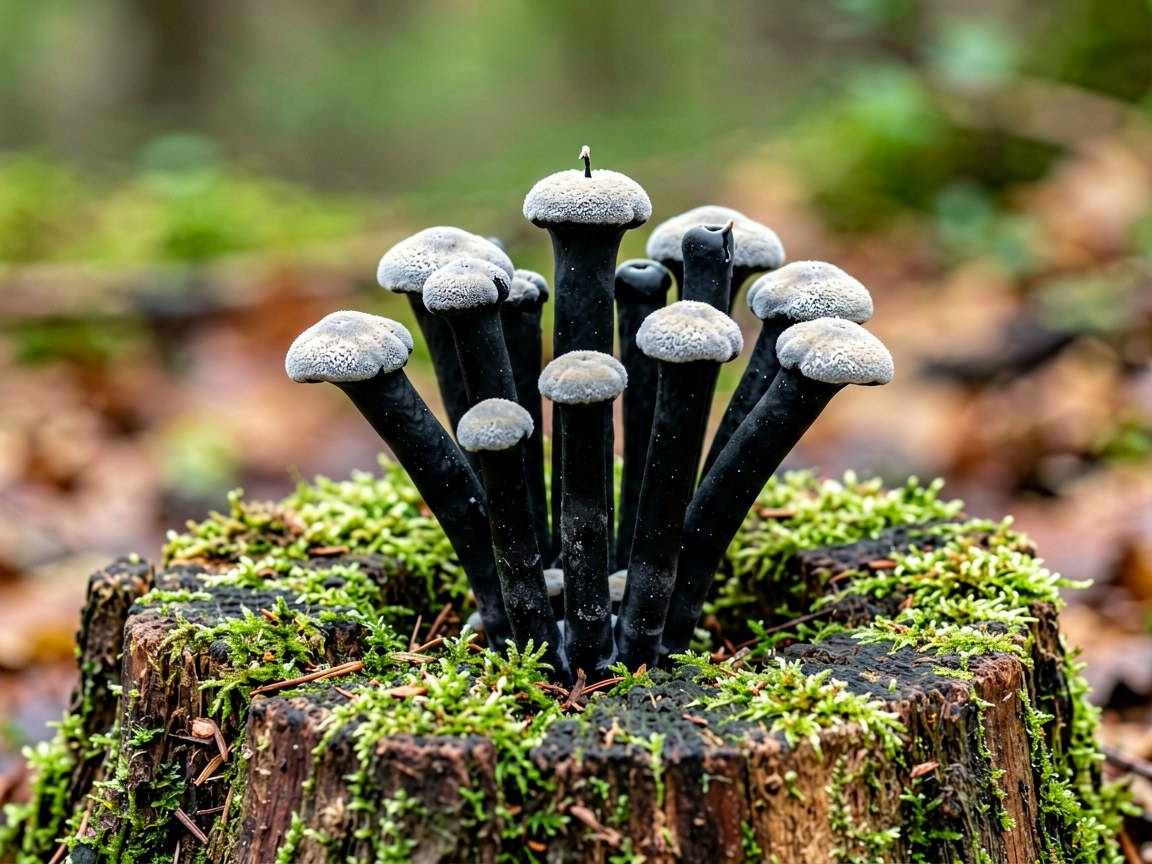
Xylaria hypoxylon | Candlesnuff Fungus
Introduction
The candlesnuff fungus (Xylaria hypoxylon) is one of the commonest and most easily recognised fungi of dead wood, a small, flattened, antler-like structure that looks rather like the blackened wick of a candle and is found in dense clusters at the base of stumps and on buried wood throughout the year. Young specimens are the striking ones: slender, upright, flattened, and branched, pale grey to whitish at the tips from a powdery covering of asexual spores, and black and velvety towards the base. Later they darken, harden, and become brittle, and the white tips disappear, leaving a black, charred-looking, branched stick. The name comes from that resemblance to a burnt candle wick, and the fungus is one of the easiest for a beginner to learn, because it is abundant, distinctive, and present in every month of the year.
Taxonomy
Xylaria hypoxylon is an ascomycete, a member of the phylum Ascomycota, in the order Xylariales and the family Xylariaceae, a large and important group of wood-decaying fungi that also includes the dead man’s fingers Xylaria polymorpha, the crust-like Hypoxylon species, and the cramp balls Daldinia concentrica. The genus name comes from the Greek for wood, and most of its members are hard, dark, upright or cushion-shaped structures on dead wood. The specific epithet hypoxylon means “under wood”, a reference to where it grows. As a sac fungus it produces its sexual spores inside elongated cells called asci, typically eight per ascus, rather than externally on basidia as the mushrooms such as Amanita muscaria do, and the asci are contained in tiny flask-shaped chambers buried in the surface of the mature fruit body. The conspicuous white powder on young specimens is not the sexual stage at all but a mass of asexual conidia.
Physical Characteristics
The fruit bodies are small, upright, and flattened, typically two to eight centimetres tall, and they are characteristically branched in an antler-like or candelabra-like fashion, with two or three main branches that fork again towards the tips. The branches are flattened rather than round, and they are covered with a fine, velvety, black to dark brown layer below, while the upper parts and the tips are clothed in a whitish to pale grey, powdery bloom when young and fresh — that bloom is the conidial stage, and it rubs off easily. As the fungus matures, the whole structure becomes uniformly black, hard, and brittle, the white tips vanish, and the surface becomes roughened by minute pimples, each of which is the mouth of one of the buried flask-shaped chambers containing the asci. The interior is whitish to cream and quite hard. The spores are dark brown to black, smooth, bean- or crescent-shaped, and the spore print is effectively black. The fruit bodies are perennial in the sense that they persist for months or even a year or more without decaying.
Habitat
It grows on dead wood of all kinds, but especially on the wood of broadleaf trees: stumps, logs, fallen branches, buried roots, wood chips, and sawdust, and it is most often seen in dense clusters arising from a stump or from wood just beneath the soil surface. Beech, oak, birch, hazel, and ash are all common substrates, and it is also frequent on conifer wood. It occurs in woodland, hedgerows, scrub, parks, gardens, and on any pile of wood chips or rotting timber, and it is one of the commonest fungi in Britain and Ireland as well as across Europe, North America, and much of the temperate world. It fruits throughout the year, with a peak in autumn and winter, and because the fruit bodies are tough and persistent they can be found in almost any month, including in dry weather, when most fungi are absent.
Diet
The candlesnuff fungus is a saprotroph, and it is one of the significant decomposers of dead hardwood. It colonises wood that is already dead and often already partly decayed, and it is particularly associated with the later stages of decay, when the wood has been softened by other fungi. It is a white-rot fungus: it produces enzymes capable of breaking down both the cellulose and the lignin of the wood, and although it is less aggressive in this respect than some of the larger bracket fungi, its mycelium spreads through the wood well beyond the visible fruit bodies and contributes substantially to its breakdown. It is not a parasite of living trees, and it does not attack sound timber in buildings, but it will colonise damp, dead wood in any situation where the conditions allow, including wood chip mulch laid over garden beds.
Reproduction
The fungus has two distinct reproductive stages, which is why young and old specimens look so different. The first is asexual: the young, upright, branching structures produce vast quantities of minute, colourless conidia on the surface of the pale, powdery tips, and these are dispersed by wind, by rain splash, and by contact with passing animals; this stage can appear rapidly, cover a stump with white powder, and produce millions of spores within days. The second is sexual, and it follows later, often in the milder months: the surface of the mature, blackened fruit body develops the tiny raised pimples, each of which opens by a pore and contains a flask-shaped chamber lined with asci. Eight dark spores develop in each ascus and are released through the pore, germinating to produce a new mycelium that must find dead wood to colonise. Having both stages allows the fungus to spread quickly and locally by conidia and to generate genetic variation through the sexual stage.
Conservation
The species is abundant, almost cosmopolitan in temperate regions, and under no threat whatsoever. It is one of the fungi most tolerant of human activity, because it flourishes on stumps, wood chips, sawdust, prunings, and any other dead wood that people leave lying about, and it is often more conspicuous in parks and gardens than in woodland. If anything it is an indicator of a supply of dead wood rather than of any particular quality of habitat, and its disappearance from a site usually means that dead wood is being systematically cleared. Its value is primarily educational and ecological: it is one of the easiest of all fungi to recognise, it is available in every season, and it demonstrates the ascomycete life cycle, with its two distinct spore stages, more clearly than almost any other species.
Fun Facts
- The name comes from its resemblance to the blackened, burnt wick of a candle.
- The white powder on young specimens is a mass of asexual spores, not the sexual stage.
- It is an ascomycete and produces its sexual spores inside sacs, eight to a sac, buried in tiny chambers.
- It fruits all year round and can be found even in the driest months, because the fruit bodies are tough and persistent.
- It is a white-rot fungus, able to break down both the cellulose and the lignin in dead wood.