 By st20113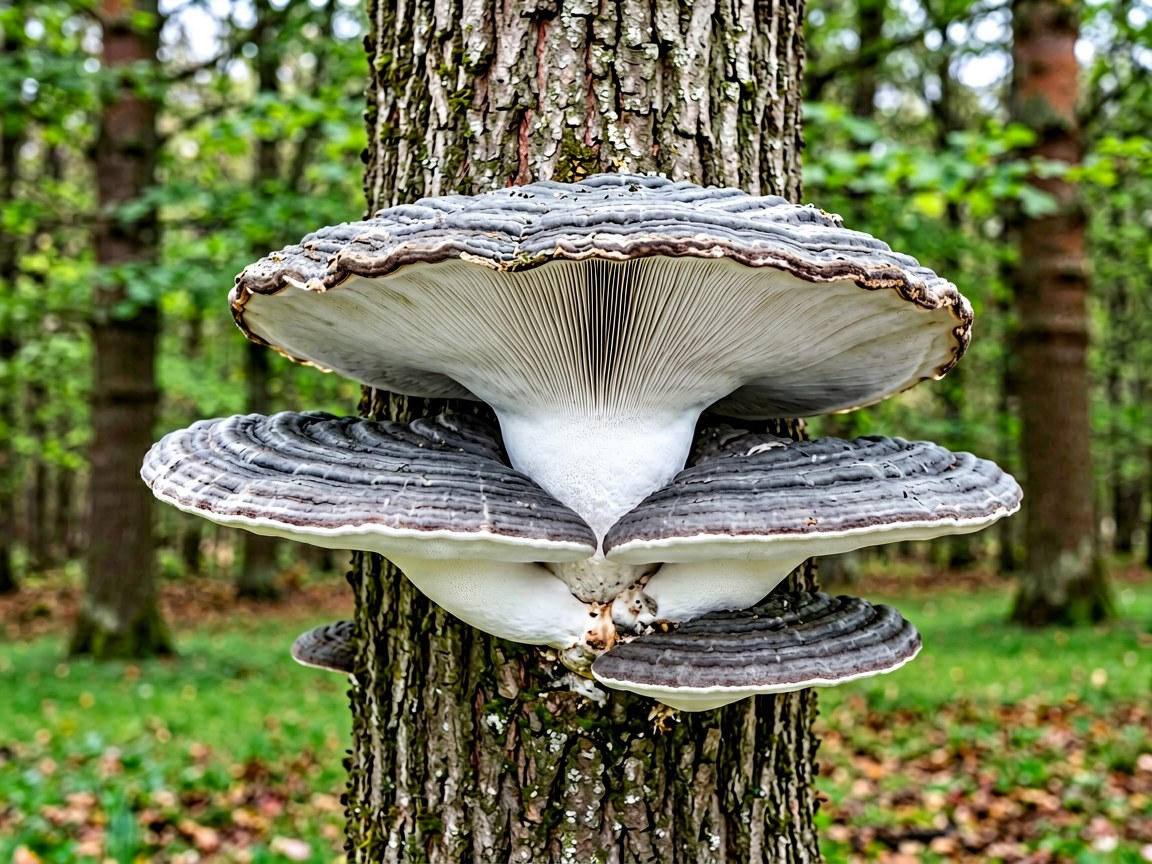
Ganoderma applanatum | Artist’s Bracket
Introduction
The artist’s bracket (Ganoderma applanatum) is a large, hard, grey-brown bracket fungus that grows on the trunks and stumps of broadleaf trees, and it is famous for one particular property: the pure white undersurface bruises dark brown wherever it is scratched, so that a fingernail or a knife blade can be used to draw on it. Drawings made on the pore surface stay legible for years, because the fungus is perennial and adds a new layer of pores each season without repairing the old ones. It is one of the most substantial of the bracket fungi, a shelf that can be half a metre across and a decade old, and it is a major agent of decay in broadleaf woodland, quietly reducing the heartwood of a living tree to a soft, pale, spongy mass for years before the tree finally falls.
Taxonomy
Ganoderma applanatum is a basidiomycete in the order Polyporales and the family Ganodermataceae, and it is the type species of a genus distributed worldwide. The genus name means “shiny skin”, a reference to the varnished, lacquered appearance of the cap surface in some of its relatives, and the specific epithet applanatum means flattened. It is closely related to the much rarer and more celebrated Ganoderma lucidum, the lacquered bracket or reishi, which is a different species with a distinctly shiny, red-brown, kidney-shaped cap and a stem, and which has been used in East Asian medicine for two thousand years; the two are frequently confused. Like the familiar Amanita muscaria, the artist’s bracket produces its spores externally on club-shaped basidia, but here the basidia line the inside of thousands of fine vertical tubes opening as pores on the underside rather than hanging from gills.
Physical Characteristics
The fruit body is a perennial, hard, woody bracket, usually five to forty centimetres across but sometimes much larger, and two to ten centimetres thick at the point of attachment. It is typically semicircular or fan-shaped in outline, projecting horizontally from the trunk, with a hard, knobbly, irregular upper surface that is covered with a thin, dull, grey-brown to dark brown crust and marked with concentric ridges and grooves corresponding to each year’s growth; the growing margin is soft, rounded, and pure white. The underside is the distinctive part: a dense layer of very fine, straight, vertical tubes, each ending in a minute round pore, giving a surface that is at first pure white and smooth, later cream to pale brown, and finally darkening with age. Bruised or scratched, the white surface turns brown within seconds, and this browning is permanent. The flesh is tough, fibrous, corky, and pale brown to cinnamon. The spores are small, oval, and brown with a double wall, and they are produced in such quantities that a large bracket can dust the ground beneath it with brown spore powder.
Habitat
It grows on the wood of broadleaf trees, both on living trunks, where it enters through wounds and broken branches, and on dead standing trees, stumps, fallen logs, and large pieces of timber. Beech is the commonest host in Europe, but it occurs on oak, birch, ash, horse chestnut, poplar, willow, maple, and many others, and it occasionally appears on conifers. It is found in woodland, parkland, gardens, hedgerows, and anywhere with mature or dead broadleaf timber, and it is one of the most widespread bracket fungi in the world, occurring throughout the northern hemisphere and beyond. It fruits all year round as a perennial structure, adding a new layer of tubes each season, and the brackets persist long after the spores are gone, gradually weathering to a hard, grey, empty shell.
Diet
The artist’s bracket is a white-rot fungus and a parasite as well as a decay organism. It colonises the heartwood and sapwood of its host, breaking down both the cellulose and the lignin that make up the wood, which is the defining feature of white rot; the attacked timber becomes pale, soft, light in weight, and stringy or spongy, and it separates along the grain. Because it works mainly on heartwood and because a vigorous tree can wall off the decay, a host may live for many years with the fungus inside it, and by the time a bracket appears externally the tree has usually been infected for a decade or more. The fungus eventually causes structural failure: the trunk becomes hollow or the base of the tree becomes so weakened that it snaps in a storm, which is one reason large brackets on amenity trees are taken seriously by arboriculturists.
Reproduction
The spores are produced inside the vertical tubes on the underside of the bracket and are released through the pores, dropping out under their own weight and being carried away by air currents, by water running down the trunk, and by anything that brushes past. A large, actively growing bracket can release spores continuously for months. They are produced in enormous numbers, because the chance of any one spore landing on a suitable wound of a suitable host tree is very small. Those that do germinate produce a mycelium that must penetrate exposed wood and meet a compatible partner before it can establish. The bracket itself is perennial: each year it adds a new layer of tubes beneath the previous year’s, so a large specimen may carry a dozen or more distinct layers, and the oldest part of the fungus can be as old as the tree’s wound. This layered growth is what makes it such a good drawing surface — the damaged layer is simply buried and never repaired.
Conservation
The species is common, widespread, and not threatened, and of all the woodland fungi it is among the least at risk, since it thrives on dead and dying timber and is tolerant of quite heavily managed woodland and parkland. Its presence is evidence of old or damaged trees rather than of pristine conditions, and it is one of the species that persists in avenues, parks, and gardens long after more demanding fungi have gone. The fungi that share its habitat and are genuinely at risk are those tied to veteran trees and to long continuity of dead wood, and the retention of standing dead timber and of old, hollow, or damaged broadleaf trees benefits the whole community. The main threat to the species locally is the removal of dead wood and the felling of old trees, and where these are carried out thoroughly the brackets disappear with them.
Fun Facts
- The white underside bruises brown when scratched, so drawings made on it with a fingernail remain for years.
- The bracket is perennial and adds a new layer of pores each year without repairing old damage.
- A large specimen can be half a metre across and may be more than ten years old.
- It is a white-rot fungus that can break down both the cellulose and the lignin of wood.
- It is closely related to the lacquered bracket, or reishi, a celebrated medicinal fungus in East Asia.