 By st20113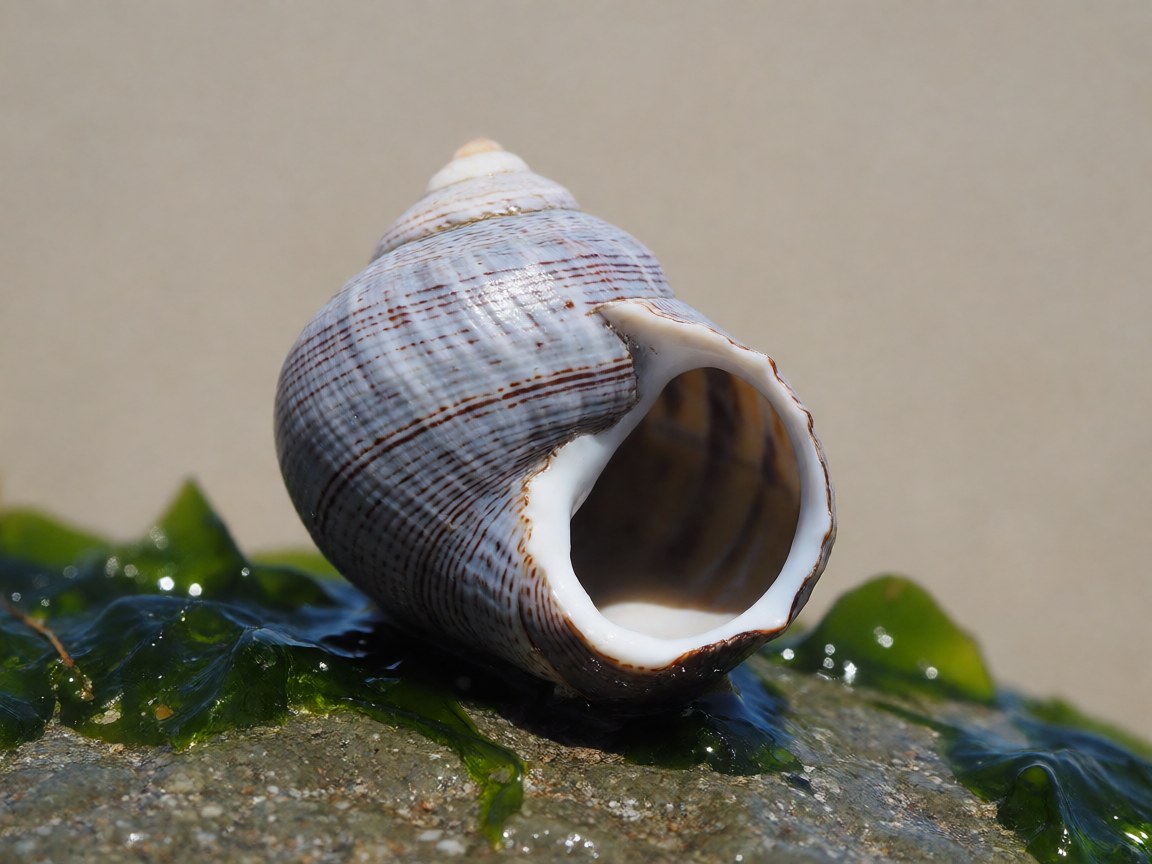
Monodonta lineata | Toothed Top Shell
Introduction
The toothed top shell (Monodonta lineata) is a small, thick-shelled sea snail of rocky shores, a neat cone about the size of a broad bean that grazes the film of microscopic algae from rocks between the tides. Its shell is greyish or olive, marked with fine spiral lines of purple or brown following the whorls, and the opening has a single blunt white tooth on the inner lip — the feature that gives the species both its English and its scientific names. On suitable shores in south-west Britain and Ireland it can be one of the commonest snails on the mid-shore, sitting in damp crevices and shallow pools at low tide and creeping out to feed when the water returns. It belongs to the top shells, the family Trochidae, a group of sturdy, algae-scraping snails whose shells are among the most familiar objects in a rock pool.
Taxonomy
Monodonta lineata is a gastropod mollusc in the family Trochidae, the top snails, within the vetigastropods — an ancient lineage of largely herbivorous marine snails that retain a number of primitive features, including a heart with two auricles and a shell with a nacreous, or pearly, inner layer. The genus Monodonta contains a handful of warm-temperate and tropical species, and lineata is the one that reaches north-west Europe. Its relatives on British shores include the painted top shell Calliostoma zizyphinum, the grey top shell Gibbula cineraria, and the thick top shell Steromphala cineraria, all of which share the conical shape and the horny operculum. It is a snail rather than a sea slug or a cephalopod, but it is a mollusc in the same broad group as Octopus vulgaris, and it shares with that animal the basic molluscan body plan of muscular foot, mantle cavity, and a feeding organ armed with a toothed ribbon. The specific name lineata refers to the linear markings on the shell.
Physical Characteristics
The shell is top-shaped, up to about two centimetres high and slightly less wide, with a conical spire and five or six rounded whorls separated by a shallow suture. It is thick and solid for its size, grey, olive-grey, or greenish, and the surface carries fine spiral ridges crossed by growth lines, with a pattern of broken purple-brown or reddish spiral stripes running around the whorls that can be quite bright in clean, unworn shells. The aperture is rounded and oblique, and on the inner or columellar lip there is a single prominent blunt tooth, often white, which is diagnostic. Inside, the shell is nacreous and iridescent. The animal seals the aperture with a horny, circular, many-whorled operculum, which fits tightly and is the snail’s defence against drying out when the tide is out. The soft parts are greyish to greenish, and the head carries a pair of long, slender tentacles with the eyes on short stalks at their base; the foot is broad and muscular and bears three pairs of sensory tentacle-like lobes along each side, a characteristic feature of the vetigastropods. The sexes look alike.
Habitat
It lives on rocky shores from the middle of the shore down to the lower shore and into the shallow sublittoral, usually on open rock, in crevices, under stones, and in rock pools, and it is especially abundant on moderately exposed coasts where there is enough wave action to keep the rock clean and enough algae to graze. It is markedly tolerant of exposure to air: at low tide the snails retreat into crevices, damp hollows, and weed cover, close the operculum, and wait for the water to return. The species is distributed along the eastern Atlantic from Britain and Ireland south through France and Iberia to north-west Africa and the Canary Islands, and it is absent from the northern North Sea. Within Britain it is commonest in the south-west and in Ireland and becomes scarce or absent on the colder north and east coasts, a distribution that reflects its preference for warmer water and makes it a useful indicator of the warming of British seas.
Diet
The snail is a herbivorous grazer. It feeds with a radula, a flexible ribbon of chitinous teeth, which it draws back and forth across the rock surface to rasp off the thin film of microalgae, diatoms, bacterial film, and sporelings that coat any damp, lit surface in the intertidal. Adults also take larger, softer algae and some organic detritus, and they will graze the surface of fucoid and other seaweeds. Feeding is done mainly when the snail is covered by the tide or when the rock is wet, which on the middle of the shore means for a few hours either side of high water; at low tide in a damp crevice it may continue to feed slowly. By keeping the rock surface cropped, large populations of toothed top shells help control the growth of algal film and create space for barnacles, limpets, and settling larvae, and in turn they are eaten by crabs, fish, and birds.
Reproduction
The sexes are separate, and fertilisation is external. In late spring and summer, males and females release sperm and eggs into the sea, usually when the tide is high and the water is moving, and the eggs are fertilised in open water. Development passes through the trochophore larva and then the veliger, a minute swimming larva that feeds and drifts in the plankton for a period before settling onto suitable rock and metamorphosing into a tiny snail. The planktonic stage is the main means by which the species spreads along the coast, and it also explains why healthy populations depend on the surrounding coastline having suitable habitat nearby. Growth is modest and the animals probably live for several years; the shell grows by adding to the aperture margin, and older individuals often have worn, eroded spires, though the tooth and the inner nacre remain clearly visible.
Conservation
The species as a whole is common and not considered globally threatened, and in the warmer parts of its range it is abundant. The main threats are local and episodic: oil spills have devastated populations of trochid snails on affected shores, including in Britain and on the coasts of Iberia, because these snails sit in the zone most exposed to floating oil and cannot escape it. Coastal construction, the armouring of the shore with concrete, and heavy trampling in rock pools all reduce habitat quality, and collection for aquaria and for craft uses puts pressure on accessible populations. In northern Britain the position is the reverse of the usual picture — the species is at the edge of its range and may be increasing as sea temperatures rise, which makes it a species of interest in monitoring the effects of climate change on rocky shore communities.
Fun Facts
- The single blunt tooth inside the shell opening gives the species its name.
- Like other top shells, it can seal itself into its shell with a horny operculum to survive hours out of water.
- The inside of the shell is pearly and iridescent, as in the shells of its tropical relatives.
- It is a natural grazer of the rock surface, and its constant rasping helps keep the shore free of algal film.
- Empty toothed top shells are often taken over and worn by hermit crabs.