 By st20113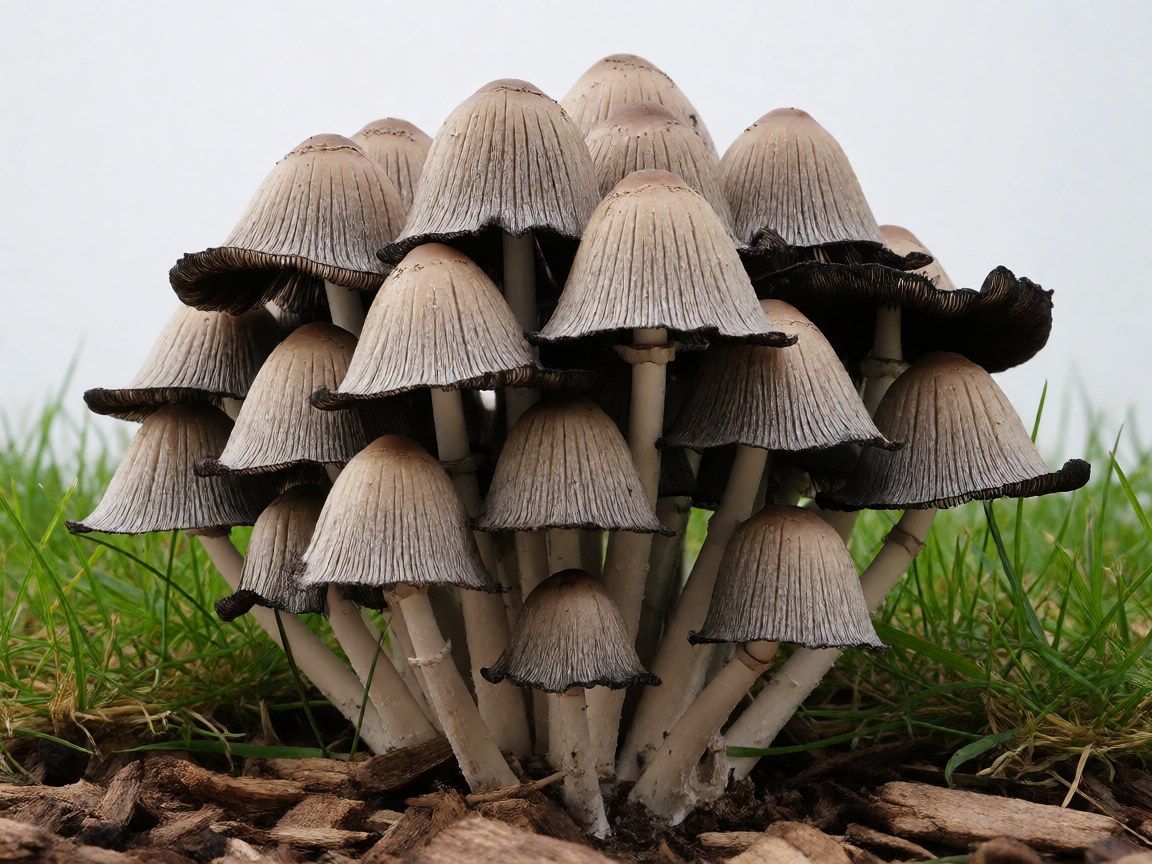
Coprinopsis atramentaria | Common Inkcap
Introduction
The common inkcap (Coprinopsis atramentaria) is a mushroom built to fall apart. It appears in tight clusters on disturbed ground and buried wood, a neat grey-brown bell that looks unremarkable at breakfast and has usually turned itself into a pool of black liquid by the following afternoon. This self-destruction is not decay but strategy: the cap and gills deliberately digest themselves, dissolving from the edge inward into a black, spore-laden fluid that drips away from the shrinking cap — the origin of both the name “inkcap” and the old practice of using the liquid as writing ink. It is also one of the best-known mushrooms with a catch attached: the fungus is edible on its own but becomes genuinely unpleasant, and in some people alarming, if alcohol is drunk at around the same time. That combination of a spectacular life cycle and a memorable warning has made it one of the most frequently described fungi in European field guides.
Taxonomy
Coprinopsis atramentaria is a basidiomycete in the order Agaricales and the family Psathyrellaceae. It was long known as Coprinus atramentarius, and most older literature and many guidebooks still use that name, but molecular work showed that the old genus Coprinus was spread across several unrelated lineages; only a small group around the shaggy inkcap’s relatives remained, and most of the inkcaps were moved into Coprinopsis. Related species include the shaggy inkcap Coprinus comatus, which stayed behind in the old genus, and the various mica caps of Coprinellus. The genus name refers to living on dung or filth and the epithet atramentaria to ink. As a gilled fungus it forms its spores on club-shaped basidia, as does Amanita muscaria, but the resemblance ends there: the inkcap’s gills do not merely drop their spores, they liquefy themselves in order to do it.
Physical Characteristics
The cap is three to seven centimetres tall, at first oval and only later expanding into a bell, and even then it rarely flattens completely. It is grey to grey-brown, often with a slightly warmer brown or faintly scaly centre, smooth to finely silky, and the margin is typically marked with fine radial lines. As it matures the margin begins to split and curl, and the whole cap turns black and drips away, a process known as deliquescence. The gills are crowded, free, and pass in sequence from white through pinkish to black — the colour change reflects the spores maturing from the edge inward — and they too dissolve into black fluid. The stem is five to fifteen centimetres tall, white, smooth, and hollow, often with a faint ring-like zone low down that disappears as the mushroom ages, and it frequently arises from a common buried base shared with a dozen or more neighbours. The spore print is black. The flesh is thin, pale, and pleasantly mild in smell and taste while young.
Habitat
It grows on disturbed ground and on buried dead wood, which is why it turns up so often in urban and suburban places: wood-chip mulch, garden borders, lawns with buried roots, roadside verges, paths through parkland, building sites, and around old stumps. It is saprotrophic and, unlike many mushrooms, it does not need obvious rotting wood above ground — a buried root or a layer of wood chips is enough. It fruits in dense tufts, sometimes of twenty or more, from spring to late autumn, and after rain. The species is widespread and common across Europe and North America and throughout Britain and Ireland. Individual fruit bodies are extremely short-lived, often appearing in the morning, deliquescing by the following day, and leaving nothing but a black stain on the pavement or soil beneath. Because the tufts arise again and again from the same buried mycelium, a single spot under a hedge or along a wood-chip path can produce flush after flush over several years, and a colony may appear to “move” gradually as the food source beneath it is consumed. The speed of the whole cycle is part of the appeal: a cluster can go from tight grey egg-shaped buttons to a spreading black puddle in under forty-eight hours, and anyone who photographs it in the morning and returns the next day will usually be too late.
Diet
The fungus is a saprotroph that decomposes dead woody material: buried roots, stumps, sawdust, wood chips, and other lignified debris. It secretes enzymes that break down cellulose and lignin, absorbing the soluble products, and its mycelium can run for a considerable distance through soil from a buried food source, which is why mushrooms often appear well away from any visible wood. Its ability to exploit wood chips means it thrives in planted municipal beds and landscaped gardens, and it is far more common in towns than many woodland fungi. It is not mycorrhizal and takes nothing from living plants. Because the mycelium can run through soil for a metre or more from its food source, a gardener may find mushrooms surfacing on a lawn with no apparent wood anywhere nearby, and the only visible clue is often an old stump or a buried root some distance away. The fungus is also capable of growing through and fruiting from quite heavily compacted ground, which is another reason for its success on paths and in municipal planting.
Reproduction
Spores are produced on the gill surfaces and are the reason for the mushroom’s extraordinary self-digestion. As each batch of spores matures, the gill tissue holding it breaks down and liquefies, so that the spores are released into a sticky black fluid that drips off the cap; the process continues from the margin inward, with the outer, oldest parts dissolving first while the younger parts near the centre are still producing spores. This autodigestion lets the mushroom go on releasing spores as the cap shrinks and collapses, instead of being limited to the brief window in which a conventional cap can simply drop them. The fluid dries, and the spores it carries are dispersed by rain splash, by running water, and by insects and other small animals that contact it. Sexual reproduction follows the standard basidiomycete pattern, with nuclear fusion and meiosis in the basidia producing four spores each, and compatible mycelia must meet for fruiting to occur. The mycelium persists underground or within the wood for years, fruiting whenever conditions allow.
Conservation
The species is common, widespread, and not threatened, and it is one of the fungi that has clearly benefited from human activity: wood-chip mulching, urban planting, and soil disturbance all expand its habitat. It is often one of the first larger fungi people encounter in towns and is a standard species in recording schemes for that reason. There are no conservation measures directed at the fungus itself. The more relevant concerns are safety, since it is collected as an edible, and the general loss of soil and dead-wood habitat in intensively managed landscapes.
Fun Facts
- The cap and gills dissolve into a black, spore-filled liquid, which was once used as writing ink.
- The whole mushroom can appear in the morning and be a puddle of black liquid by the next day.
- It fruits in tight clusters because many mushrooms share a single buried mycelium feeding on one root.
- It is edible, but drinking alcohol within a couple of days of eating it causes flushing, nausea, and palpitations, because the mushroom contains coprine, which blocks the enzyme that breaks down alcohol byproducts.
- Gourmets who want it are advised to skip the wine rather than the mushroom.