 By st20113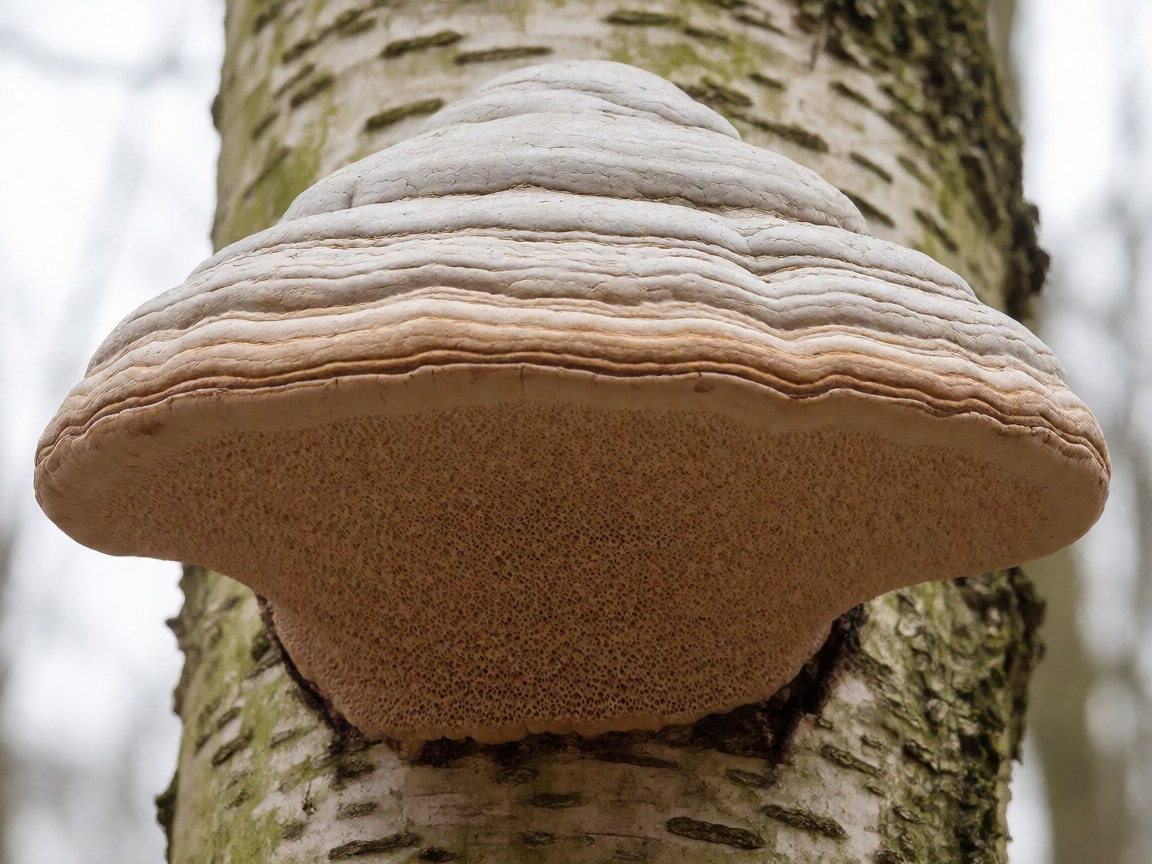
Fomes fomentarius | Tinder Fungus
Introduction
The tinder fungus (Fomes fomentarius) is a hard, hoof-shaped bracket that grows on birch and beech trunks, grey above and rusty brown beneath, and it has a claim to more human history than almost any other fungus. Its inner flesh can be prepared into tinder that holds a spark, and it was carried across the Alps by Ötzi the Iceman more than five thousand years ago. Long-lived and woody, a single bracket can persist on the same trunk for decades.
Taxonomy
Fomes fomentarius is a basidiomycete in the family Polyporaceae, the bracket or pore fungi, which release their spores from tiny tubes rather than from gills. Its hard, perennial, hoof-shaped fruit body is very different from the soft, short-lived caps of the gilled mushrooms typified by Amanita muscaria, the fly agaric, and it lives as a parasite and decay organism inside the wood rather than in partnership with living roots.
Physical Characteristics
The bracket is hard, woody, and hoof- or disc-shaped, five to forty centimetres across, with a thick, blunt, rounded rim. The upper surface is smooth but marked with concentric ridges and grooves in shades of grey, grey-brown, and sometimes whitish or almost black, with a hard crust. The underside is flat, pale brown to rusty cinnamon, and covered in very fine round pores, about three per millimetre. The flesh inside is thin, tough, and cinnamon-brown and fibrous.
Habitat
It grows mainly on birch, beech, and other broadleaved trees, on standing trunks, dead wood, and stumps, in woodland, parkland, and hedgerows. It is found across Europe, Asia, and North America. The fungus enters through wounds and continues fruiting long after the tree has died, so brackets are often abundant on dead standing timber. Because it is perennial, one bracket adds a new layer of pores every year and can survive for many decades.
Diet
The fungus is a parasite and a white-rot decomposer. Its threads grow through the wood, breaking down both cellulose and lignin and leaving the timber pale, soft, and stringy. It typically attacks living trees through wounds and can eventually kill them, then continues to feed on the dead wood for years. This combination is what makes it both an agent of decay and a creator of the soft, punky wood that cavity-nesting birds need.
Reproduction
Spores are produced inside the fine tubes on the underside and are released mainly at night or in humid conditions, drifting to reach wounds on other trees. Because the bracket is perennial, it produces a new layer of tubes each season, and very old brackets can be seen to have many stacked layers of pores beneath. The underground part of the fungus is the long-lived network within the wood, which continues to feed and fruit for decades.
Conservation
The species is widespread and not threatened, though it depends on mature woodland with plenty of standing and fallen dead wood, which is scarce in intensively managed forests. Where it is present it is ecologically valuable: the soft, decayed wood it creates provides nest sites for hole-nesting birds and shelter for countless invertebrates. Removing all dead wood from a wood removes its habitat.
Fun Facts
- Ötzi the Iceman carried prepared pieces of this fungus as tinder over 5,000 years ago.
- The dried inner flesh, called amadou, catches a spark from flint and steel and smoulders for hours.
- It is a perennial bracket: a new layer of pores is added each year, so old brackets are layered inside.
- Prepared amadou has been used as a styptic and as a material for hats and cloth.
- The fungus weakens wood so thoroughly that it helps create cavities used by nesting birds.