 By Iris
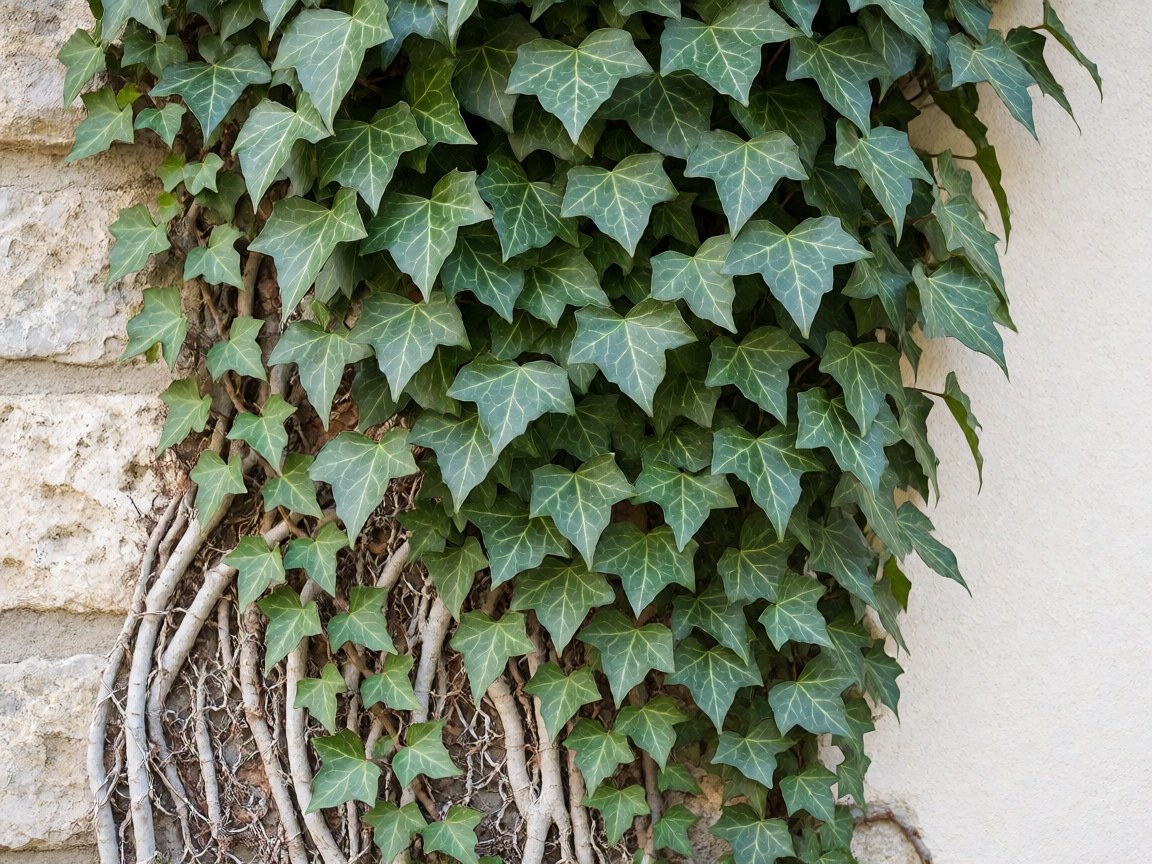
Hedera helix | Common Ivy
Introduction
Common ivy (Hedera helix) is the evergreen climber that sheets walls, tree trunks, and woodland floors across Europe, familiar enough to be almost invisible. It climbs by clinging rootlets, changes shape as it matures, and flowers late in the year when almost nothing else does—making it one of the most important nectar and berry sources of autumn and winter. Despite its reputation for harming trees, a healthy ivy-covered trunk is usually a sign not of damage but of a rich, sheltered habitat.
Taxonomy
Hedera helix is a member of the family Araliaceae, the ivy and ginseng family, and is the only ivy native to most of Europe. It is a woody vine rather than a shrub or tree. As a green plant it depends on Photosynthesis, and its evergreen leaves are built to keep working through the cold months, taking advantage of winter sun and mild spells when deciduous competitors are bare.
Physical Characteristics
Ivy has two distinct adult forms. The juvenile, climbing form has dark, glossy, three- to five-lobed leaves with pale veins, flattened against the surface it climbs, and short aerial rootlets along the stem that grip like glue. Once the plant reaches the light at the top of its support it changes into the adult form: upright, non-climbing, with unlobed, oval to diamond-shaped leaves and no clinging roots. Adult ivy bears small greenish-yellow flowers in rounded umbels in autumn, followed by black, berry-like fruit.
Habitat
It grows in woodland, on hedgerows, cliffs, walls, ruins, and tree trunks, in shade or sun, on most soils except waterlogged or very acidic ones. Native across Europe and western Asia, it has been widely introduced elsewhere and is invasive in parts of North America and Australia. It tolerates deep shade on the woodland floor as a creeping carpet and full exposure on walls, which is why it succeeds almost everywhere.
Diet
Ivy is entirely autotrophic. Its evergreen leaves photosynthesise whenever temperature and light allow, including through winter, and the plant stores the resulting sugars to fund the very late flowering season. It draws water and minerals from a fibrous root system in the soil; the aerial rootlets on climbing stems are for attachment only and do not take nourishment from the tree or wall it grows on.
Reproduction
The greenish-yellow autumn flowers are rich in nectar and are visited by late-flying bees, wasps, hoverflies, and moths—one of the last nectar sources of the year. The black fruits ripen in late winter and are eaten and dispersed by birds such as blackbirds, thrushes, and woodpigeons. Ivy also spreads vigorously by vegetative growth: stems root wherever they touch the ground, and a single plant can cover a very large area over time.
Conservation
The species is abundant, widespread, and not threatened. It is often removed from walls and trees on the assumption that it damages them, but ivy does not parasitize its support; problems arise mainly where it adds weight and wind-loading to already weak or dying trees, or where it hides structural defects in masonry. Because its flowers and fruit feed so many insects and birds late in the year, leaving some ivy in place is one of the easiest ways to support garden wildlife.
Fun Facts
- Ivy has two completely different leaf shapes: lobed when climbing, unlobed once it reaches the light.
- It flowers in autumn and fruits in late winter, feeding wildlife when little else is available.
- It does not take food from the trees it climbs—the rootlets are only for grip.
- Climbing stems can grip so tightly that they hold bark, glass, and stone together.
- Ivy was sacred to Dionysus in ancient Greece and was worn at winter festivals long before holly.