 By st20113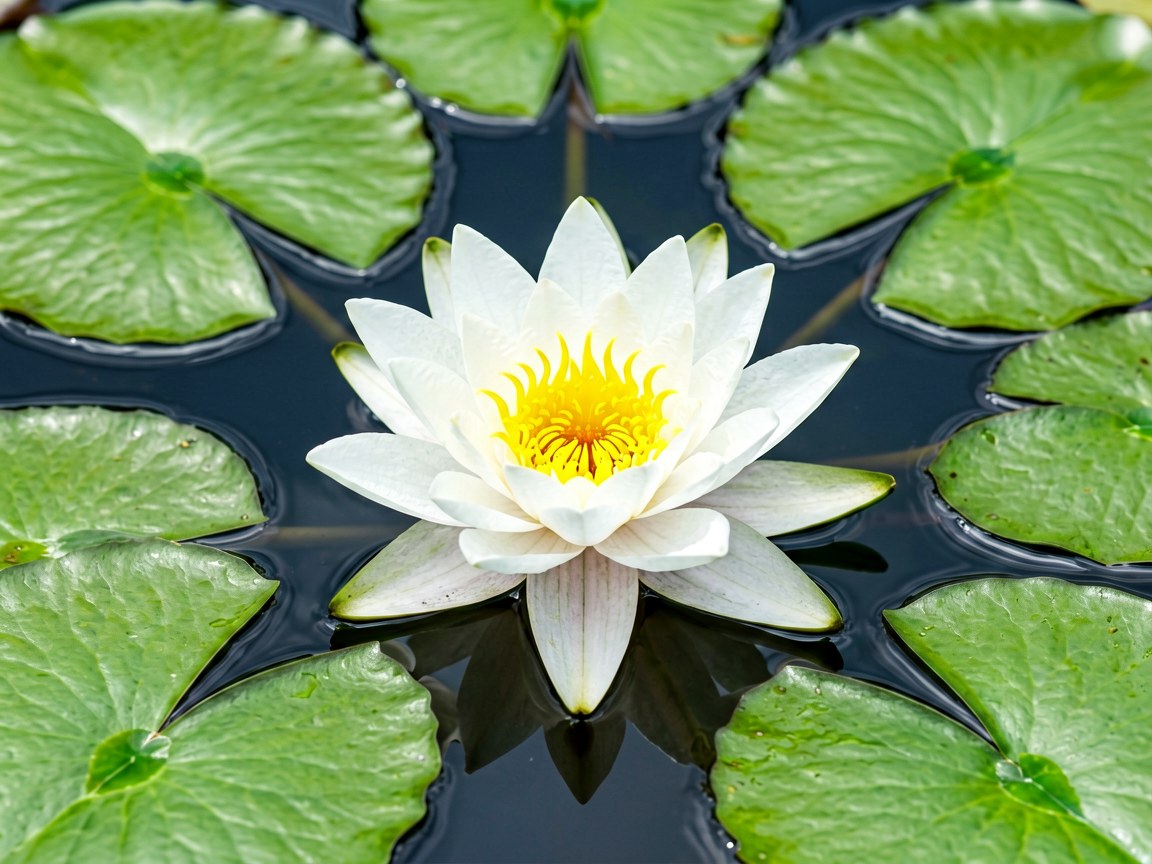
Nymphaea alba | White Water-lily
Introduction
The white water-lily (Nymphaea alba) is the floating-leaved plant that turns still ponds, lakes, and slow rivers into carpets of broad green plates studded with large white flowers. Each bloom opens in the morning, closes at night, and lasts several days, and beneath the surface a thick creeping rhizome anchors the whole display in the mud. It is one of the most familiar and beautiful plants of still fresh water across Europe.
Taxonomy
Nymphaea alba belongs to the family Nymphaeaceae, the water-lilies, a very ancient lineage of flowering plants that split from the rest early in their evolution. Despite living in water, it is not related to the true lotuses and it is a fully ordinary green plant in how it feeds: its broad floating blades carry out Photosynthesis in open air, while air channels running through the leaf stalks carry oxygen down to the buried rhizome.
Physical Characteristics
The leaves are large, almost circular, ten to thirty centimetres across, leathery and dark green above, often reddish beneath, with a deep notch at one side and a long stalk that reaches up to the surface. They float flat on the water rather than standing above it. The flowers are five to twenty centimetres across, with many pointed white outer petals graduating inward to a dense boss of yellow stamens; they float on the surface and have a faint sweet scent. Underwater, thick branching rhizomes creep through the mud and give off the long stalks.
Habitat
White water-lilies grow in still or slow-moving fresh water—ponds, lakes, ditches, canals, and sheltered river backwaters—usually in one to two metres of water over fine, organic mud. They are found across Europe and into parts of North Africa and western Asia, and are widely planted in ornamental ponds. They need calm water, since waves and strong flow tear the floating leaves, and they favour slightly acidic to neutral conditions.
Diet
The plant is entirely autotrophic. Its floating leaves sit in full sun at the surface, photosynthesising efficiently and drawing carbon dioxide from the air rather than from the water, which is why the leaves must stay dry on top. Nutrients, however, are taken up from the sediment by the rhizome and its roots. This split—light from above, minerals from below—is the defining trick of life as a floating-leaved water plant.
Reproduction
The flowers open over three or four days, receptive to beetles, flies, and bees on the first days and shedding pollen later. After pollination the flower stalk coils and the flower is dragged below the surface, where the fleshy fruit ripens and releases seeds that float briefly before sinking. The plant also spreads vigorously by its branching rhizome, which creeps along the mud and can eventually fill a small pond. In cold winters the rhizome simply lies dormant in the sediment.
Conservation
The species is widespread and not globally threatened, and it is protected in law in some countries against uprooting. Its habitat, however, is vulnerable: pond drainage, agricultural runoff, dredging, and invasive introduced water plants all reduce the clean, still, open water it needs. Where ponds are cleaned out too thoroughly or shaded over by trees and scrub, water-lily colonies disappear and are slow to return.
Fun Facts
- Each flower opens in the morning and closes at night, repeating for several days.
- After pollination the flower is pulled underwater, where the seeds ripen.
- The leaf stalks contain air channels that carry oxygen down to the buried rhizome.
- Water-lily leaves have a waxy, water-repellent upper surface that makes water bead into pearls.
- White water-lilies are among the oldest lineages of flowering plants still living.
[…] The yellow water-lily belongs to the family Nymphaeaceae, the water-lilies. It sits in the genus Nuphar. A small group of yellow and reddish water-lilies of the north. Linnaeus named it in 1758 as Nymphaea lutea. And it was later moved into its own genus as the flower was studied. The genus name Nuphar comes from a Persian word for the plant. The family is an old one. And its members share the floating leaves. The showy flowers and the thick rhizome. The yellow water-lily is one of the closest relatives of the white water-lily. […]