 By st20113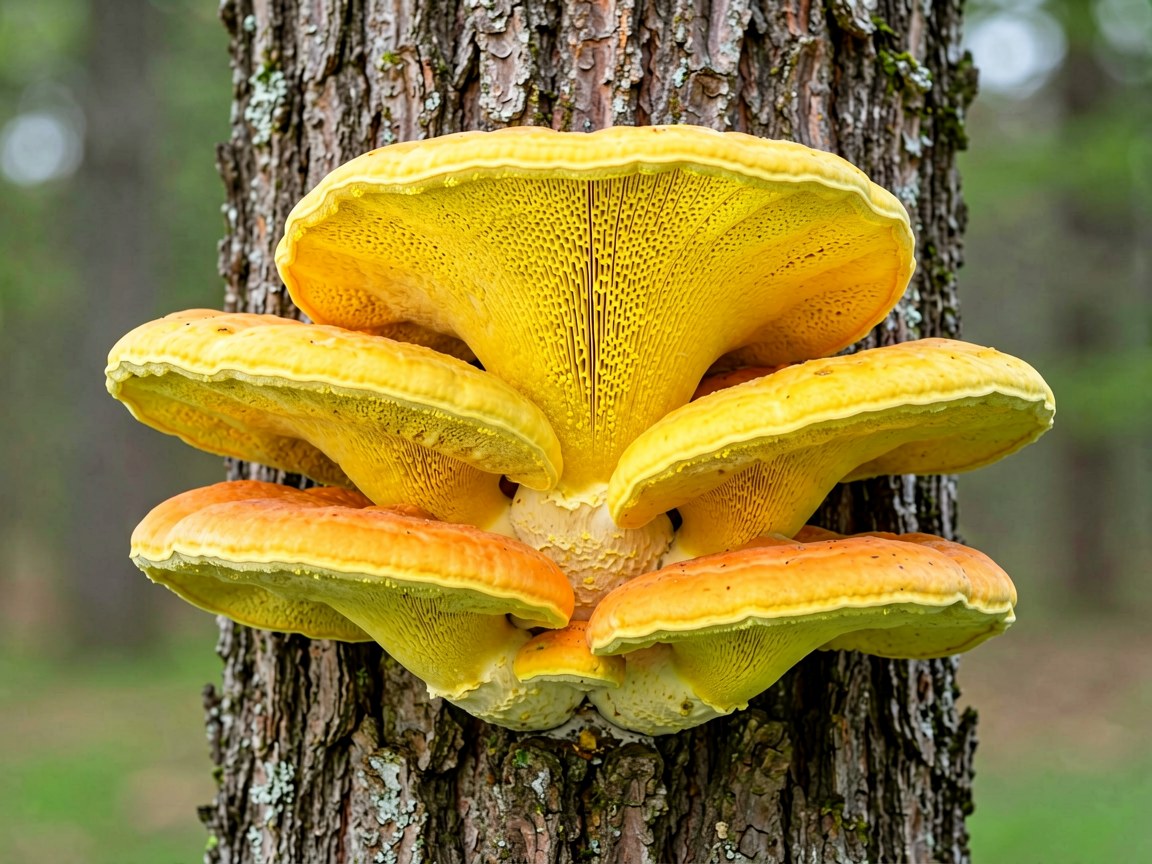
Laetiporus sulphureus | Chicken of the Woods
Introduction
Chicken of the woods (Laetiporus sulphureus) is a bold, sulphur-yellow bracket fungus that grows in great shelf-like tiers on tree trunks, often so large and heavy that a single cluster can weigh many kilograms. Bright orange-yellow when young and fading to pale cream as it ages, it is one of the most conspicuous fungi of summer and early autumn. It is also one of the best-known edible wild mushrooms, though it must be correctly identified and properly cooked.
Taxonomy
Laetiporus sulphureus is a basidiomycete in the family Laetiporaceae, within the order Polyporales, whose members release spores from pores rather than gills. It belongs to the same broad group of bracket fungi as the thin, banded turkey tail, and although it looks nothing like the capped, gilled mushrooms typified by Amanita muscaria, the fly agaric, it shares the same basic life plan of a hidden feeding network protected inside its food source.
Physical Characteristics
The brackets are thick, soft, and juicy when young, growing in overlapping shelves that together can span half a metre or more. The upper surface is bright sulphur-yellow to orange, often with a finely suede-like texture, while the underside is a vivid yellow covered in tiny round pores. The flesh is pale yellow, soft, and watery, becoming crumbly, chalky, and whitish with age. Young brackets are tender enough to cut with a knife; old ones dry brittle and break apart.
Habitat
It grows on living and dead broadleaved trees—especially oak, sweet chestnut, willow, beech, and cherry—and occasionally on conifers such as yew and larch. It usually appears low on the trunk or on a wound, and because it is parasitic as well as saprotrophic it may reappear on the same tree for several years running. It fruits from late spring into autumn and is found across Europe, North America, and beyond.
Diet
The fungus feeds on wood, and it does so as a brown-rot organism: it breaks down the pale cellulose and leaves the dark, crumbly lignin behind. Its threads grow through the heartwood of the trunk, causing a cubical brown rot that weakens the structural timber of the tree. This makes it a serious decay organism in living trees and in wooden structures, even though the fruit bodies themselves are prized as food.
Reproduction
Millions of microscopic spores are produced in the tiny tubes lining the pores on the underside and are shed into the air, particularly in warm, humid weather. Spores that settle on a suitable wound or on dead timber germinate into a new network that grows into the wood. The bright brackets are short-lived—often lasting only a week or two before rotting, drying, or being eaten by insects—while the network inside the tree persists for years.
Conservation
Chicken of the woods is widespread and common and is not threatened. It does not need protecting, but it does need dead and mature trees: intensive forestry, tidy park management, and the removal of old or damaged trees reduce its habitat. Foragers are advised to take only a little of any cluster, only from the younger soft growth, and never from yew or other poisonous hosts, since the fungus can take up toxins from the tree.
Fun Facts
- Its name comes from the flavour and texture of young cooked brackets, said to resemble chicken.
- A single cluster can weigh more than twenty kilograms.
- It causes brown rot, leaving the wood dark, cracked, and crumbly in cubes.
- The bright sulphur colour fades to pale cream as the bracket ages.
- Some people react badly to it, so only a small amount should be tried the first time.