 By st20113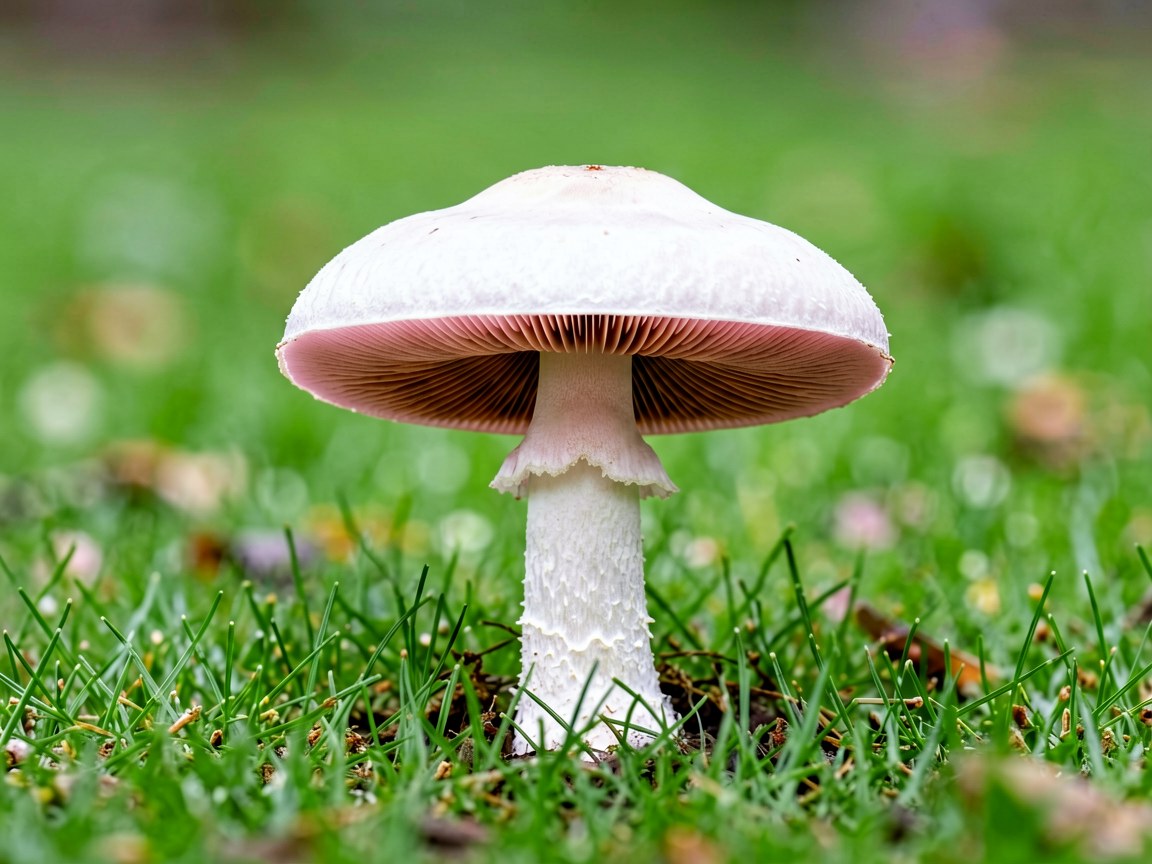
Agaricus campestris | Field Mushroom
Introduction
The field mushroom (Agaricus campestris) is the wild original of the cultivated button mushroom, the one that appears in short grass after rain and has been gathered for the table for centuries. With its neat pink-then-brown gills and clean white cap, it is the classic “toadstool” shape that most people picture as a mushroom. Common in pastures and lawns, it is one of the most rewarding—and safely identifiable—of edible wild fungi.
Taxonomy
Agaricus campestris is a fungus in the family Agaricaceae, within the order Agaricales—the gilled mushrooms. It is a close relative of the shop mushroom and of the fairy-ring champignon, and it shares the fungal way of life with Amanita muscaria: both are fungi that absorb their food rather than make it by photosynthesis.
Physical Characteristics
The field mushroom has a cap 5–10 cm across, at first dome-shaped and white, later flattening and sometimes cracking. The gills underneath start pink, then turn chocolate-brown as the spores ripen; there is no ring on the stem in the young wild form, though the cultivated relatives have one. The stem is short, stout, and white, and the whole mushroom smells faintly of mushroomy almonds. The flesh is solid and does not change colour when cut.
Habitat
Field mushrooms favour short, fertile grassland—grazed pastures, parks, lawns, and playing fields—especially on rich soil after warm rain in late summer and autumn. They often fruit in rings or troops where the underground mycelium runs through the turf. They are creatures of open, managed grass rather than woodland, which is why they turn up on amenity land as well as farmland.
Diet
Like all fungi, the field mushroom is heterotrophic. Its mycelium lives in the soil and dead grass roots, secreting enzymes that break down organic matter and absorbing the nutrients released. It does not photosynthesise; the cap and stem are only the brief, spore-producing fruiting body of a larger, hidden feeding network that recycles the goodness of the pasture.
Reproduction
Field mushrooms reproduce by spores formed on the gills. As the gills darken, millions of tiny brown spores are released into the air; a few that land in suitable grass may germinate into new mycelium. The familiar “fairy rings” of mushrooms mark the expanding edge of a single mycelium growing outward through the soil year after year.
Conservation
The field mushroom is common and not threatened, though it has declined in some intensively farmed landscapes where fertiliser and compaction reduce the open turf it likes. Because it depends on healthy grassland, its presence is a small sign of a functioning meadow. Careful, limited picking—taking only what is needed—helps keep local populations going.
Fun Facts
- It is the wild ancestor of the white button mushroom sold in shops.
- Young gills are pink and turn brown as the spores ripen—a key identification clue.
- It often fruits in fairy rings, the expanding edge of one underground network.
- Unlike some look-alikes, its flesh stays white when cut and smells pleasantly mushroomy.
- It appears most reliably after warm rain on rich, grazed grassland in autumn.