 By Iris
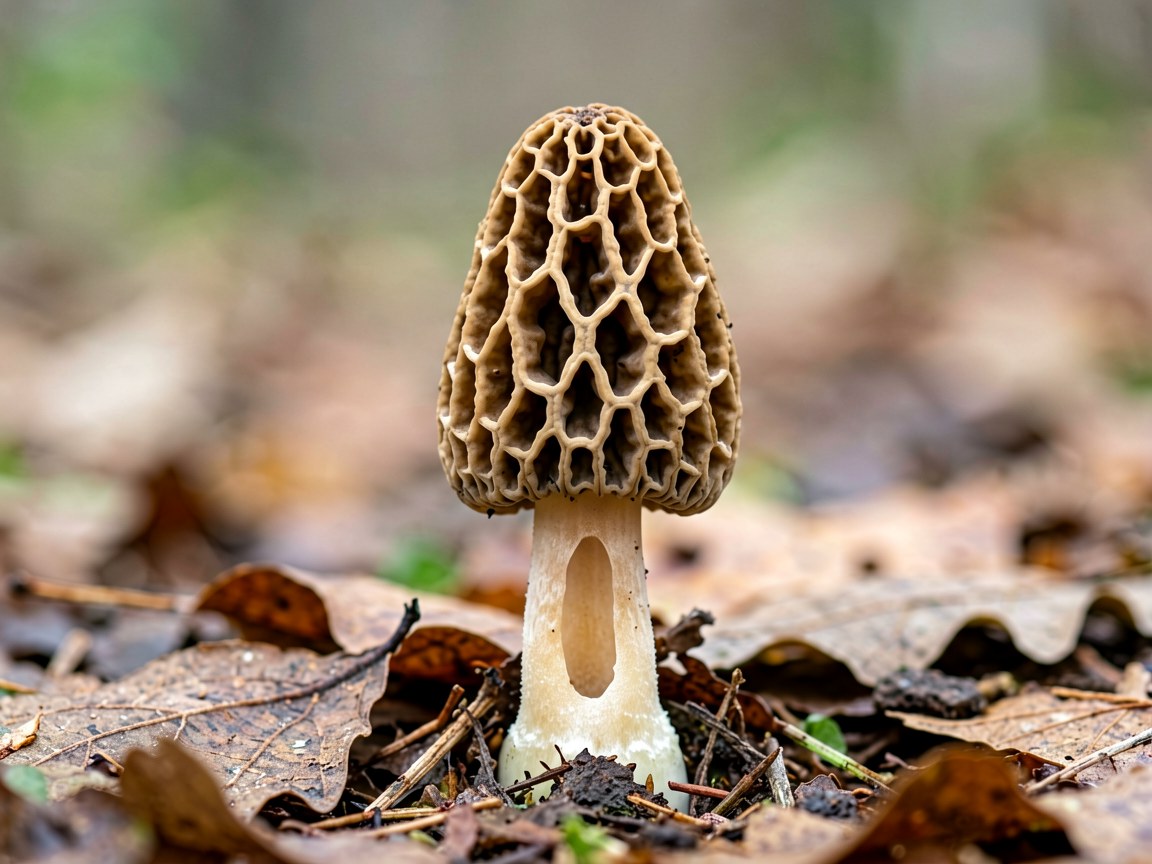
Morchella esculenta | Common Morel
Introduction
The common morel (Morchella esculenta) is one of the most sought-after wild mushrooms in the world, prized by cooks for its nutty, earthy flavour. It is instantly recognisable by its honeycomb-like cap, a cluster of pits and ridges that looks like a sponge or a convoluted brain. Morels appear in spring and have inspired devoted foragers across Europe, North America, and beyond.
Taxonomy
Morchella esculenta is a fungus in the family Morchellaceae, within the order Pezizales—the cup and morel fungi. It is the type species of the genus Morchella, the true morels. Although it looks utterly unlike a gilled mushroom, it shares the fungal way of life with relatives such as Amanita muscaria, the fly agaric: both are fungi that grow by absorbing food rather than by photosynthesis.
Physical Characteristics
The morel has a hollow stem and a hollow, upright cap 2–9 cm tall, covered with a network of irregular pits separated by pale, darker-edged ridges, giving the classic honeycomb look. The cap is usually greyish-tan to yellowish-brown and merges at the base with the stem. The stem is whitish, brittle, and pithy-hollow. The whole fruiting body is light for its size because it is mostly air spaces.
Habitat
Morels favour disturbed ground and open woodland, often appearing in spring on calcareous soils, in old orchards, along hedgerows, in burnt or cleared areas, and at the edges of forests. They are famously associated with the aftermath of fire and with the margins of parks and gardens. They fruit in cool, moist spring weather, typically a little earlier than most other mushrooms.
Diet
Like all fungi, the morel is heterotrophic. It cannot photosynthesise; instead, beneath the soil or leaf litter, its thread-like mycelium secretes enzymes that break down dead plant material and organic matter, absorbing the released nutrients. The conspicuous cap is only the brief reproductive structure; the living, feeding part of the organism is the hidden mycelial network.
Reproduction
Morels reproduce by spores. The cap’s pits are lined with spore-producing tissue that releases vast numbers of microscopic spores into the air. A single fruiting body can shed millions. The spores germinate into mycelium in suitable soil, which over time gives rise to new morels in the right spring conditions. The details of the morel life cycle are unusually complex and still studied by scientists.
Conservation
The common morel is widespread and not globally threatened, though it is protected from commercial picking in some regions and is generally discouraged from being over-collected. Its dependence on specific, often disturbed spring habitats means local populations can be fragile. Responsible foraging—taking only a few and leaving the rest to spore—helps keep populations healthy.
Fun Facts
- Its honeycomb cap is not decoration but spore-producing surface, vastly increased by all those pits.
- Morels are among the few mushrooms that must always be cooked; raw morels can upset the stomach.
- They are famously hard to cultivate, and wild-picked morels can command high prices.
- The name “morel” is older than modern botany and appears in medieval herbals.
- Their close relative, the false morel, can be poisonous, so accurate identification matters.