 By st20113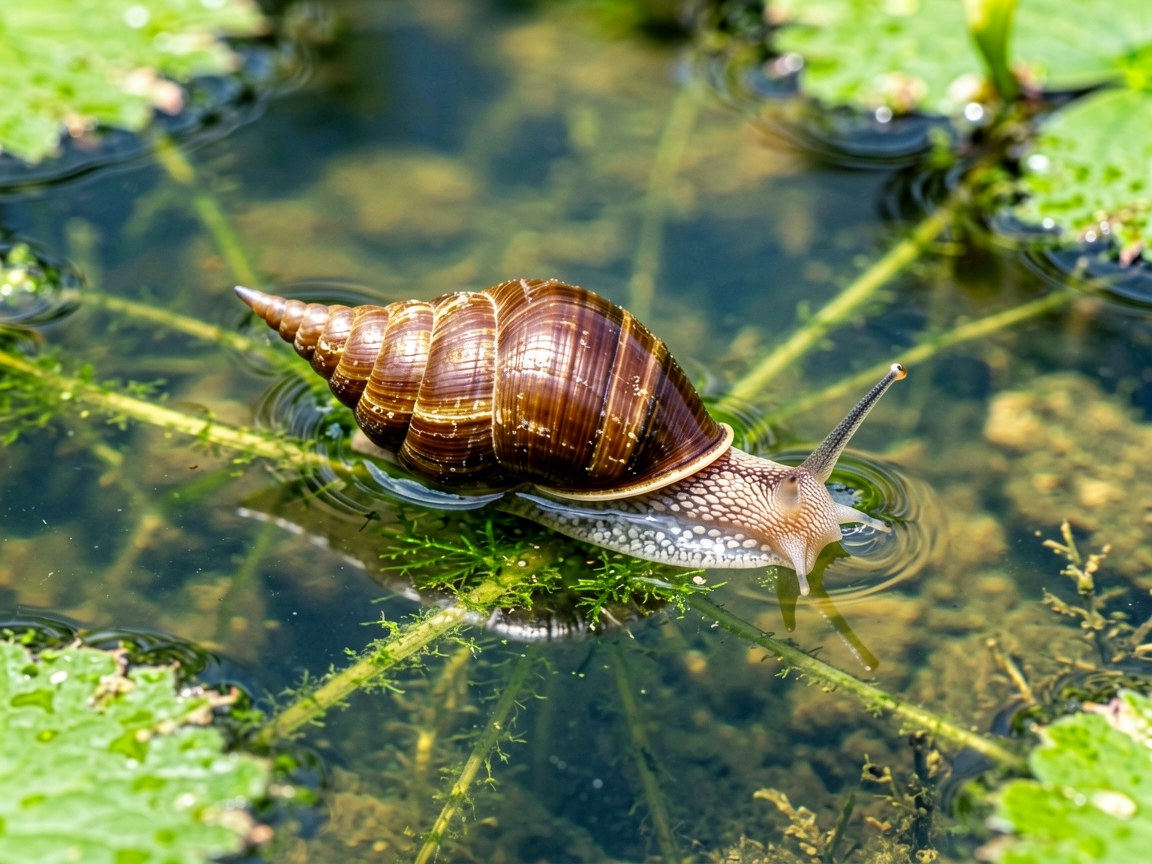
Lymnaea stagnalis | Great Pond Snail
Introduction
The Great Pond Snail (Lymnaea stagnalis) is the largest pond snail of Europe, a slender, pointed-shelled mollusc of still and slow water that breathes air at the surface like a tiny submarine. Reaching 4–6 cm, it is a familiar sight in garden ponds and ditches, where it glides over leaves and mud scraping algae and debris.
Unassuming as it looks, the great pond snail is one of the most studied animals in biology: its unusually large nerve cells made it a favourite for early neuroscientists unravelling how nervous systems work. It is also a small but important link in the pond food web, recycling matter and feeding the birds and invertebrates above it.
Taxonomy
Lymnaea stagnalis was described by Linnaeus in 1758; the genus name Lymnaea is from the Greek for a marsh or pool, and stagnalis means “of standing water.” It belongs to the family Lymnaeidae, within the class Gastropoda and the phylum Mollusca.
Like the common octopus, described in our article on Octopus vulgaris (Common Octopus), the great pond snail is a mollusc, but the contrast could hardly be greater: the octopus is a soft, intelligent ocean cephalopod, while the pond snail is a small air-breathing gastropod sealed in a thin spiral shell on a garden pond. Both show the molluscan plan bent to utterly different lives.
Physical Characteristics
The great pond snail has a tall, conical, right-handed shell 4–6 cm long, thin and pale brown with fine growth lines, and a large opening. The soft body is dark grey to black, with a broad foot for creeping and two long, flattened tentacles that are triangular rather than the stalked “horns” of land snails; the eyes sit at the tentacle bases.
It is an air-breather, holding a lung inside the mantle cavity and rising to the surface to gulp air through a breathing pore, then sealing it with a flap. It can also absorb some oxygen through the skin when water is warm and oxygen-poor. The mouth bears a radula for scraping, and the whole animal glides on a muscular foot leaving a slime trail.
Habitat
The great pond snail lives in ponds, ditches, canals, and the slow margins of rivers and lakes, especially where there is plenty of aquatic vegetation and soft mud. It tolerates a wide range of conditions and is common in garden ponds across temperate Europe and beyond, having been spread by trade and aquarium discards.
It needs access to the surface to breathe, so it favours shallow, vegetated water rather than deep or fast-flowing channels. Because it breeds readily and eats algae and detritus, it thrives where nutrients are ample, though it is sensitive to pollution and to waters that lose their plants and oxygen.
Diet
The great pond snail is a grazer and detritivore, scraping algae, diatoms, and biofilms from leaves and stones with its radula, and also eating soft decaying plant matter and the occasional bit of dead animal. By clearing algae and recycling rotting vegetation it helps keep pond water clearer and the bottom cleaner.
Its feeding ties it into the pond web: the algae it eats are built by photosynthesis, and the snail in turn is food for ducks, frogs, and large aquatic insects. In this way the pond snail converts microscopic plant growth into a package that birds and predators can use, a small but busy link in the cycle of the pond.
Reproduction
The great pond snail is a hermaphrodite, carrying both sexes, and individuals usually cross-fertilise, though self-fertilisation can occur. After mating, each snail lays gelatinous masses of eggs on the undersides of leaves and stones, and the young hatch as tiny snails that grow rapidly through the warm season.
Because it breeds so readily and the young develop fast in warm water, a single pond can support a large population in a good summer. The eggs and juveniles are eaten by many predators, so only a fraction survive, but the snail’s high reproductive rate keeps numbers up where habitat is suitable.
Conservation
The great pond snail is widespread and of no conservation concern as a species, though it is sensitive to the loss of clean, vegetated ponds and to agricultural and urban pollution that strips oxygen and plants from water. Where garden ponds and roadside ditches survive, it remains abundant.
Its scientific value is outsized: for decades it was a model organism in neurobiology because its identifiable giant nerve cells let researchers trace how single neurons control behaviour, including a famous “memory” experiment in which trained snails passed a habit to others by cannibalism. Conservation in practice means keeping ponds healthy—planted, unpolluted, and connected—so this useful mollusc and its pond neighbours persist.
Fun Facts
- It breathes air at the surface through a lung, despite living entirely underwater.
- Its large, identifiable nerve cells made it a cornerstone of early brain and memory research.
- It is a hermaphrodite and usually mates with another snail, each then laying eggs.
- It scrapes algae with a ribbon-like tongue (radula) armed with thousands of tiny teeth.
- A favourite of garden ponds, it helps keep the water clear by grazing algae.