 By st20113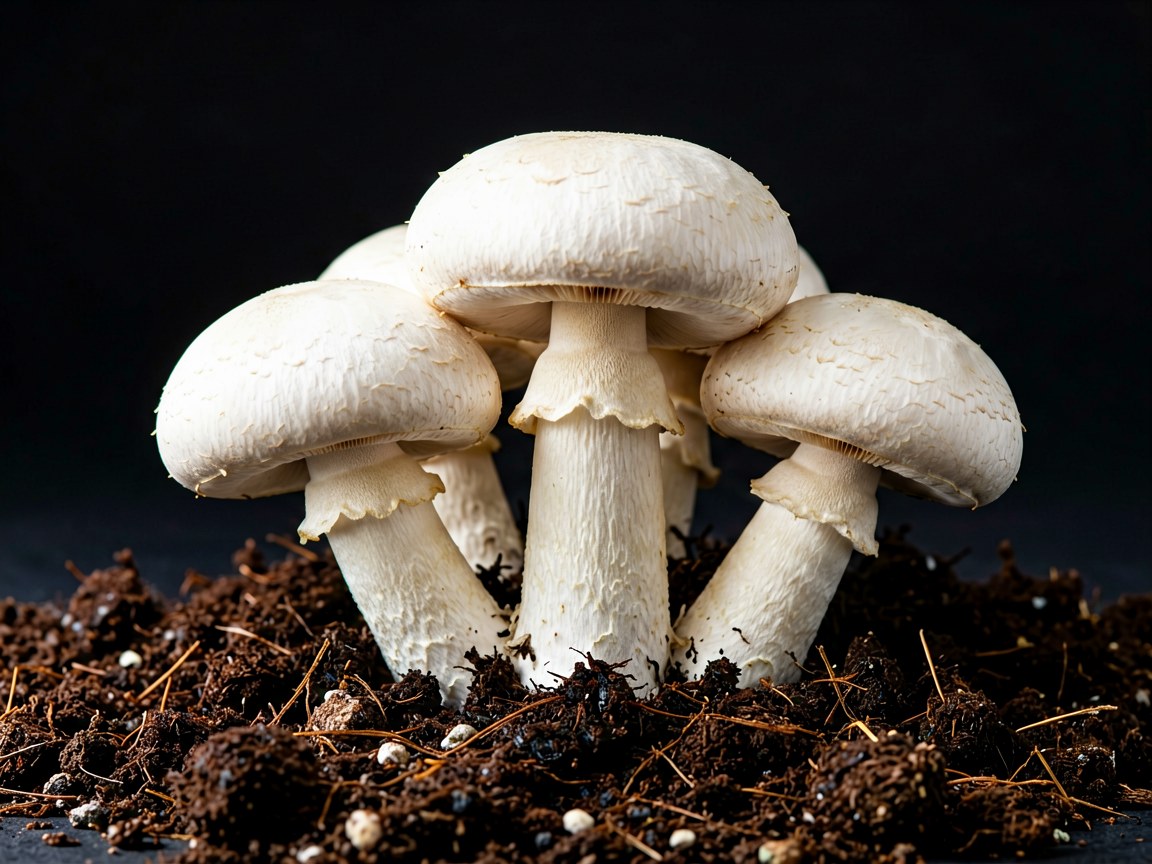
Agaricus bisporus | Button Mushroom
Introduction
The Button Mushroom (Agaricus bisporus) is the most widely cultivated and consumed mushroom on Earth, the familiarity of which conceals a remarkable range of forms. Sold as the small white “button,” the tan “cremini,” and the large mature “portobello,” all three are simply the same species at different stages of growth. Native to the grasslands and horse-rich pastures of Europe and North America, it has been tamed into a global commodity grown on every continent.
Though humble on the plate, it is a fascinating organism: a fleshy fungus that spends its life as a hidden web of threads in the soil and erupts into a fruiting body only when conditions are right. Its domestication, beginning in France in the 1600s and industrialised in the 20th century, turned a wild meadow fungus into one of the most important non-animal protein sources in the human diet.
Taxonomy
Agaricus bisporus was validly published by the Swiss mycologist Emil Imbach in 1946, building on earlier work by the Danish botanist Jakob Lange; the genus name Agaricus is the ancient Latin for a fungus, and bisporus means “two-spored,” referring to a defining trait described below. It sits in the family Agaricaceae, order Agaricales, among the gilled mushrooms, and is a close relative of the field mushroom (Agaricus campestris).
Unlike the famously poisonous fly agaric, described in our article on Amanita muscaria (Fly Agaric), which belongs to a different family and must be avoided, the button mushroom is thoroughly safe and is in fact one of the few wild-relatives of edible fungi that has been brought fully into cultivation. Both are basidiomycete fungi, but their chemistry and ecology could hardly be more different.
Physical Characteristics
The Button Mushroom forms a cap that is 5–10 cm across in the young “button” stage and can exceed 15 cm when mature (portobello), initially rounded and white to pale brown, flattening and darkening with age. The gills underneath are first pink, then turn brown, and finally a deep chocolate brown as the spores ripen; the stem bears a membranous ring (annulus) left by the partial veil that once covered the young gills.
The flesh is firm and white, sometimes staining faintly pink where bruised, and the spores are chocolate-brown—a useful field mark that separates it from the white-spored, often poisonous Amanita species. Its namesake feature is microscopic: each fertile cell (basidium) normally bears just two spores rather than the four typical of most mushrooms, a quirk that gave the species its scientific name and helps identify it under the microscope.
Habitat
In the wild, Agaricus bisporus grows in grassy, nutrient-rich places—pastures, lawns, roadside verges, and disturbed ground—especially on soils enriched with decaying organic matter, and it fruits after warm, humid weather. It is fundamentally a creature of open, cultivated landscapes rather than deep forest.
In cultivation it is grown on carefully formulated compost, usually based on pasteurised straw and horse or chicken manure, packed into trays or bags and spawned with pure fungal cultures. The transition from wild meadow fungus to indoor crop is the reason it is available year-round; the grower controls temperature, humidity, and carbon dioxide to trigger flushes of mushrooms on a predictable schedule.
Diet
The Button Mushroom is a saprotroph, feeding by decomposing dead organic matter rather than by photosynthesis. Its thread-like mycelium secretes enzymes that break down complex molecules—especially the cellulose, hemicellulose, and lignin of plant debris—and absorbs the resulting sugars and nutrients, recycling them back into the ecosystem.
This decomposer role is why it thrives on compost: the same lignin-rich plant material that resists ordinary decay is exactly what its enzymes are built to dismantle. In the wild this makes it an important recycler of nutrients in pasture soils, and in the farm it turns agricultural waste into edible protein, a rare example of a food crop that is grown entirely on material humans cannot eat.
Reproduction
Like other gilled mushrooms, Agaricus bisporus reproduces by spores produced on its gills and released from the mature cap into the air. In nature these spores germinate on suitable substrate to form new mycelium; commercially, however, growers do not rely on spores but on cloned “spawn”—grain or agar colonised with a selected strain—to guarantee uniform, predictable crops.
The cultivated mushroom’s life cycle is tightly managed: mycelium first runs through the compost, then a casing layer of peat or soil triggers the formation of tiny pinheads that swell into mushrooms. Because the commercial strains are often self-fertile and irregular in spore behaviour, nearly all production comes from cloned cultures rather than from sexual spores, making modern button mushrooms effectively a single, human-selected lineage.
Conservation
The wild Button Mushroom is widespread and not considered threatened; in its native grasslands it remains common, though intensive farming and the loss of nutrient-rich pasture have reduced some local populations. As a cultivated crop it is effectively inexhaustible, with global production running into millions of tonnes per year.
From a sustainability view, mushroom farming is unusually efficient: it converts low-value organic waste into food using little land and water compared with livestock, and the spent compost is itself a useful soil amendment. The main environmental costs are the energy for climate-controlled growing houses and the peat sometimes used in casing, both of which the industry is working to reduce through recycling and alternative substrates.
Fun Facts
- The “button,” “cremini,” and “portobello” in the shop are the very same species—just harvested young, teenage, and fully grown.
- Worldwide, *Agaricus bisporus* accounts for the largest share of all cultivated mushrooms, a true staple crop of the fungi kingdom.
- Exposing the growing mushroom to ultraviolet light sharply raises its vitamin D content, much as sunlight does in human skin.
- Its two-spored basidia are unusual among mushrooms and are the origin of the name *bisporus*.
- Because it breaks down lignin, the button mushroom is studied as a helper in recycling agricultural and even some plastic waste.