 By st20113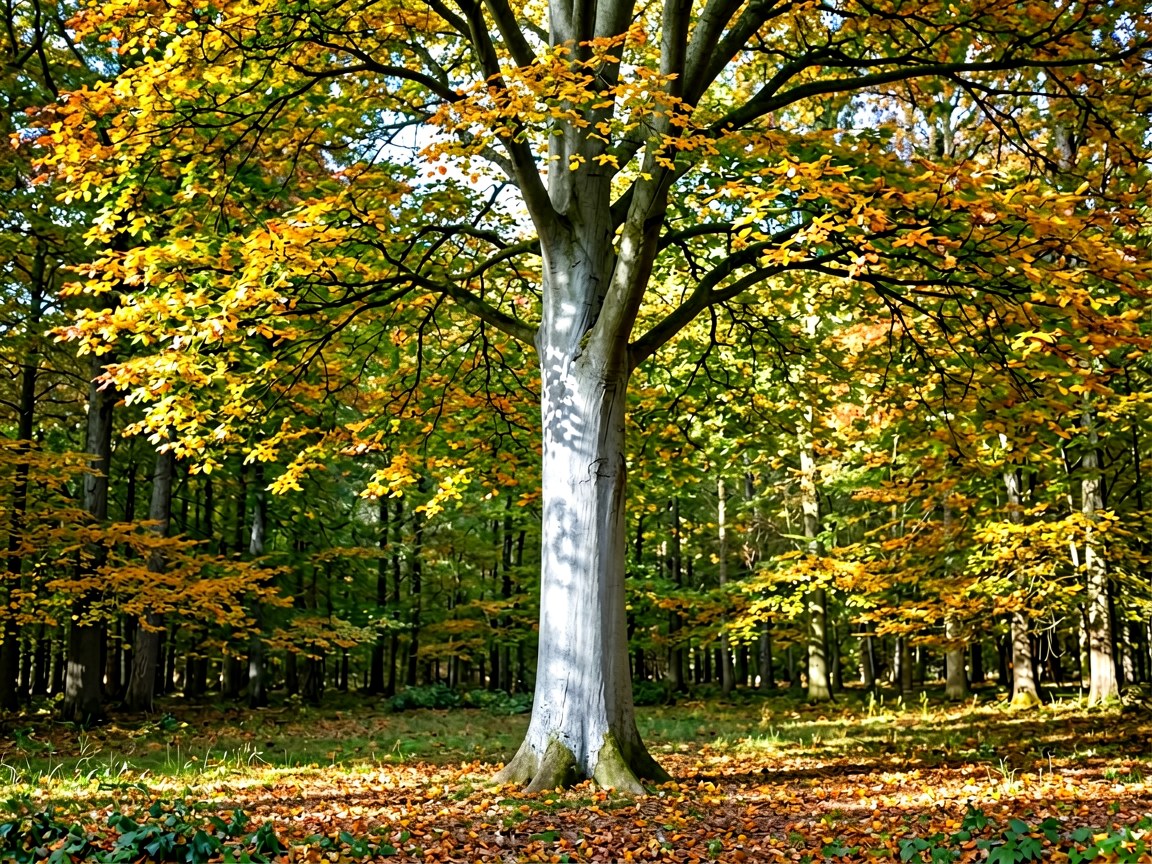
Fagus sylvatica | European Beech
Introduction
The European Beech (Fagus sylvatica) is a tall, stately deciduous tree that dominates much of central and western Europe’s natural forest. Capable of reaching 30–40 m with a smooth, silver-grey trunk and a dense, domed crown, it is a shade-casting giant whose leaf litter and mast have shaped the woodland floor for millennia. Where conditions suit it, the beech forms near-pure, cathedral-like stands of immense ecological and scenic value.
Though slow to establish, once mature the beech is a formidable competitor that can shut out sunlight and suppress rivals, becoming the climax species over vast areas. Its hard, pale wood and reliable crops of sweet beechnuts have made it both an economic mainstay and a beloved feature of the European landscape.
Taxonomy
Fagus sylvatica was described by Linnaeus in 1758; the genus Fagus is the classical Greek and Latin name for beech, and sylvatica means “of the woods.” It is a member of the family Fagaceae—the beech family—alongside oaks, chestnuts, and hornbeams, and is the most widespread native beech in Europe.
Like all green plants it depends on the process outlined in our article on Photosynthesis (the plant energy process) to turn sunlight into the sugars that build its timber and its heavy annual nut crop. Within Fagaceae it is the closest relative of the oak (Quercus robur), the two together defining much of Europe’s broadleaved forest.
Physical Characteristics
The European Beech has a characteristically smooth, mouse-grey bark that remains unbroken even on old trees, and a regular, ovoid to domed crown. Its leaves are 4–9 cm long, elliptical, with a wavy, slightly toothed margin and a short point; they emerge fresh green in spring and turn a gorgeous coppery bronze in autumn, often staying on the tree through winter (marcescence) on young branches.
The fruit is a prickly, four-lobed husk containing two triangular beechnuts (“mast”) that ripen in autumn. The wood is fine-grained, pale, and strong but not very durable outdoors. A beech can live 200–300 years, occasionally much longer, and its shallow but extensive root system helps stabilise soil on slopes and in mature stands.
Habitat
The European Beech thrives on moist, well-drained, mildly acidic to neutral soils and a humid, temperate climate, doing best where summers are not too hot and winters not too severe. It is native across central and western Europe, from southern Scandinavia to the Mediterranean mountains and from the Atlantic fringe east into the Carpathians and Balkans.
It is famous as a climax species of the nemoral (deciduous) forest zone, forming beech-dominated woods on slopes and uplands where it outcompetes less shade-tolerant trees. Young beeches tolerate deep shade and can wait decades in the understory for a gap to exploit. In parks and avenues it is planted well beyond its native range for its form and autumn colour.
Diet
The European Beech is autotrophic, producing its food by photosynthesis in its leaves while drawing water and minerals from the soil through a wide, shallow root network. It is a heavy producer, investing enormous energy each autumn into its beechnut crop—a deliberate, periodic “mast” strategy that overwhelms seed predators in bumper years.
As with the oak, the beech trades sugars with mycorrhizal fungi in exchange for soil nutrients and water, and its leaf litter creates a deep, slowly decaying mulch that acidifies and cools the forest floor. This litter and the dense shade together suppress many plants but favour specialist fungi, invertebrates, and the seedlings of the beech itself.
Reproduction
Beech flowers in spring: small, inconspicuous male and female catkins appear on the same tree, with wind carrying pollen between them. Fertilised flowers develop through summer into the bristly husks that split in autumn to release the beechnuts, which are dispersed mainly by gravity and by mammals and birds that cache them.
Germination is best on bare, disturbed, or rodent-turned soil, and seedlings grow slowly in shade, sometimes lingering as suppressed saplings for years. Mast years occur every few to several seasons; in those years the forest floor is carpeted with nuts and the surrounding wildlife—from jays to mice to deer—feeds lavishly, yet enough escape to sustain the next generation.
Conservation
The European Beech is abundant and listed as Least Concern, and vast protected beech forests in Europe are recognised as a UNESCO World Heritage landscape. Yet its ancient and old-growth stands are fragmented, and the species’ strong shade dominance can reduce plant and bird diversity where it replaces mixed woodland.
Climate change is a rising concern: the beech’s preference for cool, humid conditions makes parts of its southern and lowland range vulnerable to drought and heat, and models suggest its core may shift northward. Conservation emphasis is on protecting remaining old-growth beech, maintaining mixed and connected forest, and using diverse, climate-aware seed sources in restoration planting.
Fun Facts
- A beech’s smooth grey bark was once a favourite surface for travellers and lovers to carve initials—many old “beeches” still bear centuries-old graffiti.
- Beech mast years are so reliable a resource that in hard winters birds and mammals may depend on them for survival.
- The word “book” is thought by some to derive from the Germanic use of beech wood for early writing tablets.
- Young beech leaves are edible and were once a spring green; the nuts are sweet but mildly toxic in large amounts due to oxalic acid.
- Some European beeches form spectacular “candle” branches or twisted, gnarled “witch’s broom” growths that gardeners prize as curiosities.