 By st20113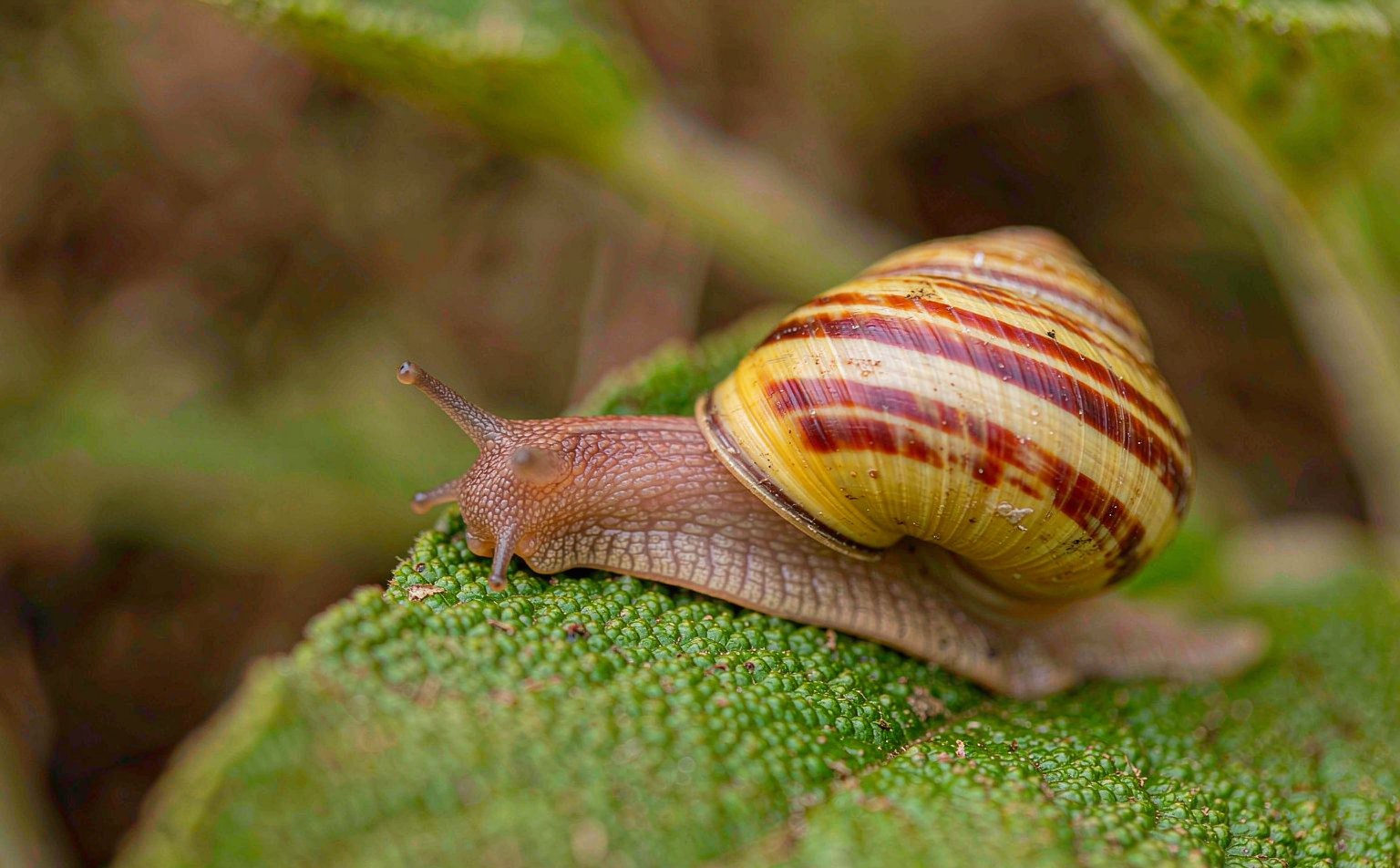
Cepaea nemoralis | Grove Snail
Introduction
The Grove Snail (Cepaea nemoralis) is one of the most colourful and best-studied snails of European gardens and woodlands, a banded snail whose shell may be butter-yellow, pink or brown, plain or marked with up to five dark bands. Roughly two to three centimetres across, it is a common sight on plants, logs and paths in summer, and it has been a favourite of biologists for more than a century because of the striking variety of its shell.
One of the most remarkable things about the Grove Snail is that no two populations look quite the same: the mix of colours and banding shifts from place to place, shaped by the local balance of sun, predators and heredity. It is a gentle herbivore of the leaf litter and low vegetation, and a classic example of how even a humble garden snail can reveal deep patterns in evolution.
Taxonomy
The Grove Snail is a pulmonate land snail in the family Helicidae, described by the Danish naturalist Otto Friedrich Müller in 1774. It is a close relative of the Cornu aspersum, the everyday garden snail, and the two are often found together, but the Grove Snail is the more brightly and variably marked of the pair. Like all helicid snails it carries a coiled calcareous shell and breathes air through a lung.
The genus Cepaea holds a small number of banded snails of European woods and meadows, and Cepaea nemoralis is the commonest and most widespread. Its shell polymorphism has made it a textbook case for the study of natural selection in wild populations.
Physical Characteristics
The shell is globular, with a flared mouth and a glossy surface that ranges from pale yellow through pink to dark brown, usually bearing zero to five dark brown bands that may be narrow or broad and that can fuse into a single dark band. The soft body is grey to blue-grey, with long, retractable eye-stalks each tipped with an eye, and a narrower pair of tentacles used for smell.
The animal glides on a muscular foot that secretes a trail of mucus, and it draws its body wholly inside the shell and seals the opening with a dried mucous film, the epiphragm, in dry or cold weather. The shell is grown at the rim throughout life, so older snails have fuller, thicker lips, and the banding pattern is fixed from the moment the shell forms.
Grove Snail (Cepaea nemoralis)
Habitat
Grove Snails live in a wide range of grassy and wooded habitats: woodland edges, hedgerows, rough meadows, gardens and parks, favouring places with both low vegetation to feed on and litter and cover to retreat into. They are most active in damp, mild weather and after rain, and they aestivate in shelter during dry spells.
They are found across Britain and temperate Europe, and the colour of their shells often tracks the background: in woods with brown leaf litter, browner, more banded forms tend to prevail, while in grassy places pale, plain shells are commoner, a balance struck between hiding from predators and warming in the sun.
Diet
The Grove Snail is a herbivore, scraping algae, fungi and the surfaces of living and dead leaves with its ribbon of teeth, the radula. It eats the soft tissues of low plants, fallen leaves and the occasional garden vegetable or flower, and it is most active by night and in wet weather when the risk of drying out is low.
Its shells are a favourite food of thrushes, which drag them to stones and smash them open, and this predation is one of the forces that shapes the banding pattern in the wild. The Turdus philomelos in particular is a skilled snail-breaker, and where thrushes are common the less conspicuous shell forms tend to survive best.
Reproduction
The Grove Snail is a hermaphrodite, each animal carrying both male and female organs, though individuals usually mate with one another rather than self-fertilise. After mating they lay clusters of round, white, calcareous eggs in the soil or leaf litter, and the young hatch as tiny snails with fully formed, delicately banded shells.
Being hermaphrodite raises the chance that any two adults meeting can breed, an advantage for a slow, scattered animal. The eggs are laid through the warmer months, and the soft-bodied young grow through their first season, reaching breeding size the next year.
Conservation
The Grove Snail is common and of no conservation concern, and it remains abundant in gardens, woods and hedgerows across its range. Like many molluscs it is sensitive to the loss of leafy cover and to dry, over-managed ground, but in general it prospers wherever vegetation is left a little wild.
Its scientific value is out of proportion to its size. Because the shell colours are inherited simply and respond to predators and climate, the Grove Snail has taught generations of biologists how evolution works in real populations, and it remains a living illustration of natural selection that anyone can observe in their own garden.
Fun Facts
- Its shell can be yellow, pink or brown, plain or banded, and the pattern is inherited like eye colour in people.
- It is a hermaphrodite, so every adult can lay eggs after mating with another snail.
- Song thrushes smash its shell on a favourite stone “anvil”, leaving piles of broken shells as evidence.
- The mix of shell colours often matches the local background, hiding it from birds.
- It seals itself inside its shell with a dried mucus door, the epiphragm, to wait out dry or cold weather.