 By st20113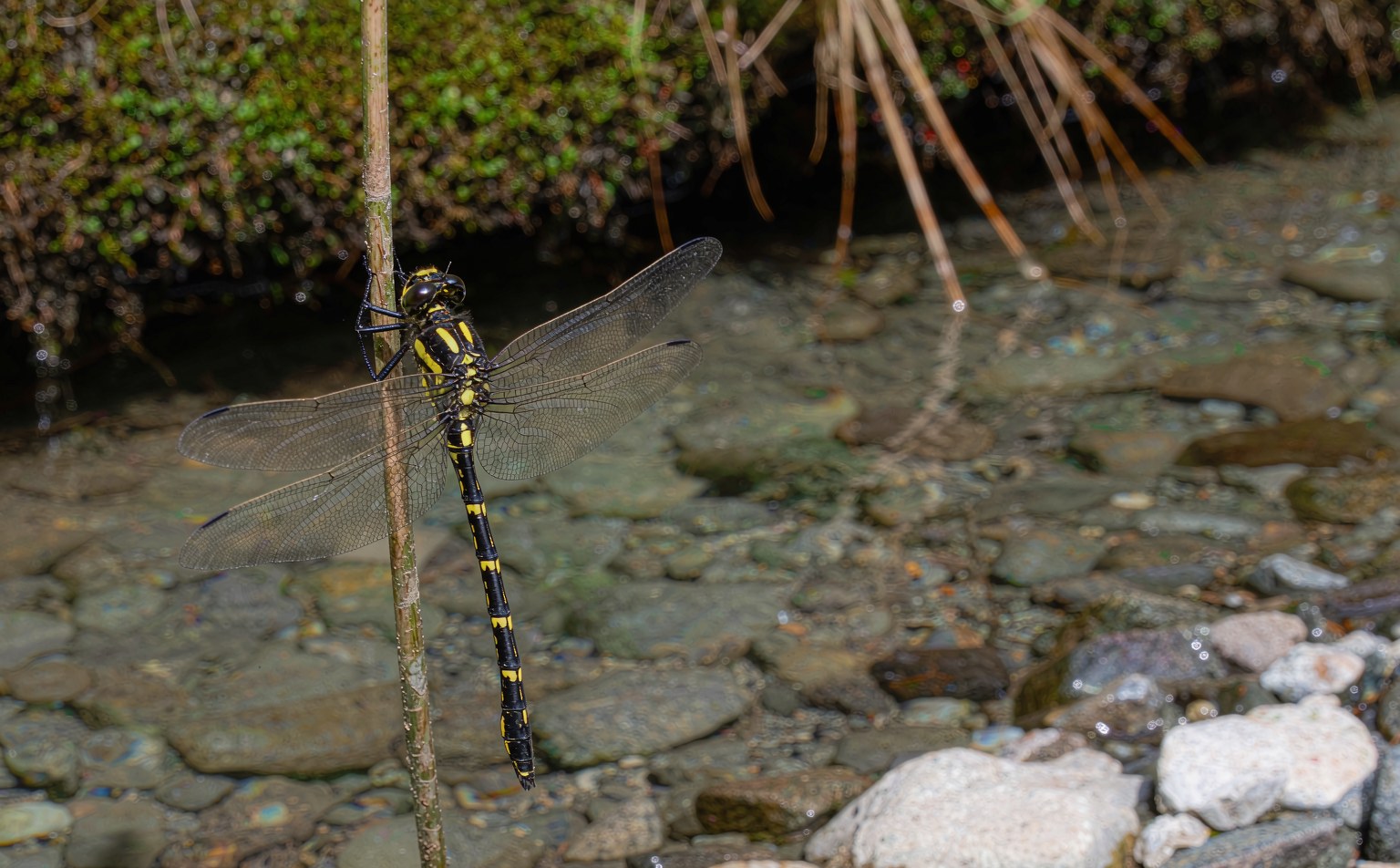
Cordulegaster boltonii | Golden-ringed Dragonfly
Introduction
The Golden-ringed Dragonfly (Cordulegaster boltonii) is the longest dragonfly in Europe and one of the most striking, a black-bodied insect banded with vivid yellow rings and armed with an extraordinarily long, narrow abdomen. A creature of fast, clean upland streams, it is most often seen in early summer as males and females meet over riffles to mate and lay eggs. Despite its size and piercing flight, it is harmless to people and is a spectacular part of healthy riverine habitats. Its ringing, metallic coloration makes it unmistakable among British and European dragonflies.
Taxonomy
Cordulegaster boltonii belongs to the family Cordulegastridae, the swingtail or golden-ringed dragonflies, a small group of stream-dwelling dragonflies. It is the only member of its genus common across much of western Europe and is the type species of Cordulegaster. It is a relative of the broader dragonfly fauna that includes the Emperor Dragonfly, though the golden-ringed is tied to flowing water rather than still ponds. It is also share of the same waterside community as the Banded Demoiselle, a damselfly of similar streams. No widely accepted subspecies divide the European population, though southern and northern forms differ slightly in size.
Physical Characteristics
Adults are 7 to 8.5 centimetres in body length, with a very long, cylindrical abdomen that can exceed the wings in length; the wingspan reaches about 10 centimetres. The body is glossy black above, marked with a continuous row of bright yellow rings along the abdomen and yellow stripes on the thorax, while the eyes are green. The wings are clear with a faint amber tint at the base and a small dark pterostigma (wing spot). Females are even longer than males because of an extended ovipositor at the abdomen tip. The legs are spiny for grasping prey in flight. Newly emerged adults are pale and gain their full colour as they harden.
Habitat
Golden-ringed dragonflies are strictly associated with clean, oxygen-rich streams and small rivers, especially those flowing through acidic heath, moorland and woodland in upland and foothill areas. They need open, sunny stretches of bank where females can alight to lay eggs and where the larvae can develop among gravel and silt in the current. They shun still, polluted or shaded water. They overlap at stream edges with the European Pond Turtle-style pond fauna only where streams meet pools, and with the Common Frog that breeds in the same healthy waters.
Diet
Adults are agile aerial predators, seizing midges, gnats, flies and smaller dragonflies on the wing with their spiny legs and strong jaws; they often hunt from a perch, darting out and returning. The larvae are aquatic ambush predators, lying partly buried in stream gravel and lunging at mayfly and caddisfly larvae, small crustaceans and tadpoles that pass by. Both stages sit near the top of the invertebrate food web of their water body. By controlling pest insects the adults are useful to people, while the larvae help regulate the stream’s bottom-dwelling community.
Reproduction
Mating is a prolonged, airborne affair: the male clasps the female behind the head and the pair fly in tandem, often in a wheel formation, to a suitable stretch of stream. The female then dips the tip of her long abdomen into flowing water to insert eggs into the gravel and silt of the bed, sometimes fully submerging. The larvae, known as nymphs, live in the current for two to five years, moulding repeatedly, before climbing a stem or stone to emerge as adults in early summer. There is no parental care after oviposition, and the adults live only a few weeks.
Conservation
The golden-ringed dragonfly is rated Least Concern across its range, but it is sensitive to the degradation of upland streams. Because its larvae need fast, unpolluted, well-oxygenated water with natural gravel beds, it disappears where streams are straightened, dammed, acidified by peat loss or choked with silt. It benefits from healthy, vegetated riparian zones that shade and stabilise banks without closing out all sunlight. It is not generally a protected species, but its presence is a strong, visible sign of a clean, lively river, and it shares the fortunes of the trout and salmon of the same waters.
Fun Facts
- It is the longest dragonfly in Europe, with a body over 8 centimetres.
- The yellow rings run the full length of its slender abdomen like a beaded belt.
- The female lays eggs by dipping her long body right into the stream current.
- Its larvae can take up to five years to grow before emerging.
- Males and females fly coupled in tandem for minutes while mating.