 By st20113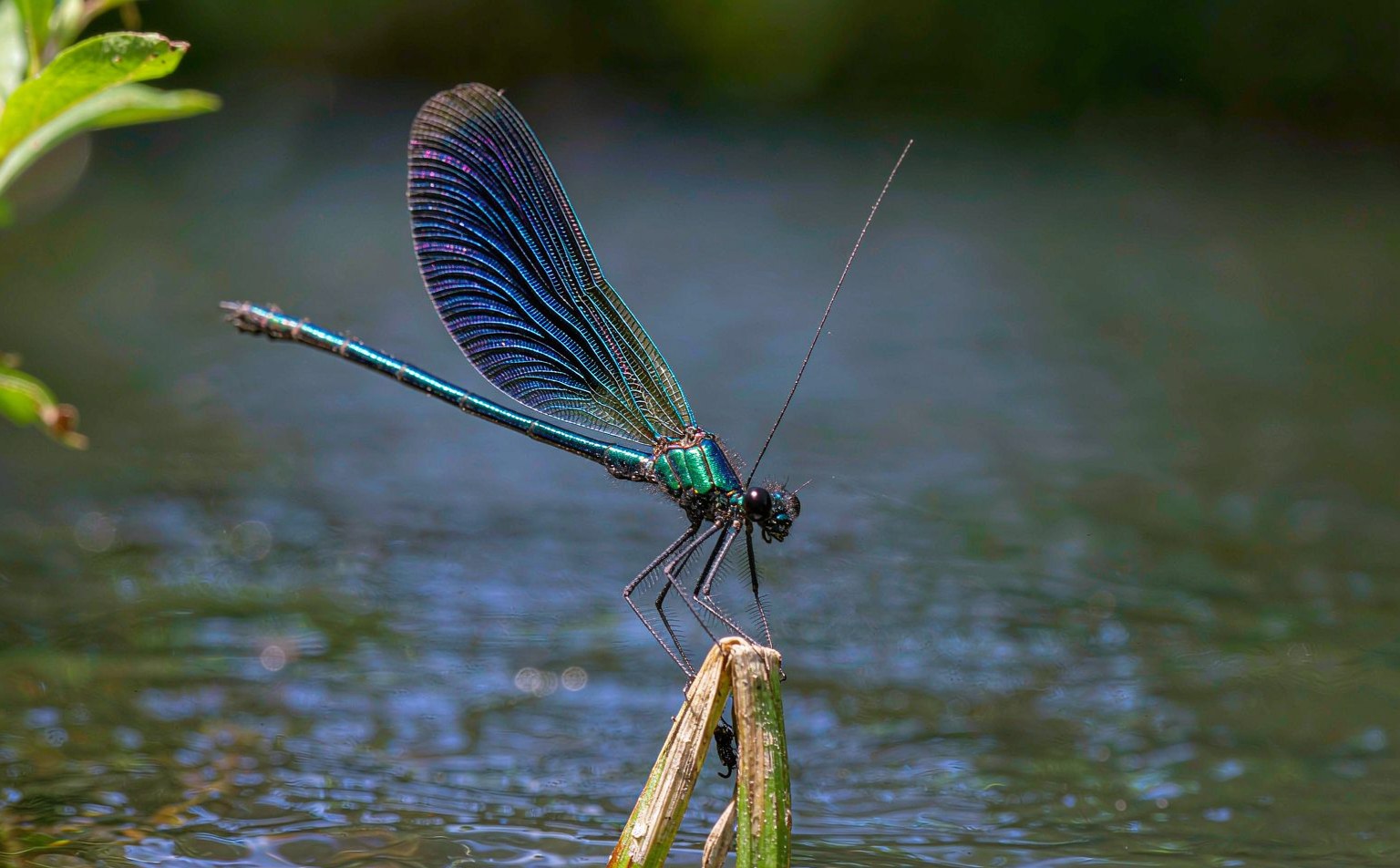
Calopteryx virgo | Beautiful Demoiselle
Introduction
The Beautiful Demoiselle (Calopteryx virgo) is one of the most striking damselflies of European rivers, a slender insect whose males show wings of deep metallic blue-violet that flash as they dart along the water. The females are bronze-winged and more secretive. A creature of clean, fast streams, it is a favourite of riverwalkers and a good sign of unpolluted flowing water.
Taxonomy
The Beautiful Demoiselle is a calopterygid damselfly, a member of the family Calopterygidae, and is found across Europe and into western Asia. It is related to other riverine damselflies and to the broader dragonfly group that includes the [Southern Hawker](https://www.gloencyc.com/aeshna-cyanea-southern-hawker/) and the [Broad-bodied Chaser](https://www.gloencyc.com/banded-demoiselled-libellula-depressa/). It is one of two demoiselles in Europe, alongside the banded demoiselle.
Physical Characteristics
Adults are 49 to 54 millimetres long with a slender body and a wingspan near 70 millimetres. Males are metallic blue-green overall with wings of uniform dark blue-violet, the colour coming from pigment and structure rather than just markings. Females are metallic green with brownish wings bearing a white false stigma near the tip. The wings are broader than those of typical damselflies and are held together above the body at rest.
The eyes are large and dark, the legs thin and spiny for gripping prey. The pterostigma, a coloured cell near the wing tip, is reduced or absent in this genus, unlike in many dragonflies. Newly emerged adults are pale and colour up over a few days, and the metallic sheen makes both sexes shine in sunlight.
Habitat
The Beautiful Demoiselle lives along clean, moderately fast rivers and streams with some shade, rooted plants and a stony or gravelly bed. It needs good water quality and is absent from polluted or heavily modified channels, so its presence marks a healthy river. It also uses shaded canals and ditches where flow and vegetation suit it, perching on waterside plants between short flights.
Diet
Adults feed on small flying insects taken on the wing, including midges, gnats, small flies and aphids, caught in a basket formed by the legs. The aquatic larvae, or nymphs, are fierce predators of mayfly and caddisfly nymphs, small crustaceans and tadpoles, breathing through three leaf-like gills at the tip of the body. Both stages help control riverine insect numbers.
Reproduction
Males defend territories on streamside vegetation and perform a courtship flutter, opening the brilliant wings to attract females. The female lays eggs alone, inserting them into the stems of underwater plants while partly submerged, a behaviour unusual among damselflies. The larvae develop over one or two years before climbing a stem to emerge as adults, and there is normally a single generation each year.
Conservation
The Beautiful Demoiselle is widespread but local, sensitive to river pollution, dredging and the loss of bankside shade and plants. It benefits from leaving natural banks, reducing agricultural runoff and keeping some open water amid woodland. Because it requires clean, flowing water, it is a useful indicator of river health and is protected in parts of its range.
Fun Facts
- The male’s dark blue-violet wings are solid colour, not just spots or bands.
- Females lay eggs fully underwater, climbing down plant stems to do so.
- It is a reliable marker of clean, unpolluted rivers.
- The metallic body shines coppery or green depending on the light angle.
- Though called a damselfly, its broad wings are held together, not spread, at rest.