 By st20113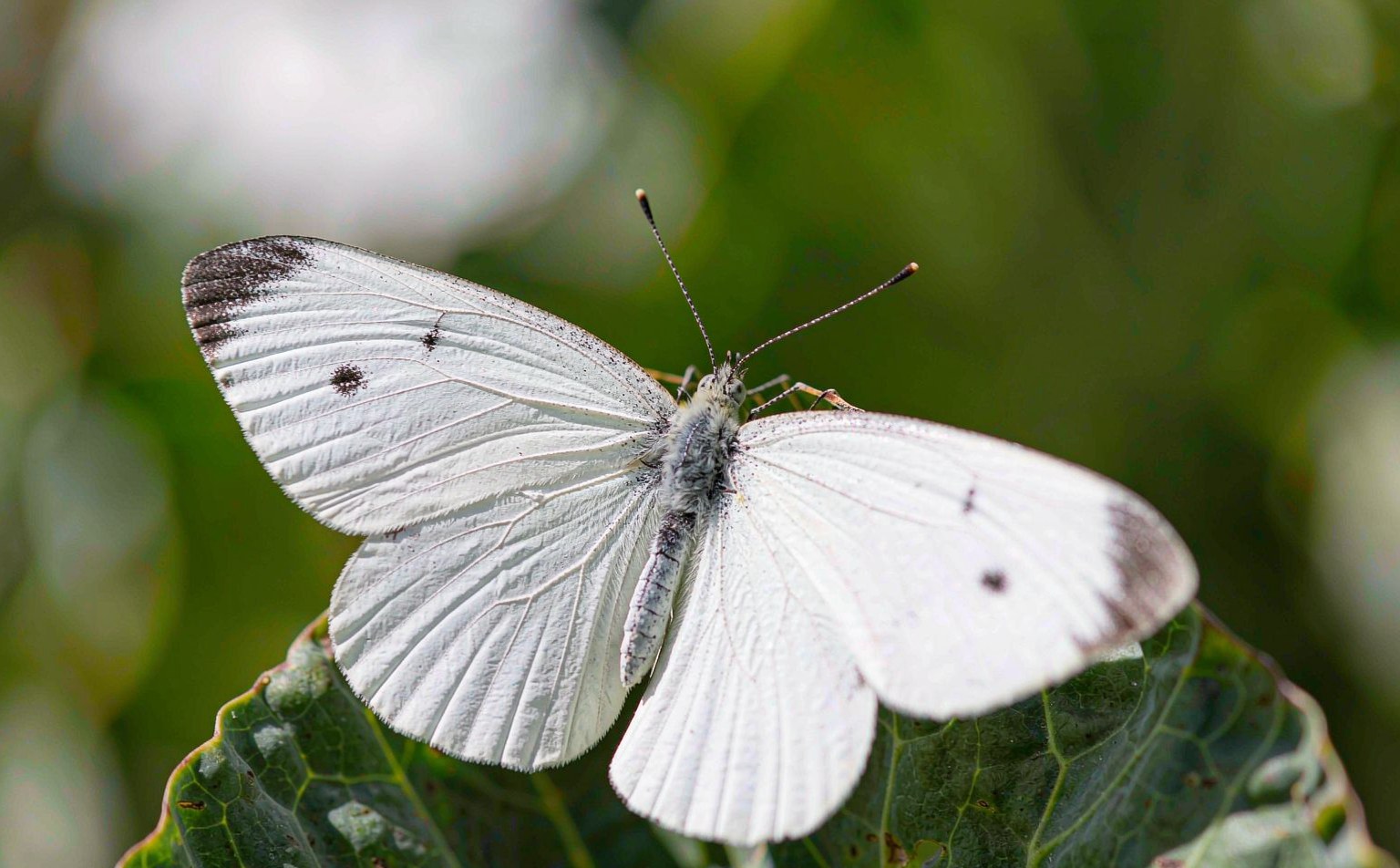
Pieris brassicae | Large White
Introduction
The Large White (Pieris brassicae), often called the cabbage white in gardens, is a large, conspicuous pierid butterfly found throughout Europe, North Africa and temperate Asia. The male is white with black wing tips, while the female bears two bold black spots on each forewing. A strong migrant and prolific breeder, it is familiar to vegetable growers as the parent of the green caterpillars that riddle cabbage and broccoli leaves, yet in the wild it plays a normal role in meadow and farmland ecology.
Taxonomy
The Large White is a member of the family Pieridae, the whites and sulphurs, related to the smaller [Small White](https://www.gloencyc.com/small-white-butterfly-pieris-rapae/) with which it is often confused. It sits in the genus Pieris, and its larvae specialise on plants of the cabbage family Brassicaceae. The species has expanded its range northward with cultivation and is an occasional migrant as far as the Arctic and across to Japan.
Physical Characteristics
Adults are large for a white butterfly, with a wingspan of 58 to 68 millimetres. The wings are white above, the forewing tips broadly black; males show a single black spot at the wing cell, females two. The underside of the hindwing is a pale sulphur yellow, dusted with grey scales at the margin. The body is grey-furred with a black head, and the antennae are clubbed and black above.
The caterpillar is a plump, velvety green larva with a faint yellow dorsal stripe and numerous small black warts, growing to about 40 millimetres before pupating. The chrysalis is angled and grey-green or blue-grey, fixed to a wall, stem or fence and pointed at both ends.
Habitat
The Large White uses open and cultivated landscapes: gardens, allotments, fields of brassica crops, roadside verges, hedgerows, meadows and woodland margins. Females seek out patches of cultivated and wild cabbage family plants for egg-laying, while adults range widely across sunny countryside. In southern Europe it also occupies olive groves, riverbanks and mountain grassland, and it migrates northward in waves during warm springs.
Diet
Adults feed on nectar from a broad range of flowers, including thistles, knapweeds, buddleia, clover and lavender, and they particularly favour purple and pink composite blooms. The caterpillars feed on the leaves of brassicaceous plants — cabbage, broccoli, cauliflower, nasturtium, wild mustard and garlic mustard among them — and can defoliate a small crop plant in days when numerous.
Reproduction
Females lay their eggs in batches of 20 to 100 on the underside of host leaves, the yellow eggs laid upright in a cluster. The larvae hatch together and feed in a group before dispersing. After several instars the caterpillars leave the plant to pupate on nearby vertical surfaces. In warm regions there may be three or more generations a year; in cooler northern areas two broods are typical, and the autumn generation overwinters as a chrysalis rather than as an adult.
Conservation
The Large White is abundant and not threatened, though it is monitored as an agricultural pest of brassica crops. Its populations fluctuate with weather and the availability of host plants, and it is a normal prey item for birds such as the [White-tailed Eagle](https://www.gloencyc.com/haliaeetus-albicilla-white-tailed-eagle/) when caterpillars concentrate, and for parasitic wasps that help check outbreaks. Encouraging a mix of flowers alongside crops supports the adult butterflies without removing their ecological value.
Fun Facts
- The yellow, clustered eggs are laid in a single sitting and hatch almost simultaneously.
- The chrysalis can hinge slightly when prodded, a startle response that may deter predators.
- Males gather at mud and damp ground to sip minerals, a behaviour called mud-puddling.
- The species migrates hundreds of kilometres, with invasions reaching Iceland and northern Scotland in some years.
- Despite its pest reputation, a single Large White does little harm; damage comes from massed caterpillars.