 By st20113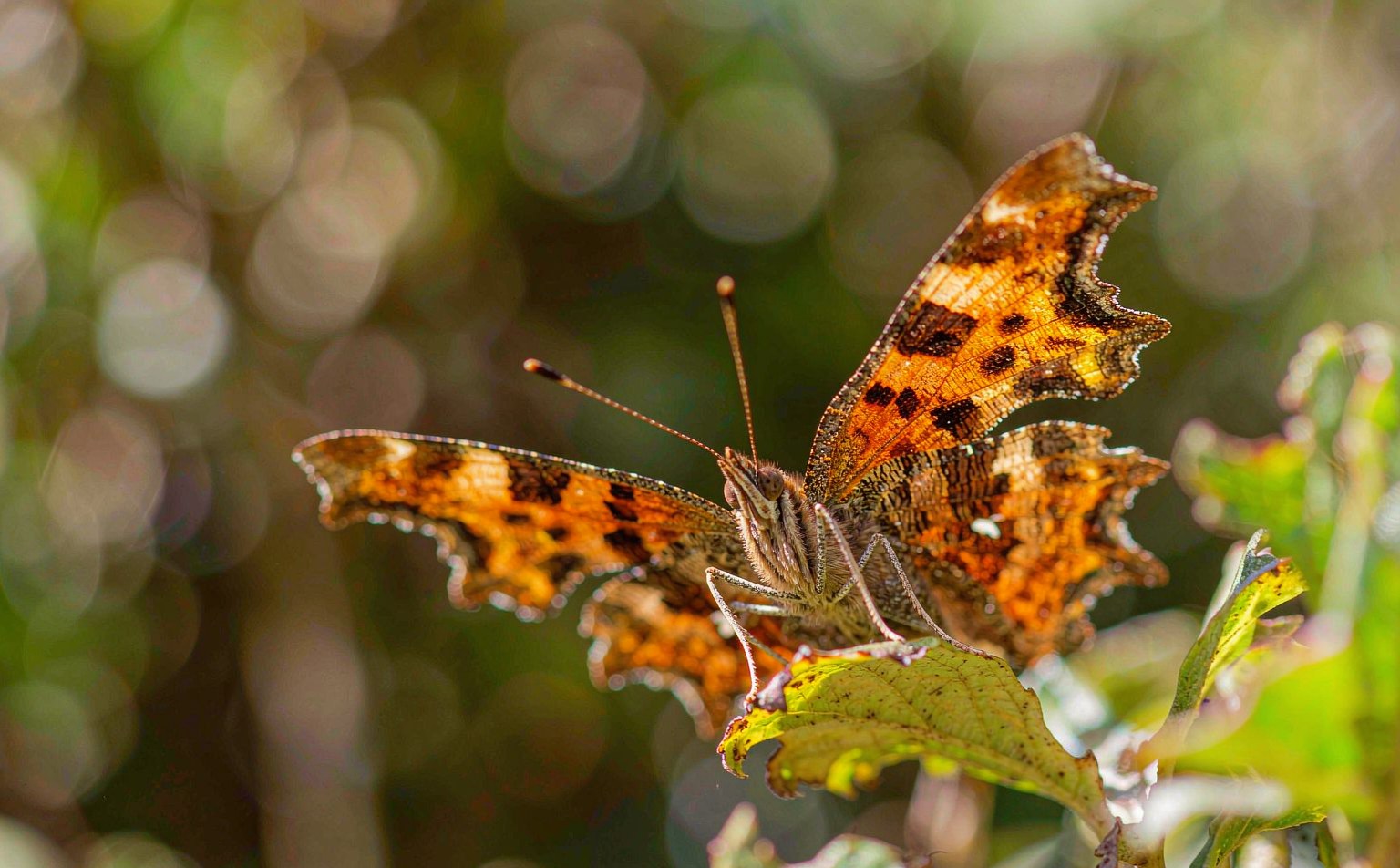
Polygonia c-album | Comma Butterfly
Introduction
The Comma (Polygonia c-album) is a distinctive angle-winged butterfly named for the small white comma-shaped mark on the underside of its hindwing. Its jagged wing edges and leaf-like closed appearance make it one of the best-camouflaged butterflies in Europe, almost impossible to spot when at rest among dead leaves. Once a local woodland species, it has expanded its range and now regularly visits gardens, where it basks on sunny paths and feeds on fallen fruit.
Taxonomy
The Comma is a member of the family Nymphalidae and the tribe Nymphalini, closely related to the [Small Tortoiseshell](https://www.gloencyc.com/peacock-butterfly-aglais-io/) and the [Peacock Butterfly](https://www.gloencyc.com/peacock-butterfly-aglais-io/). Its genus name Polygonia refers to the many-angled wing outline, while the species name c-album describes the white “c” or comma mark on the underside. The caterpillars feed on hops, elms, nettles and currants depending on the region.
Physical Characteristics
Adults reach a wingspan of about 50 to 60 millimetres. The upper side is orange-brown with a scattering of dark spots and a darker marginal band, the colour richer in the summer generation and duller, almost blackish, in the hibernating autumn form. The wing margins are deeply notched and angled rather than smooth, a feature shared by few European butterflies. The underside is a variegated pattern of greys and browns with a silver comma mark, so convincingly leaf-like that a resting butterfly vanishes against bark or litter.
The body and the bases of the wings are densely scaled in dark fur, helping the adult survive winter hibernation. Fresh individuals show a clean white wing border above, which wears away with age.
Habitat
The Comma occupies woodland edges, rides, hedgerows, orchards, riverbanks and increasingly gardens and parks. Females of the spring generation seek out sunny nettle and hop stands for egg-laying, while adults of both generations favour sunny, sheltered spots rich in nectar and ripe fruit. In autumn the butterflies leave woodland for gardens and houses, where they hibernate in outbuildings, hollow trees or behind loose bark.
Diet
Adults nectar from flowers such as buddleia, lavender, thistles and dandelion, but they are especially fond of decaying fruit, gathering in numbers on windfall apples, pears and plums in late summer. They will also take tree sap and occasionally dung or carrion fluids for minerals. The caterpillars eat the leaves of hop (Humulus lupulus), elm (Ulmus), stinging nettle, currant (Ribes) and willowherb, depending on local abundance.
Reproduction
Eggs are laid singly on the upper leaves of the larval food plant, usually in a sunny position. The caterpillar is a striking spiny form, mottled yellow, white and black, and feeds openly on the leaf surface. After several moults it pupates hanging from a stem or leaf, the chrysalis shaped and coloured like a withered leaf. There are typically two broods: a smaller spring generation from overwintered adults and a larger summer generation, with the autumn emergence entering hibernation without breeding.
Conservation
The Comma recovered strongly after a severe decline in the mid-twentieth century and has expanded across Britain and much of western Europe, a rare butterfly success story. It remains widespread and is not of conservation concern, though it benefits from the same habitat continuity that supports other woodland butterflies. Leaving mature elms, hop thickets and nettle patches, together with autumn fruit sources, sustains healthy populations.
Fun Facts
- The silver comma on the hindwing underside is the species’ namesake and a key identification feature at rest.
- Its ragged wing shape is thought to deflect bird attacks by breaking up the butterfly’s silhouette.
- The hibernating autumn form is so dark it was once mistaken for a different species.
- Comma butterflies often return to the exact same garden year after year as they expand their range.
- Males perch and patrol sunny spots to intercept passing females, a behaviour known as hill-topping when done on banks.