 By st20113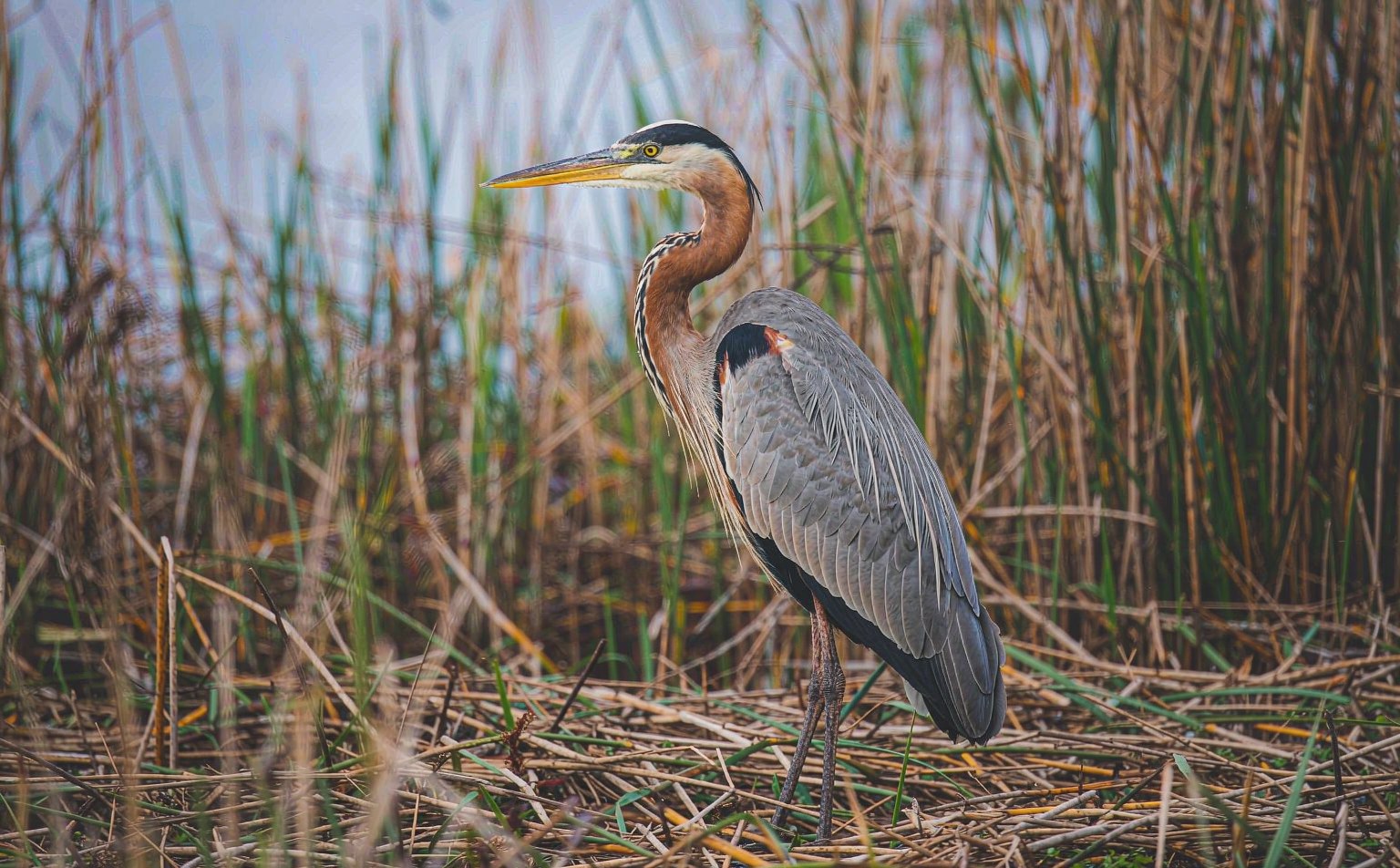
Ardea purpurea | Purple Heron
Introduction
The purple heron, Ardea purpurea, is a tall, slender wading bird of reed beds and wetlands across southern Europe, Africa, and southern Asia. More secretive and elongated than its better-known relative the grey heron, it blends superbly into dense reed margins, where its chestnut and grey plumage and snake-like neck make it a master of stillness. Although widespread, it is far less often seen, favouring inaccessible marshland over open riverbanks.
A patient, almost motionless hunter, the purple heron is a characteristic sound and sight of Europe’s remaining great wetlands, from the Camargue to the Danube delta.
Taxonomy
Ardea purpurea was described by Carlo Antonio Lazzari (often attributed to Temminck) in the early nineteenth century, though the genus Ardea itself dates to Linnaeus. It is a member of the family Ardeidae and closely related to the Grey Heron, which it resembles in size but not in coloration or habits.
Physical Characteristics
The purple heron stands 78–97 cm tall with a wingspan of 120–150 cm and a weight of 0.9–1.8 kg. Adults are striking: a chestnut neck with black streaks, a buff-white throat stripe, a dark grey back and wings, and a black crown extending into slender nape plumes. The long bill is yellowish or horn-coloured, and the legs are dull yellow-green.
Its body is narrower and its neck longer and more sinuous than the grey heron’s, an adaptation to threading through reeds. In flight the neck is retracted in a tight S, and the slow, deep wingbeats and trailing legs recall other herons. Juveniles are browner and duller, lacking the adult’s rich chestnut tones.
Habitat
The species is strongly tied to extensive reed beds, papyrus and reed-fringed lakes, slow rivers, deltas, rice paddies, and seasonally flooded marshes. It requires tall, dense aquatic vegetation both for nesting in colonies and for the cover it uses while hunting. Unlike the grey heron, it rarely frequents dry ground or urban ponds.
In Europe it is largely a warm-region breeder, migrating south to sub-Saharan Africa for the winter, though some populations in north Africa and southern Asia are resident. The preservation of large, undisturbed wetland complexes is essential to its survival.
Diet
The purple heron feeds mainly on fish, amphibians, and invertebrates, supplemented by small reptiles, rodents, and the occasional bird or large insect. It hunts by standing motionless or slowly stalking through shallow water, then striking with a lightning thrust of the long bill. Its slender form lets it reach prey deep within reed channels inaccessible to bulkier herons.
Foraging is most intense at dawn and dusk. The bird often adopts a peculiar crouched posture with the neck bent, waiting for prey to come within range — a behaviour that enhances its camouflage among stems.
Reproduction
Breeding takes place in colonies, frequently mixed with other herons and egrets, within reed beds or on low trees over water. The nest is a platform of reeds and twigs, and the female lays three to five pale blue-green eggs. Both parents incubate for about four weeks and jointly feed the chicks, which fledge after around six to seven weeks.
Young birds remain dependent for some time after leaving the nest and gradually learn to fish independently. The colony’s safety depends on water surrounding the nest site, which deters terrestrial predators such as foxes and wild boar.
Conservation
The purple heron is assessed as Least Concern globally, but European populations are concentrated in a few key wetlands and are vulnerable to drainage, reed-bed degradation, pollution, and disturbance. The loss of extensive natural marshland across the continent has made the species locally scarce in many former strongholds.
Protected wetland reserves, controlled water levels, and restrictions on reed cutting during the breeding season are the main conservation tools. As an indicator of healthy, large-scale marsh habitat, the purple heron benefits directly from broad landscape-level wetland restoration.
Fun Facts
- Its neck is so long and thin it can strike prey hidden deep inside reed stands.
- The adult’s chestnut and grey plumage gives the species its “purple” name.
- It nests in dense colonies, often alongside other heron and egret species.
- Unlike the grey heron, it rarely leaves the cover of wetlands for dry land.
- It migrates from Europe all the way to sub-Saharan Africa for the winter.