 By st20113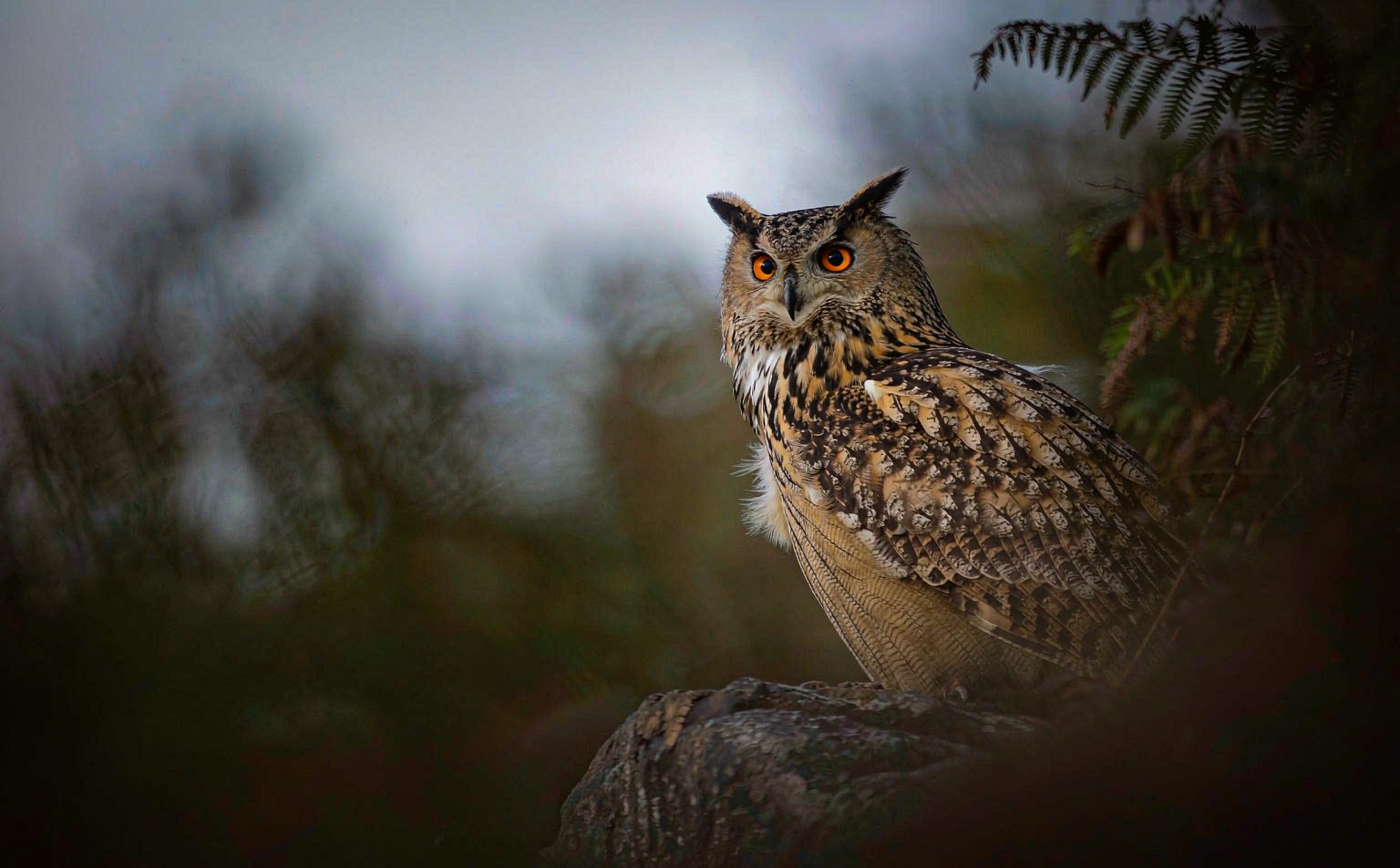
Bubo bubo | Eurasian Eagle-Owl
Introduction
The Eurasian Eagle-Owl (Bubo bubo) is one of the largest and most powerful owls in the world, a nocturnal raptor whose deep, resonant hoot carries for kilometers across the woodlands, rocky gorges, and open countryside of Europe and northern Asia. With a wingspan that can exceed 180 centimeters and a body built for silent ambush, it sits near the apex of the nocturnal food web across much of its vast range. The species has long been woven into human folklore as a bird of omen and mystery, yet in ecological terms it is simply a supremely efficient predator of the night.
This owl occupies an extraordinary variety of habitats, from Mediterranean scrub and temperate forest to semi-deserts, mountain slopes, and even the outskirts of large cities where old buildings and quarries provide nesting ledges. Its adaptability, combined with a broad and flexible diet, has allowed it to persist across landscapes that have been heavily altered by people, though it remains sensitive to disturbance at its breeding sites.
Across its range the Eurasian Eagle-Owl is generally widespread but unevenly distributed, with some of the densest populations found in Russia and the Balkans and more fragmented groups in western Europe. Where it remains common, it serves as a useful indicator of healthy populations of the small mammals and birds on which it feeds. For a contrasting perspective on European raptors, see the golden eagle, a diurnal hunter that occupies many of the same upland landscapes.
Taxonomy
The Eurasian Eagle-Owl was first described by Carl Linnaeus in 1758 and remains the type species of the genus Bubo, which includes the great horned owl of the Americas and several other large owls worldwide. Its scientific name, Bubo bubo, simply doubles the Latin word for owl, an apt reflection of its status as the archetypal large owl of the Old World.
A number of subspecies are recognized across the species’ enormous range, varying chiefly in size and plumage tone. Birds from the cold northeast are notably larger and paler than those from the warmer Mediterranean and Middle Eastern parts of the distribution. Despite this variation, the forms intergrade broadly, and most authorities treat the species as a single, highly variable taxon rather than splitting it into several.
Molecular studies place the eagle-owls within the tribe Bubonini, alongside other horned and eagle-owls, and confirm their close relationship to the smaller Strix owls such as the tawny owl, a familiar woodland species that shares the Eurasian Eagle-Owl’s preference for hunting from a perch at dusk. Genetic evidence also supports the grouping of the eagle-owls with the fishing owls of the genus Ketupa, reflecting a shared evolutionary history among the larger nocturnal raptors of the Old World.
Physical Description
The Eurasian Eagle-Owl is a bulky, heavy-headed bird with prominent ear tufts, intense orange eyes, and a conspicuous facial disk of feathers that frames the face and helps channel sound to its ears. Adults typically stand 60 to 75 centimeters tall and weigh between 1.5 and 4.2 kilograms, with females considerably larger than males, a pattern common among birds of prey. The upperparts are a mottled tawny, buff, and brown, finely barred and streaked, providing excellent camouflage against tree bark and rock.
The underparts are paler, marked with darker streaks and bars that break up the bird’s outline when it roosts motionless by day. The wings are broad and rounded rather than long and pointed, an adaptation for maneuvering through dense cover and for slow, buoyant flight. The talons are massive and strongly curved, built to seize and immobilize prey as large as a young hare or a full-grown duck.
Juvenile eagle-owls are clad in soft, pale down before growing a first set of feathers that resembles the adult plumage but appears fluffier and less sharply marked. The brilliant orange irises, present even in the young, are a hallmark of the species and distinguish it at a glance from the darker-eyed owls with which it might otherwise be confused in poor light.
Habitat
Eurasian Eagle-Owls favor broken terrain that offers both open hunting ground and secluded roosting and nesting sites. Cliffs, rocky outcrops, steep river valleys, and quarries are particularly favored, as are mature forests with clearings, wooded steppe, and agricultural mosaic landscapes. In several European countries the species has colonized urban and industrial areas, nesting on the ledges of abandoned buildings, bridges, and silos where food is abundant and disturbance is surprisingly low.
The key requirements are a reliable prey base, suitable ledges or platforms for nesting, and enough quiet during the breeding season to raise young. The owls use the same general territories year after year, and pairs may occupy home ranges of several dozen square kilometers depending on habitat productivity. Roosting sites are typically chosen in dense conifers or among rocks, where the bird is shielded from the sun and from potential daytime mobbing by crows and other birds.
Although the species tolerates a wide climatic range, from near-arctic taiga to semi-arid steppe, it avoids intensively farmed lowland with no nesting refuges and avoids areas where persecution or heavy human presence prevents successful breeding. Its presence is often a sign that a landscape still supports the rabbits, rodents, and game birds that make up the bulk of its diet.
Diet
The Eurasian Eagle-Owl is a versatile predator that takes an exceptionally wide range of prey, adapting its hunting to whatever is most available. Small mammals form the backbone of the diet: voles, mice, rats, rabbits, and hares are taken wherever they occur, and in some regions rabbits alone can constitute the majority of food brought to the nest. The owl hunts mainly by dropping silently from a perch or from slow, low flight, using its keen hearing and vision to locate prey in near darkness.
Birds are also important, particularly in winter when mammals are scarce or snow-covered. The owl readily captures ducks, gulls, corvids, and game birds, and it is strong enough to overpower birds heavier than itself. Reptiles, amphibians, fish, and large insects supplement the diet in warmer months, and coastal or riverside birds may take fish and crustaceans when opportunity allows.
Because the eagle-owl is large and bold, it can exploit prey that smaller owls cannot, which reduces direct competition with species such as the tawny owl and the long-eared owl that share parts of its range. This dietary flexibility is a major reason the species has retained such a broad distribution despite centuries of human pressure on the wider environment.
Reproduction
Breeding begins in late winter, with pairs establishing or reclaiming a territory and performing mutual calling and food presentations. The Eurasian Eagle-Owl does not build a nest in the usual sense; instead it lays its eggs on a bare cliff ledge, a sheltered rock shelf, a scrape on the ground, or the abandoned stick nest of another large bird such as a hawk or heron. In urban settings, building ledges and industrial structures substitute effectively for natural cliffs.
The female typically lays two to three eggs, sometimes only one and rarely as many as six, at intervals of two to three days. She alone incubates for about 34 to 36 days while the male brings food, and the chicks hatch asynchronously, which means the eldest is often considerably larger than its siblings. This size hierarchy can lead to brood reduction in lean years, when the weakest chick may not survive, a common strategy among large raptors that buffers the family against food shortage.
The young fledge at roughly seven to eight weeks but remain dependent on their parents for several more months, learning to hunt through the autumn and early winter. Sexual maturity is reached at around two years, though many birds do not breed successfully until they have secured a high-quality territory. Pairs are generally monogamous and may remain together across multiple seasons.
Conservation
The Eurasian Eagle-Owl has a large global population and is classified by the IUCN as a species of Least Concern, but its status varies sharply by region. In western Europe the species was heavily persecuted during the nineteenth and early twentieth centuries and was eliminated from many countries, only to recover in the late twentieth century following legal protection, reductions in pesticide use, and the growth of abundant prey such as rabbits and rats in human-dominated landscapes.
Principal threats today include collision with vehicles and power lines, poisoning from rodenticides that accumulate in prey, and disturbance at nesting sites from climbing, quarrying, and development. In some areas illegal shooting and trapping persist, and the expansion of wind farms has added a localized source of mortality. Because the owls range widely and live long, individual birds can accumulate toxins and injuries that affect breeding success.
Conservation measures center on legal protection, public education, the marking or burial of dangerous power lines, and the safeguarding of key nesting cliffs and quarries from disturbance during the breeding season. Translocation and reintroduction projects have re-established breeding populations in countries such as Germany and the Netherlands where the species had been lost. Compared with its smaller and more strictly forest-dwelling relatives, the eagle-owl has proven comparatively resilient, and continued protection of its prey base is the single most important factor for its long-term stability.
Fun Facts
- The Eurasian Eagle-Owl’s hearing is so acute that it can catch prey entirely by sound in total darkness, locating a moving vole under snow or leaf litter.
- A fully grown female can weigh more than twice as much as her mate, one of the most extreme size differences among European birds of prey.
- The species’ deep, rhythmic call, described as “ooh-hu-oh-hu,” can be heard up to several kilometers away on a still night.
- Eagle-owls sometimes prey on other raptors, including falcons and smaller owls, making them one of the few birds that regularly hunt their own relatives.
- In some cities, pairs have learned to nest on supermarket and factory rooftops, raising young within a few meters of human activity yet remaining almost invisible by day.
[…] She was the goddess of wisdom in ancient Greece. That link gave the bird its common name. The Eurasian Eagle-Owl is a distant relative in the same order. That bird is far larger, and it hunts at […]