 By st20113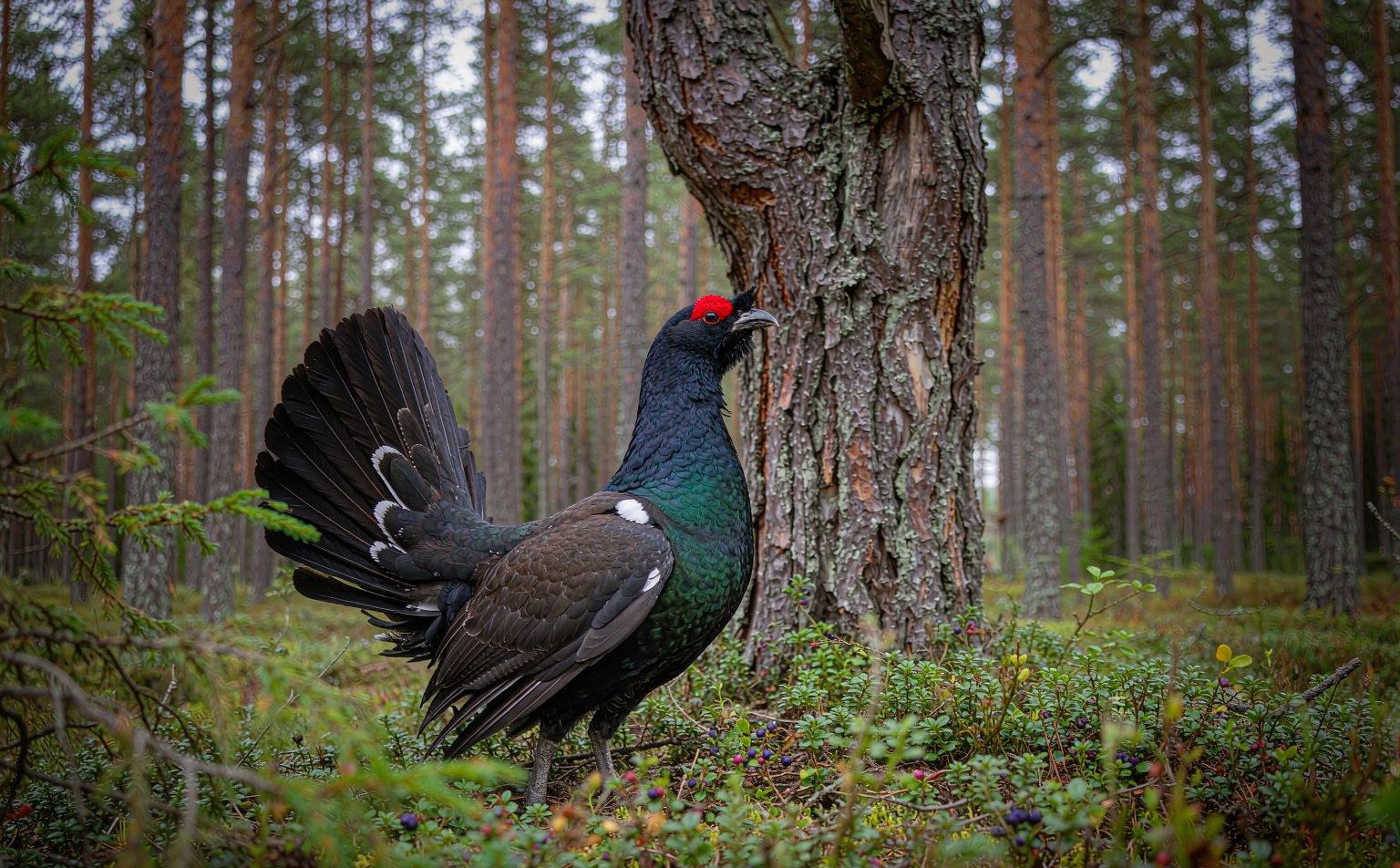
Tetrao urogallus | Western Capercaillie
Introduction
The Western Capercaillie (Tetrao urogallus) is the largest member of the grouse family and one of the most iconic birds of the European boreal forest. This impressive galliform bird inhabits old-growth coniferous woodlands across Scandinavia, the Alps, the Carpathians, and eastward through Russia to Siberia. Known for the male’s spectacular courtship display, the species has long captured the imagination of naturalists, hunters, and birdwatchers alike.
The species is strongly associated with pristine pine and spruce forests, where it depends on a delicate balance of canopy cover, ground vegetation, and abundant bilberry. Because of its specialized habitat requirements, the Western Capercaillie is widely regarded as an indicator species for the health of boreal and montane forest ecosystems. Where capercaillie thrive, the forest itself is usually structurally diverse and ecologically intact.
Across much of Central and Western Europe, the species has declined dramatically over the past century. Populations in Scotland, Germany, and France have become small and fragmented, and several national populations are now considered critically endangered. Conservation programs across the continent aim to restore both the bird and the mature forests on which it depends. For more information on another iconic European forest species, see the red deer.
Taxonomy
The Western Capercaillie was first formally described by Carl Linnaeus in 1758. It belongs to the family Phasianidae and the genus Tetrao, which also includes the Black-billed Capercaillie (Tetrao urogalloides) of eastern Siberia. The species name urogallus derives from Latin, combining urus, the ancient aurochs, and gallus, the rooster, a reference to the bird’s great size and rooster-like appearance.
Several subspecies are recognized across the species’ vast range, including the nominate T. u. urogallus in Scandinavia and Russia, T. u. major in Central Europe, T. u. aquitanicus in the Pyrenees, and T. u. cantabricus in the Cantabrian Mountains of northern Spain. The Cantabrian subspecies is particularly distinctive, inhabiting deciduous rather than purely coniferous forest, and is treated as endangered by Spanish authorities.
Genetic studies have revealed significant differentiation among these peripheral populations, and some researchers have argued that the Pyrenean and Cantabrian forms may warrant full species status. Molecular phylogenetic work has also clarified the relationships within Tetraonini, the grouse subfamily, confirming that capercaillies are most closely related to the black grouse of the genus Lyrurus, with which they occasionally hybridize in the wild.
Physical Description
The Western Capercaillie is a heavily built bird with pronounced sexual dimorphism. Males, often called cocks, are dramatically larger than females, weighing between 3.3 and 4.7 kilograms, while hens typically weigh 1.5 to 2.5 kilograms. The male measures 74 to 85 centimeters in length with a wingspan of about 90 to 125 centimeters, making him the heaviest of all living grouse.
The male’s plumage is dark and lustrous, with metallic green on the chest, deep blue-black on the belly, and brownish-black wings marked with white spots. A distinctive white spot at the shoulder, a prominent red wattle above the eye, and a hooked ivory-colored beak complete his striking appearance. During display, the cock droops his wings, fans his tail into a forward-curving arc, and raises his neck feathers into a ruff.
The female is far more modestly dressed in cryptic mottled brown and buff plumage, barred and streaked to blend seamlessly into the forest floor. Her rusty breast and slightly rounded tail help distinguish her from the smaller black grouse hen. Juveniles resemble the female during their first year, with young males gradually acquiring dark feathers through their second autumn.
Habitat
Western Capercaillie inhabit old-growth and mature coniferous forests dominated by Scots pine, Norway spruce, and silver fir, often with a well-developed understory of bilberry and other ericaceous shrubs. They occur from lowland taiga in Scandinavia and Russia up to the treeline at around 1,500 to 2,200 meters in the Alps and Pyrenees, showing remarkable flexibility in elevation across their range.
The birds require a mosaic of habitat elements within small home ranges: dense canopy for shelter from aerial predators, open forest floor with abundant bilberry for foraging, and nutrient-rich forest edges with herbs and insects for the chicks. Hens nest on the ground, usually within a few hundred meters of open lekking sites, favoring spots beneath low conifer branches that conceal the nest from above. The species shares these mountain forests with other European woodland specialists such as the European pine marten, a nimble predator of eggs and chicks.
In winter, capercaillie depend heavily on pine and spruce needles, which they digest in a specially adapted digestive system that includes enlarged caeca housing symbiotic bacteria. Deep snow is not a hardship but a resource, as birds bury themselves in snow burrows overnight to conserve heat during severe cold. Winter recreation, however, has become a growing problem, as free-riding skiers and snowshoers repeatedly flush birds from their burrows, depleting their energy reserves.
Diet
The diet of the Western Capercaillie shifts dramatically with the seasons. In spring and summer, adults feed on the shoots, leaves, and berries of bilberry, along with catkins, buds, grasses, and a variety of invertebrates, particularly ants, beetles, and caterpillars. Berries form an especially important food source in late summer and autumn, allowing birds to build fat reserves before winter.
Chicks are almost entirely insectivorous during their first weeks of life, relying on butterfly and moth larvae, which they find among the bilberry bushes. This dependence on protein-rich invertebrates links chick survival directly to the availability of insect-rich ground vegetation, and cool wet summers that suppress insect activity frequently cause catastrophic breeding failures.
In autumn, the birds turn increasingly to pine needles, and by winter the adult diet consists almost exclusively of conifer foliage, with Scots pine needles preferred wherever available. Birds feed in the canopy in early morning and late afternoon, resting and ruminating in snow burrows or beneath dense branches during the middle of the day. Grit and small stones are regularly swallowed to help the muscular gizzard grind the tough, resinous needles.
Reproduction
The Western Capercaillie is famous for its lek mating system. In early spring, usually from late March through May, males gather at traditional display grounds, or leks, which are often used for decades. Each cock defends a small territory within the lek, and the dominant males occupy the central positions where most matings occur.
The male’s display is a theatrical sequence of sounds and postures: a double wing clap as he jumps into the air, followed by a strutting walk with drooped wings and fanned tail, then a vocal crescendo of clicks, cork-popping sounds, and a rolling hiss that carries hundreds of meters through the still forest. Remarkably, during the final hissing phase of his display, the cock becomes momentarily deaf, a physiological quirk that once made displaying males easy targets for hunters.
Females visit the lek singly or in small groups, usually mating with only one or two dominant cocks. After mating, the hen performs all subsequent parental duties alone. She lays 5 to 9 eggs in a shallow scrape on the ground, often at the base of a tree or beneath a bush, and incubates them for 24 to 26 days. The precocial chicks leave the nest within a day of hatching and can fly short distances at two to three weeks, though they remain with their mother into early autumn. Males take 2 to 3 years to reach full plumage and lek status, while hens typically breed in their first or second spring.
Conservation
The Western Capercaillie has declined severely across much of Central and Western Europe. Scotland’s population, reintroduced in the nineteenth century after earlier extinction, has fallen to only a few dozen birds and is on the brink of disappearing once more. In Germany, the Black Forest population persists only thanks to intensive management, while numbers in the Alps and Jura have contracted significantly since the 1990s.
The causes of decline are manifold. Fragmentation of old-growth forests by roads, ski resorts, and tourism infrastructure has degraded and isolated habitat. High deer and chamois densities prevent forest regeneration and trample bilberry stands. Collisions with deer fences, predation by foxes and ravens, and disturbance from recreation compound the pressure. Adult birds face few natural enemies, though the golden eagle will take a capercaillie given the opportunity. Climate change brings additional threats, as warmer springs desynchronize chick hatching with caterpillar availability and reduce the quality of winter snow burrows.
Conservation efforts include the restoration of lekking and brood habitats, removal or marking of dangerous fences, creation of quiet zones where access is restricted during the breeding season, and in some regions predator management or reintroduction programs. The Cantabrian subspecies, numbering around 400 birds, is the focus of a dedicated Spanish recovery plan. Under the IUCN global assessment, the species remains classified as Least Concern due to its vast Siberian population, but European national red lists paint a far more alarming picture, with several countries listing it as critically endangered or regionally extinct.
Fun Facts
- The name “capercaillie” comes from the Gaelic “capall coille,” meaning “horse of the woods,” a nod to the male’s large size and the horse-like gurgling of his display song.
- During the loud finale of his display, the male capercaillie goes temporarily deaf, losing hearing for a fraction of a second at each note, an adaptation that protects his ears from his own volume.
- A displaying cock can be approached very closely, as his focus on the lek becomes nearly trance-like, a trait that made him devastatingly vulnerable to hunters and photographers alike.
- Capercaillie hens sometimes mate with black grouse cocks, producing hybrids known as “rackelhahn,” which display a puzzling mix of features and were long treated as a mysterious separate species.
- A single bird can eat up to 250 grams of pine needles per day in winter, processing resin-rich foliage that few other animals can digest.
[…] conservation interest as forests are managed and fragmented. It shares its wooded world with the Western Capercaillie, another bird of mature […]