 By st20113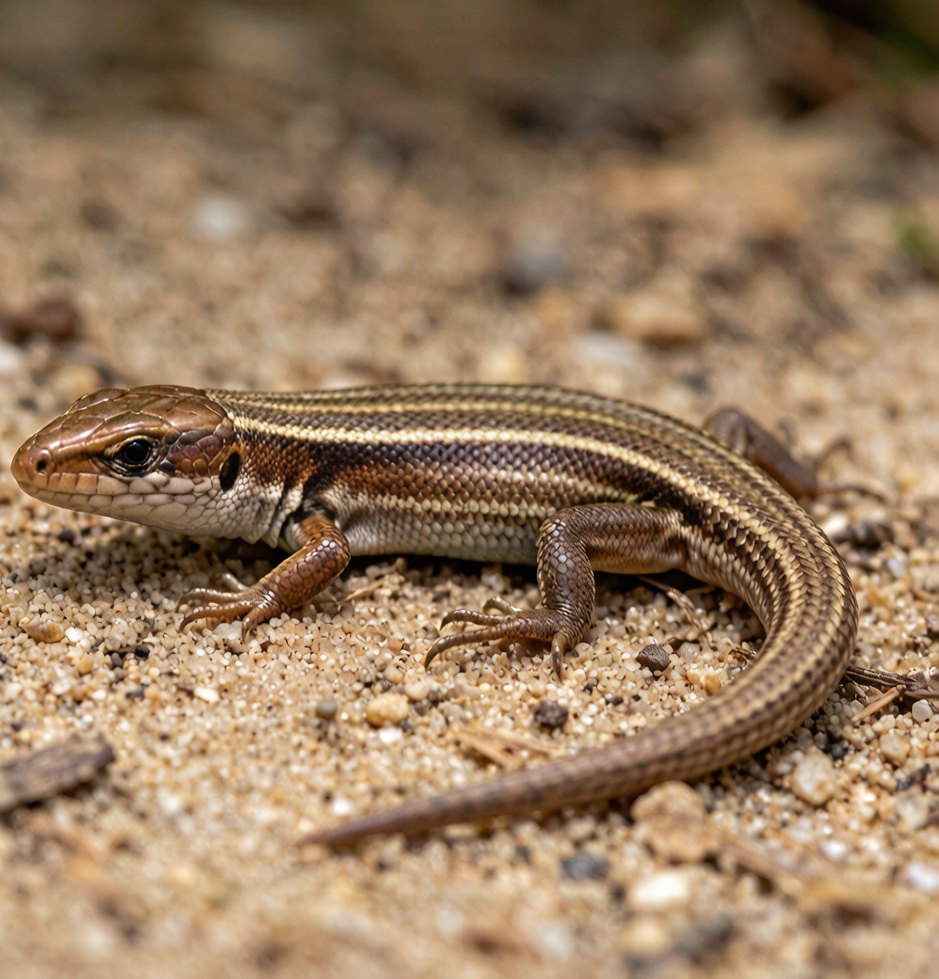
Introduction
The Five-lined Skink is a slender, glossy lizard common across sub-Saharan Africa, easily recognized by the five pale stripes that run along its body from head to tail. Active by day and quick to dash for cover, it is one of the most frequently seen reptiles in gardens, savannas and woodland edges. Like many skinks it has smooth, overlapping scales that give it a polished, almost metallic sheen, and a long tail that it can shed and regrow if seized by a predator.
Taxonomy
Trachylepis quinquetaeniata belongs to the family Scincidae, the skinks, one of the largest lizard families in the world, and shares the broader lizard radiation with the lizard and the Komodo dragon. The genus Trachylepis includes numerous African skinks once grouped under Mabuya. Several close relatives carry similar striped patterns, but the five-lined skink is distinguished by its neat, even striping and its familiarity around human dwellings across much of the continent.
Physical Characteristics
Adults are small, usually eight to fifteen centimetres including the tail, with a streamlined body and short legs. The background colour is brown or bronze, overlaid with five pale lines—one down the spine and two on each side—that fade with age. The scales are smooth and shiny, reducing friction as the animal slips through grass and leaf litter. Like all lizards it is ectothermic, relying on external heat to warm its body. The tail is fragile by design, breaking off cleanly when grabbed and wriggling to distract a predator while the skink escapes.
Habitat
Five-lined skinks occupy a wide range of warm, open and semi-open habitats: savanna, woodland edges, rocky outcrops, gardens and the bases of buildings. They bask in sunlit spots and retreat into crevices, under stones or into leaf litter when threatened or when temperatures peak. Highly tolerant of human presence, they are often found around homes, where walls and foundations provide both warmth and hiding places. They avoid dense forest and very dry desert interior, preferring places with a mix of sun and shelter.
Diet
These skinks are largely insectivorous, taking ants, beetles, crickets, termites, spiders and other small invertebrates caught on the ground or low vegetation. They hunt by sight, darting forward to seize prey with a quick snap of the jaws before retreating to safety. Because they consume large numbers of pest insects, they are welcome inhabitants of gardens and farms. Occasionally they eat small fruits or scavenge, but animal prey makes up the bulk of their varied diet through the year.
Reproduction
Breeding takes place in the warm season. Females lay small clutches of two to six eggs in a hidden, humid site such as under a stone, in a termite mound or within a wall cavity. The leathery eggs incubate for several weeks before hatching into tiny, independent replicas of the adults. Young skinks are striped even more boldly than adults and must fend for themselves from the moment they emerge. In milder regions several broods may be produced across a single long warm season.
Conservation
The Five-lined Skink is listed as Least Concern and is abundant across its extensive African range. It faces few serious threats thanks to its adaptability and tolerance of disturbed habitat. Local collection for the pet trade is minor compared with its huge wild population. Continued abundance depends mainly on retaining the sunny, vegetated microhabitats and the ground cover that these small lizards need for basking, feeding and shelter from birds and snakes.
Fun Facts
A skink can drop its tail when caught, and the detached tail keeps wriggling to distract the predator. The five pale lines are brightest in youngsters and fade as the lizard ages. Smooth, shiny scales help it slip easily through dense grass. It is one of the few reptiles happy to live right beside people in African towns. In some cultures these skinks are kept as cheerful, low-maintenance garden guests that help control insect pests, and a healthy skink regrows a lost tail within weeks.