 By st20113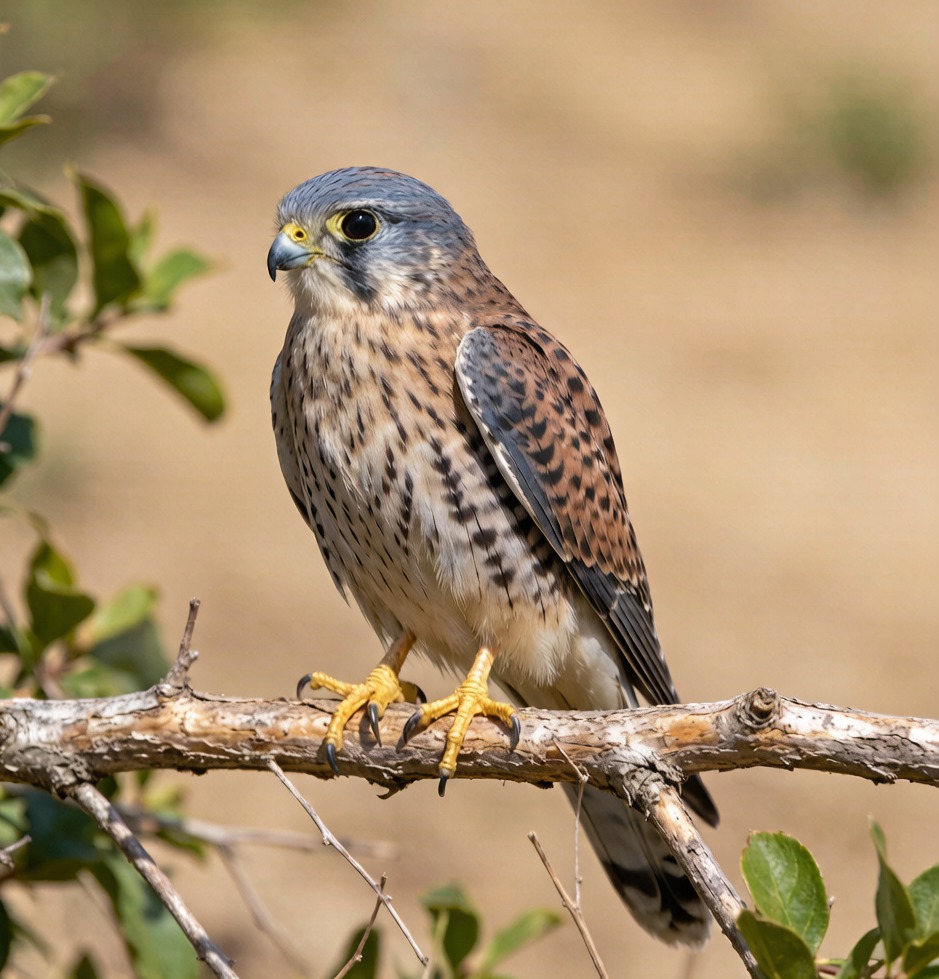
Introduction
The Common Kestrel is a small, colorful falcon found across Europe, Asia and Africa. Roughly the size of a pigeon, it is best known for its habit of hovering motionless over fields, wings beating and tail fanned, before dropping onto prey below. One of the most widespread raptors in the world, it thrives in open countryside, farmland, grasslands and even city edges where tall buildings substitute for cliffs as nest sites. Its cheerful “kee-kee-kee” call often reveals its presence long before the bird itself is seen.
Taxonomy
Falco tinnunculus belongs to the falcon family Falconidae, within the genus Falco that includes hobbies and the bald eagle (which is placed in a different genus, Haliaeetus, but remains a fellow bird of prey). The Common Kestrel is the type species of the “true” kestrels, a group of small falcons that hunt by hovering rather than by high-speed stoops. Numerous subspecies span its enormous Old World range, varying slightly in size and plumage tone from the Atlantic forests to the steppes of central Asia and the highlands of East Africa.
Physical Characteristics
Males have a blue-grey head and tail with a chestnut back spotted black, while females are browner and more heavily streaked—a clear sexual dimorphism unusual among raptors. Both show dark “tear” spots below the eye and a pale, unmarked face that reduces glare. Wingspan reaches sixty-five to eighty centimetres. Like all falcons, kestrels have pointed wings, a notched beak with a tomial tooth for dispatching prey, and exceptional daytime vision, including the ability to see ultraviolet light that reveals the scent trails of small mammals.
Habitat
Kestrels occupy open and semi-open landscapes: meadows, pastures, steppes, hedgerows, coastal dunes, moorland and increasingly towns. They avoid dense forest but perch on wires, posts and rooftops to scan for food from a vantage point. Nest sites include cliff ledges, tree hollows, old crow nests and the ledges of buildings. Their success in human-altered landscapes makes them among the most familiar birds of prey, readily nesting on churches, warehouses and apartment blocks across the continent.
Diet
Small mammals dominate the diet, especially voles and mice, supplemented by birds, large insects, lizards and earthworms when available. The kestrel’s hallmark hunting technique is the hover: it faces into the wind, holds position and drops precisely onto prey detected by sight and by the ultraviolet glow of scent marks. In lean times it hunts from a perch, sallying out to grab quarry on the ground below. A single bird may take several voles a day, making it a valuable controller of rodent populations in farmland throughout its range.
Reproduction
Kestrels are typically monogamous and may pair for several seasons at a time. They do not build elaborate nests, instead using a bare ledge, cavity or abandoned nest of another species. The female lays three to six eggs, incubated mainly by her for about four weeks while the male provisions her with food. Chicks fledge at four to five weeks and remain dependent for a further few weeks as they master the difficult art of hunting on their own from nearby perches and posts.
Conservation
The Common Kestrel is classified as Least Concern and remains abundant overall, though some European populations have declined with agricultural intensification that removes vole habitat and nest sites. Provision of nest boxes has helped locally where natural cavities are scarce. Pesticides that reduce prey and thin eggshells were historic threats, now much reduced through regulation, and the species adapts well to many open habitats provided voles remain plentiful and toxic chemicals stay out of the food chain.
Fun Facts
Kestrels can see ultraviolet light, letting them track vole scent trails that are invisible to the human eye. They hover by facing into the wind and adjusting their wingbeat to stay almost perfectly still. Able to spot a vole from thirty meters up, they drop like a stone onto it with folded wings. Despite their small size, they are fierce hunters of mice and large insects alike. In cities they nest on ledges that mimic the cliffs of their wild ancestors high above the streets below.