 By st20113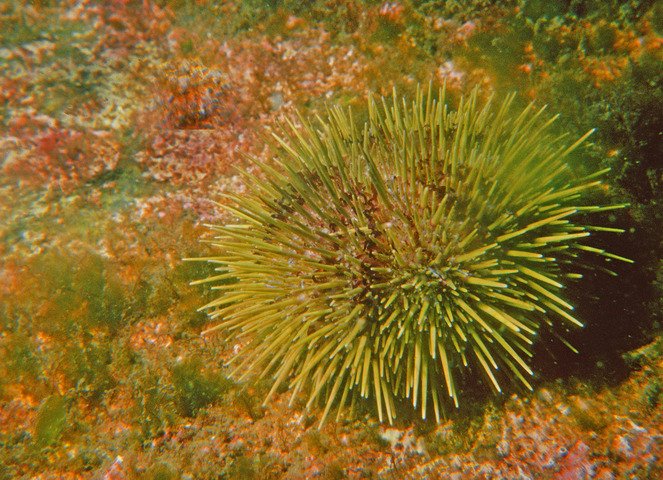
Introduction
The Green Sea Urchin (Strongylocentrotus droebachiensis) is a remarkable marine invertebrate that plays a pivotal role in shaping rocky coastal ecosystems across the Northern Hemisphere. Recognised by its dark green test and dense covering of short spines, this echinoderm is one of the most abundant and ecologically significant sea urchin species in cold waters. Found from the intertidal zone to considerable depths, it is both a keystone herbivore controlling algal communities and a commercially valuable species harvested for its roe, known as uni in sushi cuisine. Its population dynamics profoundly affect the health of kelp forests and the broader marine food web.
Taxonomy
The Green Sea Urchin belongs to the family Strongylocentrotidae, a group of sea urchins characterised by a globose test and well-developed Aristotle’s lantern—the distinctive feeding apparatus of many echinoids. Its full scientific classification is: kingdom Animalia, phylum Echinodermata, class Echinoidea, order Camarodonta, family Strongylocentrotidae, genus Strongylocentrotus, and species S. droebachiensis. Otto Friedrich Mueller described the species in 1776. The genus Strongylocentrotus comprises a small number of closely related species including the well-known purple sea urchin of the northeastern Pacific. Genetic studies reveal distinct lineages in Atlantic and Pacific populations.
Physical Characteristics
The Green Sea Urchin has a spherical test measuring up to 7 centimetres in diameter, with individuals in food-rich environments commonly reaching 5 to 6 centimetres. The test is covered in short, closely spaced spines roughly 1 to 2 centimetres long, dark green on the shaft with lighter green or purplish tips. Surrounding the mouth on the underside is Aristotle’s lantern—a complex feeding apparatus of five calcified teeth protruded to scrape algae from rock surfaces. The body displays pentamerous radial symmetry with five rows of tube feet used for locomotion, adhesion, and respiration. Despite lacking eyes, the urchin possesses light-sensitive cells across its epidermis, allowing detection of shadows that signal approaching predators.
Habitat
The Green Sea Urchin is one of the most widely distributed marine invertebrates in the Northern Hemisphere, found across the North Atlantic from the Arctic coast of Canada and Greenland to Maine and the British Isles, and across the North Pacific from Alaska to the Commander Islands. Green Sea Urchins inhabit rocky substrates, gravel bottoms, and algae-dominated communities from the intertidal to depths exceeding 200 metres. Population densities can fluctuate dramatically, with explosive growth phases followed by mass die-off events. During periods of intense wave action or predator pressure, individuals may shelter in crevices and rocky overhangs, adopting a cryptic lifestyle.
Diet
Green Sea Urchins are primarily herbivorous, grazing on green, brown, and red seaweeds. In kelp forest ecosystems their diet is dominated by kelps such as Laminaria and Alaria species. When kelp is abundant they are selective feeders, preferring the most nutritious species. During food scarcity or high population density, they switch to a generalised diet consuming almost any available algae, including encrusting coralline algae. The urchin uses Aristotle’s lantern to scrape algae from rock surfaces, leaving characteristic bare patches. Intense overgrazing can convert lush kelp forests into barren, urchin-dominated barrens with far-reaching consequences for the associated marine community.
Reproduction
Green Sea Urchins are broadcast spawners, releasing eggs and sperm into the water column in synchronised mass spawning events. The peak season varies by region but typically occurs during winter and early spring. A single large female may produce several million eggs per spawning event. Fertilisation is external, and zygotes develop into free-swimming planktonic larvae within 48 hours. The larval stage lasts two to four months, facilitating long-distance dispersal by ocean currents. Juvenile mortality is extremely high during the early benthic phase. Sexual maturity is reached at approximately two to three years, and the species can live for more than 20 years where predation is low.
Conservation
The Green Sea Urchin is not globally threatened, reflecting its wide distribution and large populations. However, commercial fisheries targeting the species for its prized roe have caused localised depletions in Norway, the British Isles, Atlantic Canada, and Alaska. Overfishing has ecological consequences, as urchin removal from kelp forest ecosystems can trigger shifts between urchin barrens and productive kelp forest states. Climate change poses additional threats through warming temperatures and increased disease susceptibility. Marine protected areas have been established in some regions, while urchin ranching and restorative aquaculture are being developed to rebuild depleted populations.
Fun Facts
Aristotle’s lantern—the Green Sea Urchin’s feeding apparatus—is one of the most complex feeding structures in the animal kingdom, capable of generating scraping forces powerful enough to etch marks into solid granite. Despite its spiny armour, the Green Sea Urchin is preyed upon by sea otters, crabs, lobsters, and sea stars that evert their stomach to digest urchin flesh externally. In parts of northern Norway and Iceland, overharvesting has left urchin predators locally overabundant without their primary food source. The bright orange uni sold in sushi restaurants is the reproductive gonad of the sea urchin, prized for its creamy texture and flavour, commanding prices exceeding 100 dollars