 By st20113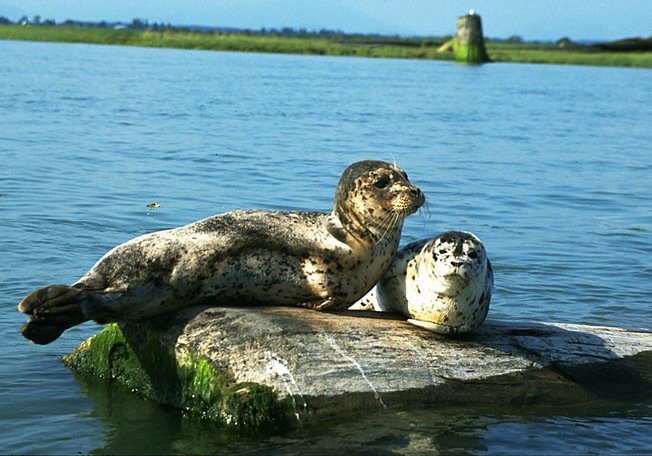
Introduction
The harbor seal, also known as the common seal, is a true seal found along temperate and Arctic coastlines of the Northern Hemisphere. Phoca vitulina is one of the most widespread and familiar pinnipeds, often seen hauled out on rocks, sandy beaches, and mudflats close to shore. Unlike some of its relatives, the harbor seal is relatively small, shy, and adaptable, thriving in both busy estuaries and remote wilderness. Its dog-like head, large dark eyes, and spotted coat make it a favorite of wildlife watchers.
Taxonomy
The harbor seal belongs to the family Phocidae, the true seals, within the order Carnivora. Its scientific name, Phoca vitulina, was established by Carl Linnaeus in 1758. Five subspecies are generally recognized, including the Eastern Atlantic, Western Atlantic, Ungava, Pacific, and Kuril seals, each occupying a distinct region. Genetic studies suggest that some populations may warrant separate species status, but most authorities continue to treat them as subspecies of a single widespread species.
Physical Characteristics
Adult harbor seals measure between 1.5 and 1.9 meters in length and weigh from 55 to 170 kilograms, with males slightly larger than females. Their bodies are streamlined and rounded, lacking external ear flaps, a defining trait of true seals. The coat is short and varies from silver-gray to brown, covered with distinctive dark spots that differ among individuals. A layer of blubber beneath the skin provides insulation in cold water. The forelimbs are modified into flippers, and the hind flippers cannot be turned forward, so the animal moves on land with an undulating, caterpillar-like motion.
Habitat
Harbor seals inhabit coastal waters of the North Atlantic and North Pacific, from California and Japan to the Arctic and the shores of Europe. They prefer shallow, sheltered bays, estuaries, and tidal channels where fish are abundant. They are rarely found far from land and commonly use isolated sandbars, rocky ledges, and ice-free coasts as haul-out sites. Seasonal movements are usually local, tied to prey availability and breeding cycles.
Diet
These seals are opportunistic feeders that primarily eat fish such as herring, cod, mackerel, and flounder, supplemented by squid, crustaceans, and mollusks. They hunt mainly near the bottom or in mid-water, using sensitive whiskers to detect prey in murky conditions. A single adult may consume several kilograms of food each day. Foraging trips are typically short, lasting a few hours, after which the seal returns to a haul-out to rest and digest.
Reproduction
Harbor seals are not highly social during breeding, and mating occurs in the water. After a gestation of about eleven months, including a delayed implantation, a single pup is born on land or ice. The pup is born with a full coat and can swim within hours. Mothers nurse their young for only three to six weeks, during which the pup triples its weight on rich milk. Weaning is abrupt, and the young seal must then learn to forage independently.
Conservation
The harbor seal is currently listed as Least Concern by the IUCN, with a global population estimated in the hundreds of thousands. Historically, it was hunted for fat, meat, and fur, and some populations were heavily reduced. Today, threats include entanglement in fishing gear, pollution, habitat disturbance, and disease. Protected under various national laws and the Marine Mammal Protection Act in the United States, many populations have stabilized or recovered, though local declines still occur. Relatives such as the harp seal, the leopard seal, and the walrus face different regional pressures, while the California sea lion shares many coastal habitats.
Fun Facts
Harbor seals can hold their breath for more than twenty minutes during deep dives. Each seal’s spot pattern is unique, much like a fingerprint, allowing researchers to identify individuals. They sleep in the water, bobbing at the surface in a posture called bottling. Pups are born knowing how to swim and can dive within hours of birth.
Harbor seals are remarkably adaptable marine mammals that have successfully colonized diverse coastal environments across the Northern Hemisphere. Their ability to regulate body temperature through a thick layer of blubber enables them to thrive in icy Arctic waters as well as temperate coastal regions. Juveniles are born with a waterproof coat and can swim within hours of birth, a critical survival adaptation in environments where predators are constant threats.