 By st20113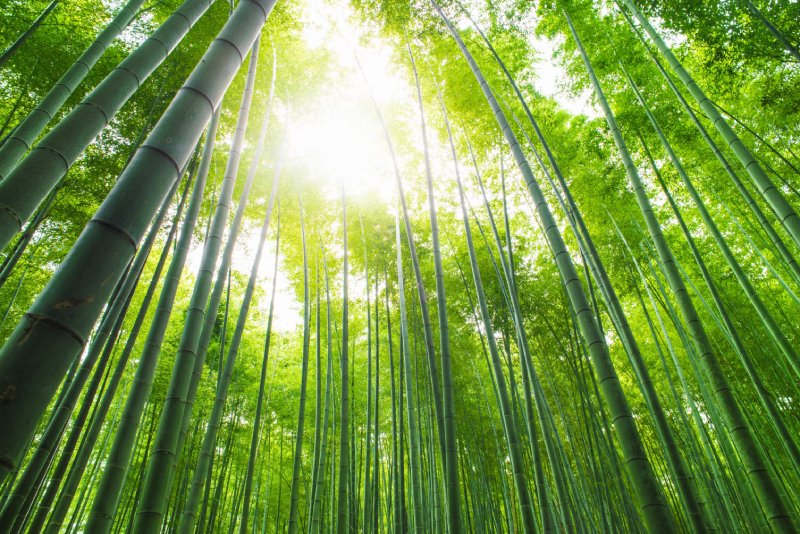
Bamboo refers to a diverse group of evergreen perennial grasses belonging to the subfamily Bambusoideae. Ranging from miniature shrubs to towering giants exceeding 30 meters in height, bamboo is one of the fastest-growing plants on Earth, with some species capable of growing up to 91 centimeters per day under ideal conditions.
Physical Characteristics
Bamboo is technically a grass, not a tree, despite its woody appearance. Its hollow, segmented stems called “culms” grow from rhizomes (underground stems) in a clumping or running growth pattern. The stems emerge from the ground at their full diameter — unlike trees, bamboo does not thicken with age.
The remarkable growth rate of bamboo is achieved through the elongation of cells in the stem’s internodes, which can expand at extraordinary speeds. In Moso bamboo (Phyllostachys edulis), shoots can grow from seed to a full 20-meter culm in just 40 to 60 days.
Bamboo leaves are typically lance-shaped and arranged alternately on the branches. Many bamboo species exhibit a unique phenomenon called “gregarious flowering,” in which all plants of a single clone flower simultaneously across vast areas, sometimes spanning hundreds of kilometers — even if the plants are physically separated. Individual plants may not flower for 30 to 120 years, and this mass flowering event can occur at intervals of up to once per century.
Habitat and Distribution
Bamboo is native to every continent except Europe and Antarctica, with the greatest diversity found in tropical and subtropical regions of Asia, particularly China and Southeast Asia. China alone hosts over 500 bamboo species, representing about half of the world’s total.
Bamboo forests are ecologically critical in Asia, providing habitat for endangered species including the Giant Panda (which feeds almost exclusively on bamboo), the Red Panda, and the Mountain Gorilla. The Red Panda’s diet consists primarily of bamboo leaves and shoots.
Uses and Cultural Significance
Humans have used bamboo for thousands of years. Its applications range from construction materials, scaffolding, and fishing poles to food (bamboo shoots), medicine, paper, textiles, and musical instruments. In many Asian cultures, bamboo symbolizes strength, resilience, flexibility, and longevity — a reflection of its ability to bend without breaking in strong winds.