 By st20113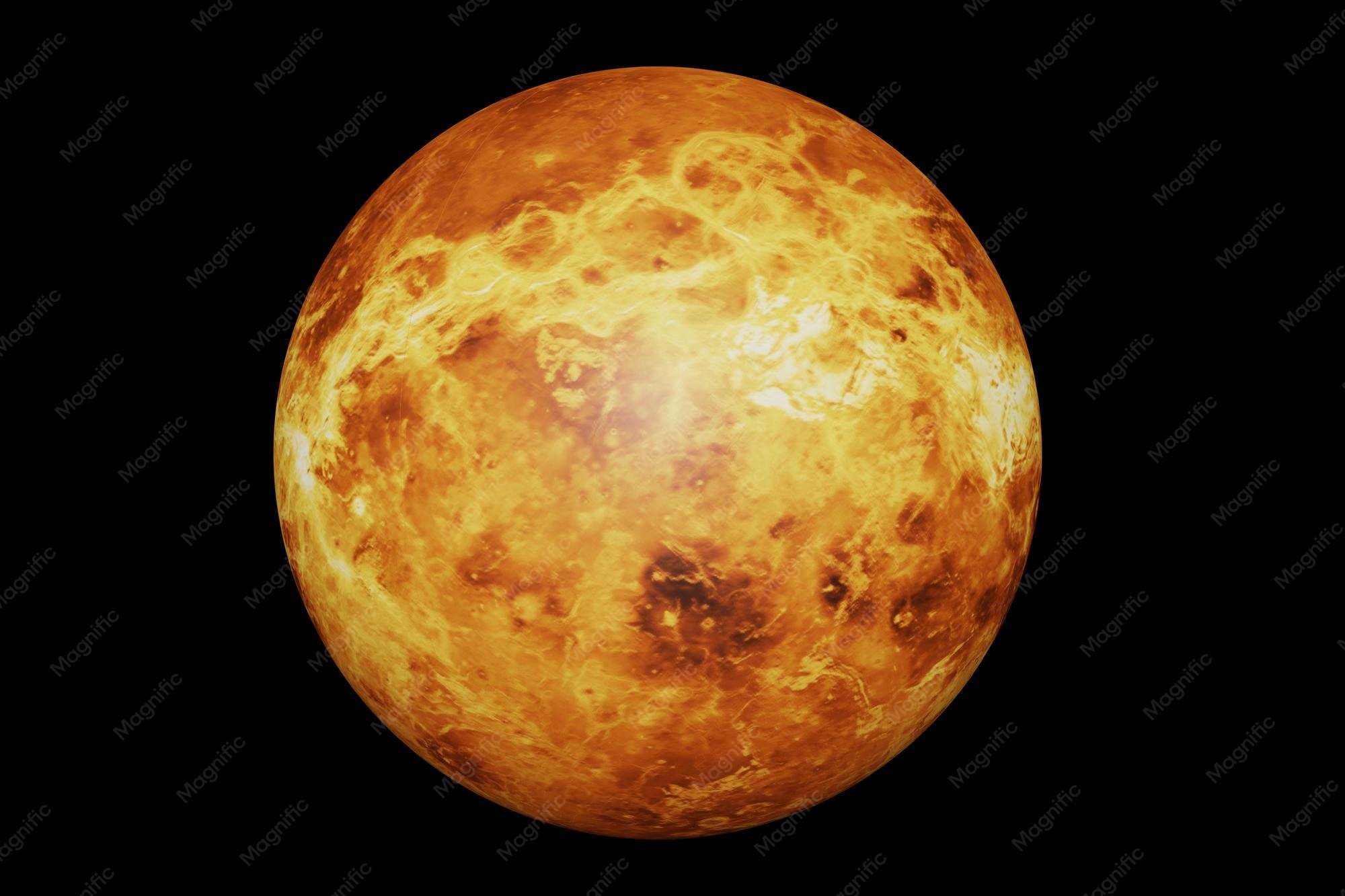
Venus is the second planet from the Sun and Earth’s closest planetary neighbor, often called Earth’s “sister planet” due to their similar size, mass, and bulk composition. However, beneath its beautiful, cloud-shrouded surface lies one of the most hostile environments in the solar system, making Venus a striking example of how planetary siblings can evolve along radically different paths.
Physical Characteristics
Venus has a diameter of 12,104 kilometers — about 95% of Earth’s — and a mass approximately 81% of Earth’s. Its dense atmosphere, composed primarily of carbon dioxide (96.5%) with clouds of sulfuric acid, creates a crushing surface pressure 92 times that of Earth at sea level.
Surface temperatures on Venus average 465 degrees Celsius (869 degrees Fahrenheit) — hot enough to melt lead. This extreme heat is driven by a runaway greenhouse effect, where thick clouds trap incoming solar radiation just as glass traps heat in a greenhouse. This makes Venus even hotter than Mercury, which orbits much closer to the Sun.
The surface of Venus is remarkably smooth at a planetary scale, with vast volcanic plains covering about 80% of the terrain. However, radar mapping by the Magellan spacecraft and subsequent missions have revealed extensive volcanic features including more than 1,600 major volcanoes, vast lava flows, and coronae (circular geological formations caused by mantle upwelling).
Rotation and Orbit
Venus has the most circular orbit of all the planets, nearly perfect in its path around the Sun. Its rotation, however, is unusual: Venus spins on its axis extremely slowly (a Venusian day lasts 243 Earth days) and in the opposite direction to most planets — the Sun rises in the west and sets in the east. This retrograde rotation may have been caused by a massive collision with another protoplanet in the ancient solar system.
Exploration
Venus has been visited by numerous spacecraft since the 1960s. The Soviet Venera program achieved the first successful landings on another planet when Venera 3 crashed onto Venus in 1966, and Venera 7 returned the first surface temperature measurements from another planet in 1970. More recently, NASA’s DAVINCI mission (2029) and ESA’s EnVision mission aim to study Venus’s atmosphere and geology in unprecedented detail, as scientists debate whether Venus may once have had liquid water and oceans on its surface.