 By st20113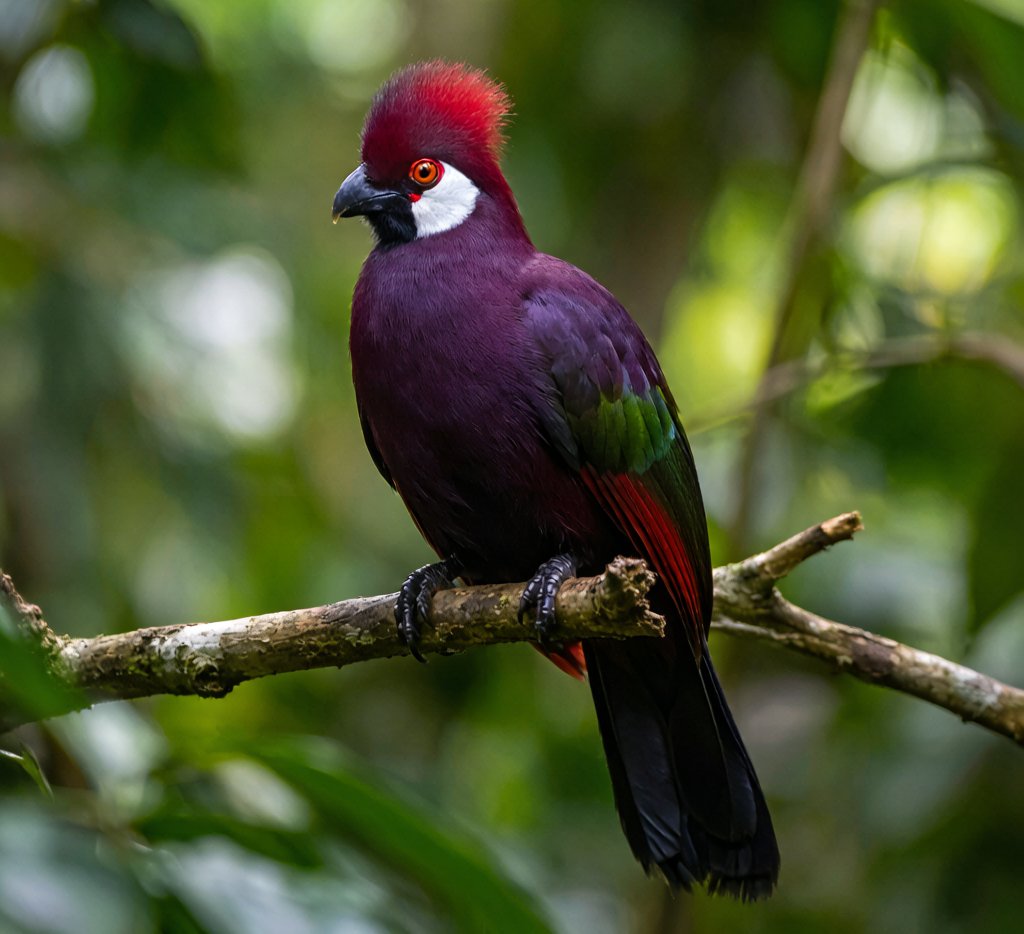
Introduction
The Purple Turaco, Musophaga violacea, also known as the Violet Turaco, is one of Africa’s most striking birds, instantly recognisable by its deep violet-purple plumage and brilliant scarlet wing patches that flash dramatically in flight. Found across West and Central Africa from Senegal to Uganda, this medium-sized fruit-eating bird inhabits dense tropical forests, gallery forests, and swampy woodland where fruiting trees provide food and nesting sites. The species plays an important ecological role as a seed disperser across the rainforest ecosystems it inhabits.
Taxonomy
The Purple Turaco belongs to the family Musophagidae and the genus Musophaga, which contains three recognised species. Musophaga violacea was formally described by Carl Linnaeus in 1758. Molecular phylogenetic studies confirm that Musophagidae diverged from the common ancestor of cuckoos and hoopoes approximately 40 million years ago. Within the family, Musophaga species are distinguished by their casqued heads and violet-purple body plumage. The Purple Turaco forms a superspecies with Ross’s Turaco (M. rossae) of central Africa.
Physical Characteristics
The Purple Turaco measures approximately 45 to 50 centimetres in length with a long graduated tail and weighs between 200 and 290 grams. Its vibrant violet-purple plumage covers the head, body, and wings, contrasting sharply with bright scarlet primary flight feathers conspicuous in flight. The head bears a compact, forward-curving pale casqued crest, and the face shows a distinctive white cheek patch with a black stripe through the eye. The feet are zygodactyl — two toes forward and two backward — adapted for gripping branches in the canopy.
Habitat
Musophaga violacea inhabits a range of forest types from lowland tropical rainforest and swamp forest to gallery forest strips along rivers, preferring dense, well-canopied areas with abundant fruiting trees, particularly fig trees and wild palms. The species occurs at elevations from sea level to 1,800 metres. Although primarily a forest bird, it readily colonises second-growth forest and large wooded gardens with mature fruiting trees. Fragmentation of continuous forest into isolated patches significantly impacts local populations by reducing suitable habitat area.
Diet
The diet of the Purple Turaco is dominated by fruit, comprising up to 90 percent of its intake, supplemented by flowers, leaves, and occasional invertebrates. Preferred fruits include wild figs, palms, and berries, which are plucked in flight or while perched. Seeds from ingested fruit are dispersed through the forest as the bird moves between feeding trees, making M. violacea an important ecosystem engineer. Young birds are fed a higher proportion of invertebrate prey during the breeding season to provide protein for growth.
Reproduction
Purple Turacos breed during the wet season, producing one to two eggs per clutch in a fragile platform nest placed in dense foliage five to fifteen metres above the ground. Both parents share incubation over approximately 21 to 24 days, and chicks are born semi-altricial. Chicks fledge at approximately 21 to 24 days old but remain dependent on their parents for several weeks. The parents’ crimson wing patches are displayed during territorial encounters, with both birds raising wings to flash red feathers at intruders.
Conservation
The Purple Turaco is classified as Least Concern by the IUCN, with a global population estimated at several million individuals. The species faces mounting pressure from habitat loss driven by deforestation for agriculture, logging, and charcoal production, particularly in West Africa. Forest fragmentation isolates populations and reduces genetic diversity over time. The species is hunted for its vivid feathers in some parts of its range. Protected areas such as Taï National Park in Côte d’Ivoire harbour significant populations.
Fun Facts
Purple Turacos possess a unique copper-based pigment called turacoverdin in their crimson wing feathers, one of the most vivid reds in the avian world. Unlike most red bird feathers that rely on carotenoids from diet, turacoverdin is synthesised by the bird itself, making it unique among all bird species. When feathers get wet, copper compounds can leach out and stain the bird’s white plumage. Despite their conspicuous colours, Purple Turacos are remarkably stealthy canopy dwellers relying on cryptic behaviour to avoid detection.