 By st20113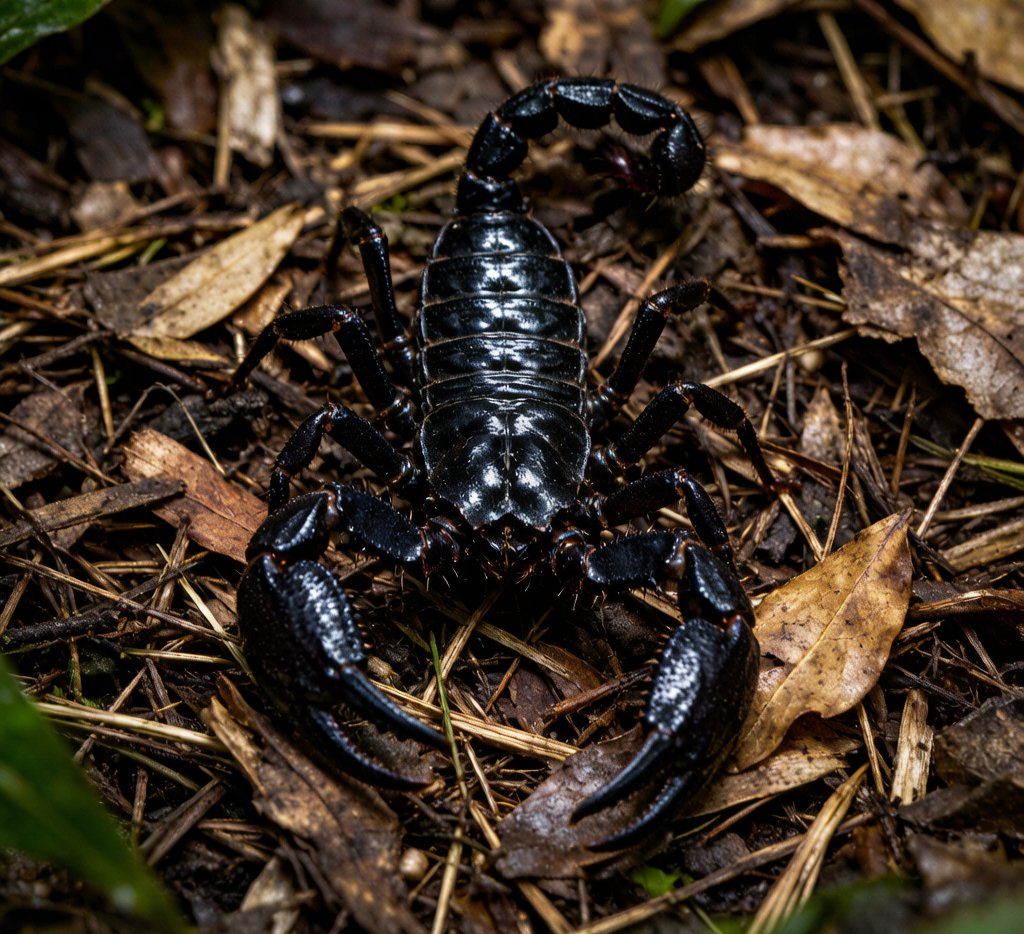
Introduction
The Asian forest scorpion (Heterometrus scorpio) is a large and impressive arachnid native to the tropical and subtropical forests of South and Southeast Asia. Known for its glossy dark exoskeleton and powerful pincers, this species is among the largest scorpions on Earth, with some individuals exceeding 15 centimeters (6 inches) in length. It is frequently kept by exotic pet enthusiasts despite its painful sting, but in the wild it plays an important ecological role as a nocturnal predator that regulates populations of insects and other small invertebrates. Found across India, Sri Lanka, Bangladesh, Myanmar, Thailand, Malaysia, and Indonesia, it typically occupies dark, humid microhabitats beneath logs, rocks, and dense leaf litter.
Taxonomy
The Asian forest scorpion belongs to the genus Heterometrus, which contains approximately 30 recognized species distributed across Asia. The scientific name Heterometrus scorpio results from taxonomic revisions that clarified the distinction between Heterometrus and the closely related genus Scorpio, with which it was historically confused. The genus name derives from Greek roots meaning different length, a reference to the proportions of certain body segments. Many Heterometrus species are morphologically similar, leading to ongoing revisions using both anatomical and genetic data to resolve species boundaries. In the exotic pet trade, it is sometimes called the Indian forest scorpion, though this name can cause confusion with other species.
Physical Characteristics
The Asian forest scorpion has a robust body composed of a prosoma (head region), mesosoma (broad mid-section), and a long segmented metasoma (tail) ending in a venomous telson (stinger). The exoskeleton is smooth and glossy, typically dark brown to black. The pedipalps, the large front claws resembling those of a crab, are well developed and used primarily for grasping and crushing prey rather than defense. The tail is thick and muscular, and the telson contains venom that causes intense local pain and swelling in humans, though it is rarely life-threatening to healthy adults. Like the nine-banded armadillo, the Asian forest scorpion relies on its armored exoskeleton as its primary defense against predators.
Habitat
Asian forest scorpions inhabit the humid floor layers of tropical and subtropical forests, seeking the moisture and shelter essential for their survival. They are commonly found beneath fallen logs, loose bark, rock crevices, and burrows excavated in soft soil. Their range spans from Sri Lanka and the Western Ghats of India through the humid forests of Myanmar, Thailand, and the Malay Peninsula, to the islands of Sumatra and Java. They are most abundant in primary forests with dense canopy cover that maintains high humidity, though they can persist in secondary forest areas where suitable microhabitats remain. Like the koala, the Asian forest scorpion is highly sensitive to dehydration and requires consistently humid conditions.
Diet
The Asian forest scorpion is a nocturnal ambush predator that feeds primarily on insects including crickets, cockroaches, beetles, and grasshoppers, as well as spiders and centipedes. Occasionally, it captures small vertebrates that venture too close to its hiding place. Like other scorpions, Heterometrus scorpio uses its powerful pedipalps to seize and crush prey before injecting digestive enzymes and consuming the liquefied tissue. The scorpion’s metabolism is relatively slow, enabling it to survive extended periods without food; individuals in captivity have gone several months between meals.
Reproduction
Asian forest scorpions reproduce through a courtship ritual called a promenade a deux, during which the male guides the female across the ground using his pedipalps before depositing a spermatophore for her to collect. After a gestation of several months, the female gives birth to 20 to 40 live young, which immediately climb onto her back and remain there until their first molt. The mother provides protection and some prey-sharing during this vulnerable period. Heterometrus scorpions exhibit extended parental care, relatively rare among arthropods, and young do not disperse until after their second or third molt. Like the emu, Asian forest scorpions demonstrate complex social behaviors including long-term associations between mated pairs.
Conservation
The Asian forest scorpion is listed as Least Concern by the IUCN due to its wide distribution and apparent tolerance of habitat modification. However, significant gaps remain in knowledge of population trends and the impacts of collection for the pet trade. In some regions, large numbers of wild-caught individuals are exported for the exotic pet industry, and unsustainable harvesting could pose localized risks. Deforestation and agricultural conversion of forest land represent the most significant habitat-based threats. Conservation of intact forest ecosystems and regulation of the wild-caught trade are essential for maintaining healthy populations.
Fun Facts
The Asian forest scorpion is one of the largest scorpion species in the world, with some individuals exceeding 15 centimeters (6 inches) in length. Unlike many scorpion species that rely heavily on venom for prey capture, Heterometrus scorpio primarily uses its powerful pedipalps to crush prey, reserving its sting for defense and larger prey.
[…] animal shares the order with the Asian Forest Scorpion. That animal lives in damp tropical forest. It grows much larger and darker. Our animal lives in […]