 By st20113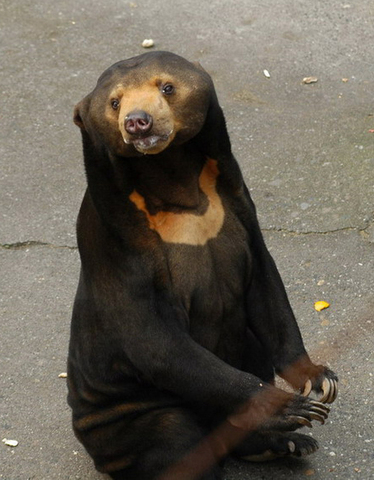
Introduction
The sun bear (Helarctos malayanus) is the smallest and perhaps the least known of the world’s eight bear species. Native to the tropical forests of Southeast Asia, this elusive omnivore is named for the distinctive golden-orange crescent marking on its chest, which resembles a rising sun. Despite its relatively small size, the sun bear is a formidable forest inhabitant, equipped with extraordinarily powerful jaws, long curved claws, and the longest tongue of any bear species — a remarkable adaptation for extracting honey and insects from deep within tree hollows and termite mounds.
Taxonomy
Sun bears are classified in the monotypic genus Helarctos, meaning “sun bear,” within the family Ursidae. The species was first described by William Thomas Blanford in 1888. Two subspecies are currently recognized: H. m. malayanus, found throughout mainland Southeast Asia, Sumatra, and Java, and H. m. euryspilus, restricted to Borneo and distinguished by its unique skull proportions and darker coat. Molecular phylogenies place sun bears as sister to all other living bears, diverging from the common bear ancestor approximately 5 to 6 million years ago.
Physical Characteristics
Adult sun bears stand approximately 60 to 70 centimetres at the shoulder and measure 1.2 to 1.5 metres in body length, with a short tail of 3 to 7 centimetres. Adults weigh between 25 and 65 kilograms, with males averaging about 30 percent heavier than females. Their sleek, jet-black coat is the shortest and most glossy of any bear species, an adaptation to their hot tropical environment. The chest patch — orange, yellow, or cream in colour — is uniquely shaped in every individual, much like a human fingerprint. Their ears are notably small and rounded, and their long, sickle-shaped claws, reaching up to 10 centimetres, are perfectly suited for scaling trees and tearing into decaying logs.
Habitat
Sun bears inhabit the lowland and montane tropical forests of Southeast Asia, from Myanmar, Thailand, and southern China through Malaysia and Indonesia to the islands of Borneo and Sumatra. They occupy primary evergreen and semi-evergreen rainforest, as well as secondary forest and swamp forest, from sea level up to elevations of 2,000 metres. They are largely nocturnal and crepuscular, spending daylight hours resting in tree hollows or platform nests constructed in the forest canopy, often 6 to 9 metres above ground. The loss of tropical forest habitat to palm oil cultivation, logging, and agricultural expansion represents the single greatest threat to sun bear populations.
Diet
Sun bears are highly opportunistic omnivores whose diet spans a remarkable diversity of foods. Termites and ants constitute the largest portion of their animal prey, supplemented by beetle larvae, earthworms, and other invertebrates found in decaying wood. They are famed for their honey-eating behaviour, using their long tongue — which can extend up to 25 centimetres — to extract honey from beehives deep within tree hollows. They also consume large quantities of figs and other tropical fruits, particularly during periods of fruit abundance, making them important seed dispersers for many forest tree species.
Reproduction
Little is known about sun bear reproduction in the wild, as the species is exceptionally difficult to observe. Captive records indicate a gestation period of 95 to 110 days, typically resulting in one to three cubs per litter. Cubs are born blind and entirely dependent on their mother’s care, emerging from the den at around two months of age. Mothers are intensely protective and have been observed physically shielding cubs from potential threats. Cubs remain with their mother for two to three years, learning critical foraging skills, tree-climbing techniques, and survival strategies before dispersing to establish their own territories.
Conservation
The IUCN classifies sun bears as Vulnerable, with populations declining across their range. Primary threats include massive deforestation for palm oil and timber production, which has eliminated vast areas of suitable habitat, and the illegal wildlife trade — sun bears are sought for their bile, which is used in traditional medicine, and for their paws, which are consumed as a delicacy in some regions. Additionally, forest fires, which are increasingly common in Southeast Asian forests, destroy both habitat and bears directly. Conservation efforts focus on protecting remaining forest habitat and cracking down on the illegal trade in bear parts.
Fun Facts
Sun bears possess extraordinarily loose, wrinkled skin around their neck — sometimes extending to 40 centimetres in circumference — which allows them to twist completely around and bite back even when gripped by a predator such as a tiger or reticulated python. This unusual adaptation likely evolved as a defence mechanism against the large predators and venomous snakes that share their forest habitat. The species is also the most arboreal of all bears, spending considerable time foraging and resting in the forest canopy, where they construct sleeping platforms from broken branches and leaves.
[…] | Southern Cassowary Tucanus tucanus | Toucan Murrayia pseudo-pilosa | Leafy Seadragon Helarctos malayanus | Sun Bear 8 Aug 2026, […]