 By st20113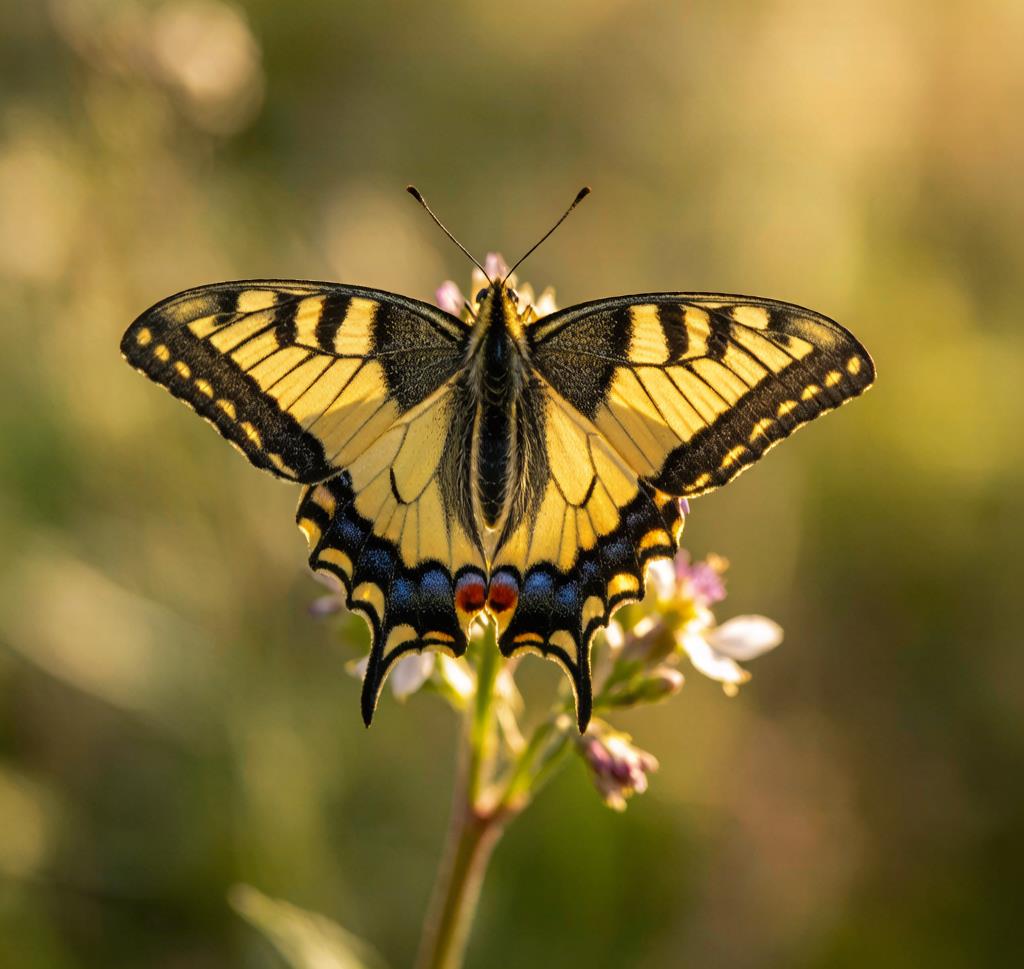
The Old World swallowtail (Papilio machaon) — named after Machaon, the legendary physician son of Asclepius in Greek mythology — is one of the most widespread and familiar butterflies in the entire world, found from the British Isles and western Europe across temperate Asia to Japan and the Russian Far East, and south through the Himalayas to northern India, China, and the mountains of North Africa. With a wingspan of 64 to 80 millimetres and wings marked with bold black veins and spots on a creamy-white to yellow background, with distinctive hindwings extended into elongated, swallowtail-like tails that give the species its common name, the Old World swallowtail is unmistakable and beloved by butterfly enthusiasts across its vast range. The species inhabits a remarkable diversity of habitats, from subarctic tundra in northern Scandinavia and Alaska to Mediterranean scrubland, alpine meadows, and the arid slopes of central Asian mountains. It is a strong, agile flier that can travel many kilometres in a single day, and individuals in northern populations are notable migrants that move south in autumn and return north in spring. As a pollinator and a conspicuous indicator of the health of wildflower meadows and grassland ecosystems, the Old World swallowtail serves as both a beautiful ambassador for insects and an important ecological indicator species.
## Physical Characteristics
The Old World swallowtail is a large, distinctive butterfly with a wingspan of 64 to 80 millimetres, though specimens from northern populations and high altitudes tend to be smaller, a phenomenon known as Bergmann’s rule. The upperside of the forewings is creamy white to pale yellow with bold black markings and veins, while the underside is similarly patterned with more extensive yellow colouring. The hindwings are predominantly yellow with bold black spots and margins and are extended into two elongated, sword-like tails — the source of the common name — the upper of which is typically longer and more prominent. The body is black with yellow spots on the sides. There is significant seasonal variation in appearance: summer brood specimens tend to be larger and paler with more extensive yellow on the hindwings, while spring brood and high-altitude individuals tend to be smaller, darker, and more heavily marked with black. The large, spherical eggs are pale yellow when laid and darken as they develop. The caterpillars are equally striking: bright green with bold black and orange transverse bands and a distinctive osmeterium — a forked, orange-red gland behind the head that can be everted to emit a foul-smelling mixture of terpenes and carboxylic acids when the caterpillar is threatened, deterring bird predators.
## Habitat and Distribution
The Old World swallowtail has the widest distribution of any swallowtail butterfly and possibly of any butterfly species in the world, found from Iceland and the British Isles east across Europe, North Africa, and the entire Palearctic region through Russia, Central Asia, China, and Japan to the Pacific coast of Asia. The northernmost populations are found in northern Scandinavia and the Far East, where the butterfly inhabits subarctic tundra and open birch woodland. In southern Europe and North Africa, it is found in Mediterranean scrubland, dry grassland, rocky slopes, and coastal cliffs. In Asia, it inhabits alpine meadows, steppe, semi-desert, and the edges of boreal and temperate forests, ranging in the Himalayas up to elevations of at least 3,500 metres. The species has been recorded as an occasional accidental vagrant in North America, with records from Alaska, Maine, Quebec, and Newfoundland, but does not appear to have established permanent populations in the New World. Habitat preferences vary regionally but typically include open, flower-rich grassland and meadow habitats with abundant larval host plants and nectar sources within easy flight range of each other.
## Life Cycle and Behavior
The Old World swallowtail completes two to three generations per year in temperate Europe, with the first adults emerging in April or May and subsequent generations in July and August. In northern Scandinavia and other cold-climate regions, only a single generation is produced each year, and the species overwinters as a chrysalis. In southern Europe and North Africa, the species can produce three to four generations annually. Eggs are laid singly on the upper or lower surfaces of the leaves of the host plant, and the caterpillars feed on the leaves and flower buds of a range of umbelliferous plants (family Apiaceae) including wild carrot, wild fennel, angelica, hogweed, and parsnip, as well as on the leaves of some members of the Rutaceae family including cultivated citrus in some parts of the range. Adult swallowtails are strong fliers and active foragers, visiting a wide variety of flower species to feed on nectar. They have a characteristic, sailing flight pattern, alternating bursts of rapid wingbeats with long glides, and males engage in hilltopping behaviour, concentrating on exposed hilltop and ridgeline locations where they wait to intercept passing females.
## Conservation
The Old World swallowtail is classified as Least Concern on the IUCN Red List and is considered abundant and widespread throughout most of its extensive range. However, the subspecies Papilio machaon subsp. brittonia, known as the Oregon swallowtail, which occurs in the Pacific Northwest of North America, is listed as a Species of Concern by the US Fish and Wildlife Service. The subspecies Papilio machaon subsp. asiaticus in Japan has experienced significant population declines in recent decades and is considered threatened in parts of its range. As an indicator species for the health of flower-rich grassland and meadow ecosystems, the Old World swallowtail provides a useful barometer of the ecological state of these increasingly threatened habitats, which are under pressure from agricultural intensification, urban development, and the widespread decline of wildflower populations driven by nitrogen deposition and changes in traditional land management practices.