 By Iris
Nepenthes attenboroughii | Attenborough’s Pitcher Plant
Species Profile · Nepenthaceae
Attenborough’s Pitcher Plant
A pitcher big enough to hold a litre, on one Philippine mountain.
Critically Endangered
Pitcher
Fluid
Altitude
Range
Plants
Rating
One mountain, one plant
A pitcher the size of a bottle
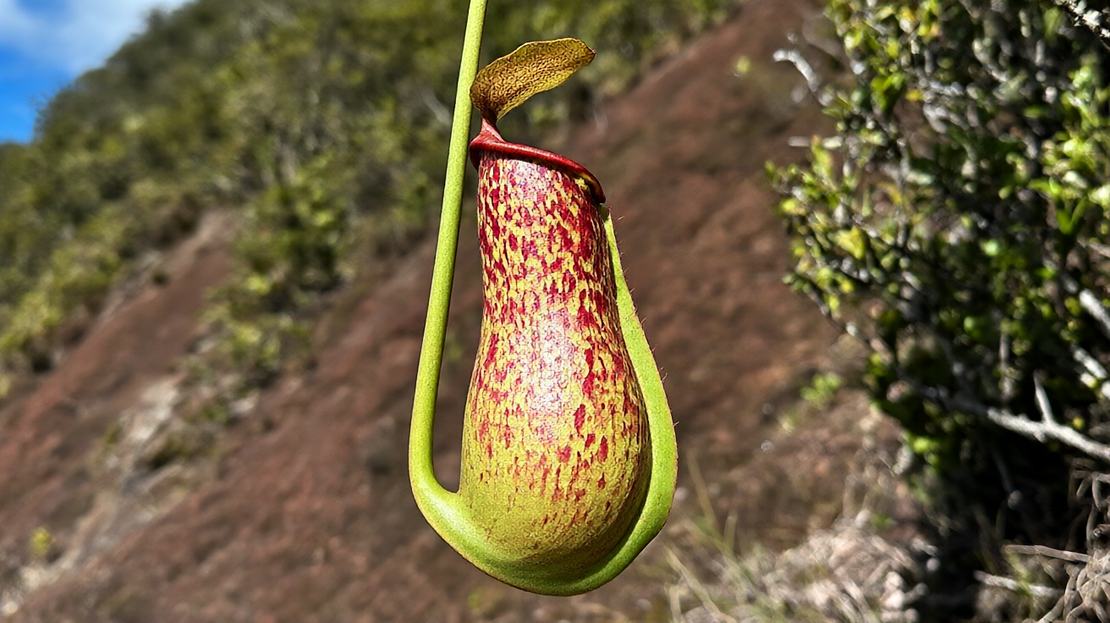
A single plant hangs a row of bell-shaped pitchers from a thick woody stem. Each pitcher holds about a litre of fluid. Insects fall in and drown, and the plant eats them. This is one of the largest pitcher plants on earth, and it grows on one mountain in the Philippines. This plant reached science only in 2007.
A team climbed Mount Victoria on Palawan after villagers reported giant pitchers. They found a plant new to botany. A formal description appeared in 2009, and the authors named it after David Attenborough. Pitchers on a strong plant can pass 30 cm in height, and the biggest ones outweigh every other pitcher plant on the whole island of Palawan. Some hold more than 1.5 L of fluid.
Nothing else on the summit grows quite like it. Every wild plant sits on a few ridges. That narrow range makes the plant easy to count and easy to lose.
Family tree
Nepenthaceae, a family of one genus
Nepenthes forms a genus of about 170 species, and all of them trap animals. Nepenthes sits in its own family, and the family has no close kin among common garden plants. Pitcher plants elsewhere, such as the North American cobra lilies, evolved the habit on separate lines. This species belongs to the group of giant mountain pitchers from Borneo and the Philippines.
Its nearest relative may be a plant from a neighbouring peak, although the link remains uncertain. Unlike the Rajah Brooke’s Pitcher Plant, which grows on a single Bornean mountain, this species holds a range of a few square kilometres. Both grow slowly, and both carry huge lower pitchers, since the soil on each peak is poor. Both were placed in the same group when the genus was last revised.
Botanists still argue about the exact branch, since the plants hybridise where ranges meet. That name honours a broadcaster rather than a botanist, which is unusual in the genus.
One genus, one family
How to tell one
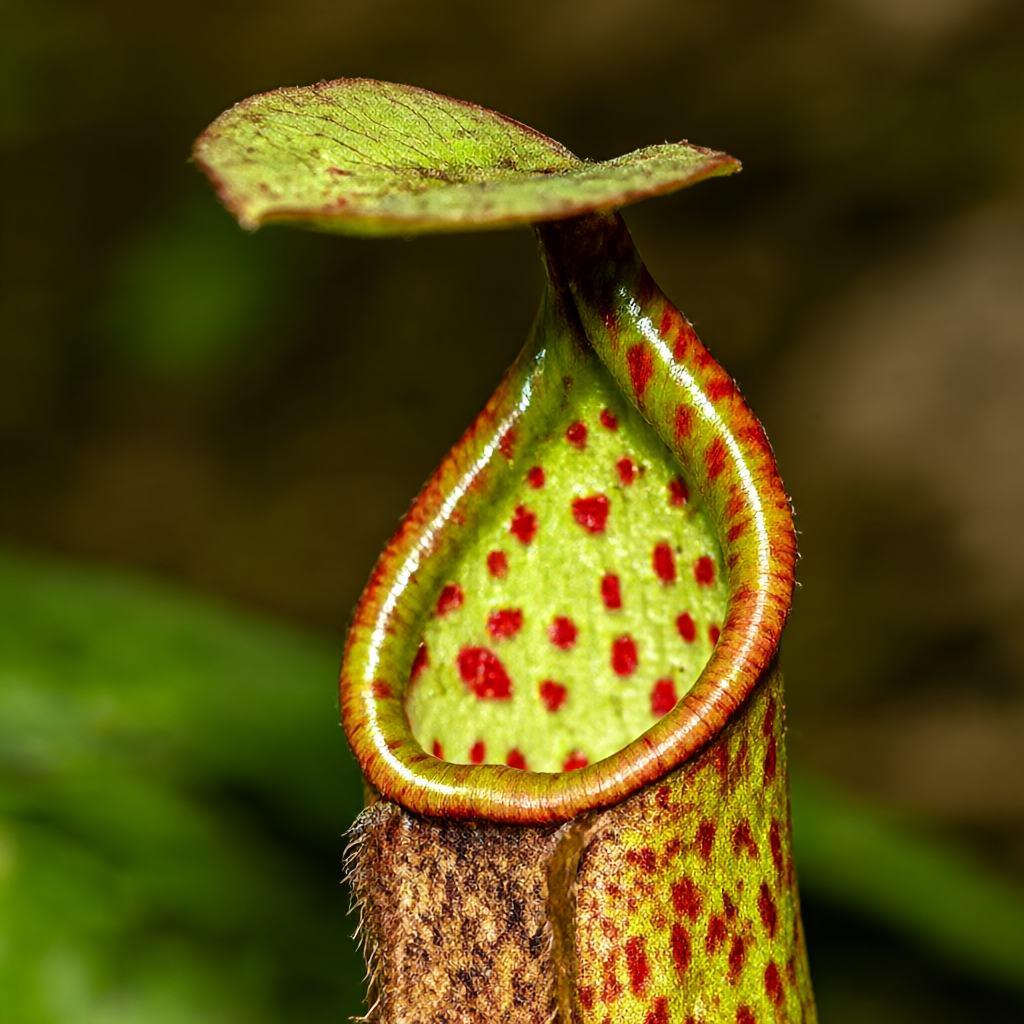
Lower pitchers are bell-shaped, with a narrow upright lid. Upper pitchers change shape, and they look like long funnels. Lower pitchers on strong plants reach 30 cm tall and 16 cm wide. Walls carry red speckles over a pale green ground. A ribbed rim runs around the mouth of each pitcher.
That rim stays slippery when wet, and insects lose their grip on it. Nectar glands sit under the lid, and they draw prey to the edge. Fluid in the pitcher holds enzymes that break down soft tissue. Stems grow woody with age. Old stems scramble over scrub.
Leaves are long and leathery, with a tendril at the tip. That tendril swells into the pitcher. Roots stay shallow, since the soil offers little.
1
2
3
Bell pitchers and a slick rim
Where it lives
Plants grow on the summit ridge of Mount Victoria, above about 1,500 m. Ultramafic rock forms the ground here, and it holds few nutrients. Soils also carry heavy metals, which most plants cannot tolerate. Moss and low scrub cover the slope.
Pitchers hang among them. Cloud passes over the ridge for much of the year, so the air stays wet and the pitchers never dry out. Rain feeds the pitchers, although the plant also catches its own. Strong wind strips water from leaves, and the plant grows slowly as a result.
Open ground suits the seedlings, since taller scrub shades them out. Landslides open fresh patches, and the plant takes them over fast. Fire rarely reaches this high ridge. The whole range covers only a few square kilometres of summit.
Ultramafic summit soil
What it eats
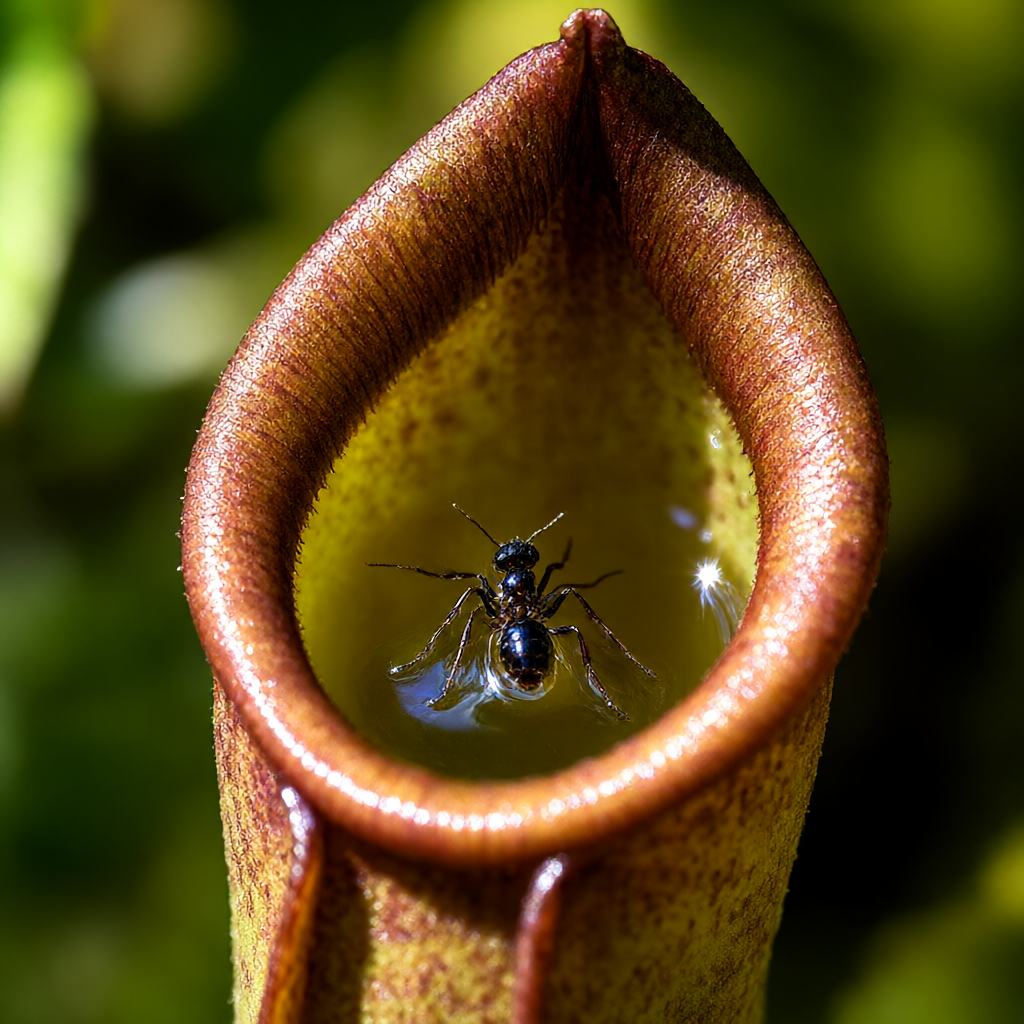
Insects form the main catch, and ants rank first. Flies, beetles and moths also fall in. Fluid drowns prey within minutes, and digestion takes days. Slurred remains drop to the bottom of the pitcher.
Some pitchers hold more than they can digest, and the upper parts rot. Larger animals sometimes fall in, and a few reports mention rats. No study has shown a regular diet of vertebrates, while a few rats do fall in now and then. Nitrogen comes from prey, which matters on poor soil.
Food from ants and flies keeps the leaves green. Older pitchers stop catching, yet the plant still takes what remains inside them. Rain dilutes the fluid now and then, so the plant tops it up with fresh enzymes from glands under the lid.
Ants, flies and beetles
The breeding cycle
Male and female plants grow apart on the ridge, and both flower. Few females set seed in any one year. Flowers sit on a tall stalk, and they carry no petals worth seeing. Wind moves the pollen between plants, although insects may also carry a little from one flower to the next.
Seeds are light and winged, and wind carries them a short way. Most seeds land on poor ground. Seedlings need open soil and steady moisture, so a dry spell kills most of them. A young plant probably takes several years to flower for the first time.
Growth stays slow, because the soil offers so little. New shoots appear now and then, and they hold a patch in place. Nobody knows how long a plant lives, although the woody stem suggests decades.
Critically Endangered, and dug up
Conservation
IUCN lists the species as Critically Endangered. Only 300 to 500 mature plants were counted on the summit soon after the find, although the total may have been higher then. Illegal digging poses the first threat, since growers pay well for a rare pitcher. Diggers take whole plants, and the summit is easy to reach on foot.
Damage follows the diggers, and a single trail can wreck a patch of scrub. Climate change may dry the cloud that keeps the ridge wet. Landslides and storms have always shaped this habitat, yet a small group recovers slowly. All Nepenthes species sit on CITES Appendix II, so trade needs permits.
Local wardens cover the mountain, and patrols have increased. Growing from seed now supplies some growers, which takes pressure off wild plants. Chances depend on the summit staying remote, since a single road would change everything.
Side by side
How It Compares
| Trait | Attenborough’s Pitcher Plant | Rajah Brooke’s Pitcher Plant |
|---|---|---|
| Pitcher | up to 30 cm tall, 16 cm wide | up to 41 cm tall |
| Fluid | over 1.5 L in big pitchers | up to 2 L |
| Altitude | above 1,500 m | 1,500 to 2,650 m |
| Range | one mountain on Palawan | Mount Kinabalu and nearby peaks |
| Prey | ants, flies and beetles | insects, and now and then rats |
| Rating | Critically Endangered | Endangered |
Common misreadings
What People Get Wrong
- Many people think the plant eats rats, yet no study shows a regular diet of them.
- A popular claim says the pitchers hold nectar, although the fluid holds enzymes.
- Some guides call the species secure, yet 300 to 500 mature plants were counted.
Going further
Sources and Further Reading
Quick hits
Five things to remember
- Formal description appeared in 2009.
- Lower pitchers can hold more than a litre.
- It grows on one mountain in Palawan.
- Botanists named it after David Attenborough.
- All Nepenthes sit on CITES Appendix II.