 By Iris
Anomalocaris canadensis | Anomalocaris
Species Profile · Anomalocarididae
Anomalocaris
Half a metre of soft hunter, from a sea older than trees.
Extinct
Length
Arms
Eyes
Flaps
Age
Status
Five hundred million years back
The first big hunter
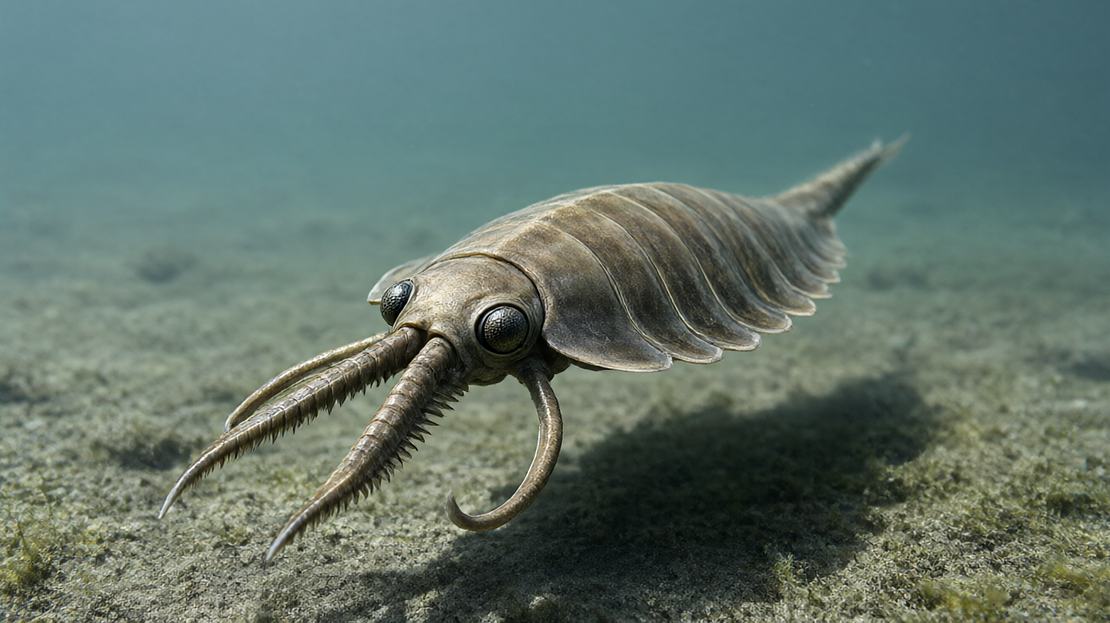
Half a metre of soft body swims through a warm sea, with two spiny arms held out in front. Nothing else in that water looks quite like it. This animal hunted in the Cambrian, more than 500 million years ago. Its name means strange shrimp, and the name still fits. Fossils come from the Burgess Shale in British Columbia, where fine mud buried whole bodies.
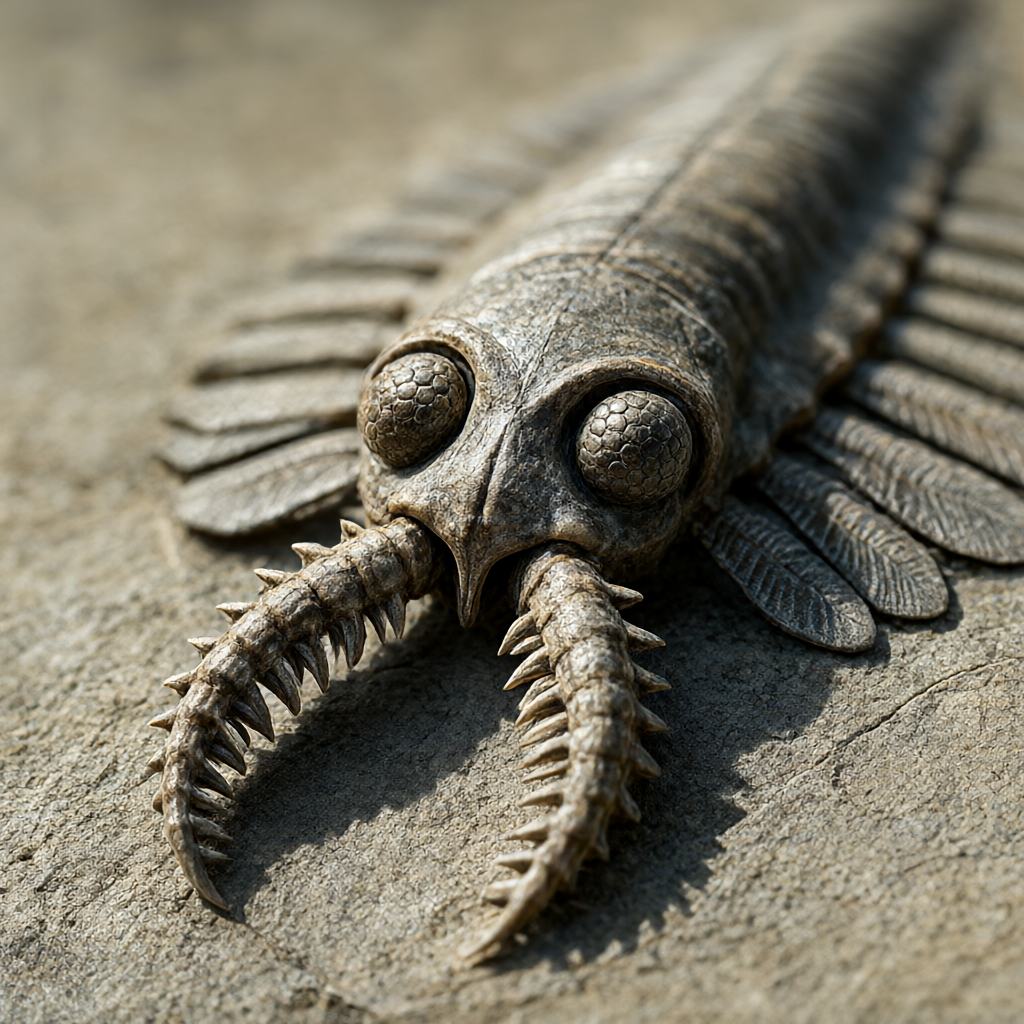
Soft parts survived as thin films on grey rock. Buyers now prize those slabs. A good specimen shows the arms, the eyes and the ring of plates around the mouth. Study of the animal changed how people read the Cambrian. Hunters of that size were not expected in such old rocks.
This hunter sat near the top of its food chain, although it carried no shell at all. Everything known about the creature comes from stone. Stone rewards patience.
Family tree
Anomalocarididae, the radiodonts
Radiodonta holds the species, and that group forms an early branch of the arthropod line. Those forms share a pair of spiny front arms and a round mouth. Anomalocaris canadensis was named in 1892 from a single arm, which the author took for a shrimp. Other pieces turned up later under other names, because nobody linked them.
A mouth became Peytoia, and a body became Laggania. Scientists then counted each part as its own animal. Work in the 1980s joined them up, so one animal had been split into three. True arthropods lie further along the same stem, since radiodonts branch off below them.
Its closest kin include a giant from Morocco that strained food from the water. Both share the same ring of mouth plates, although the Moroccan form grew far larger. Extinction came long before the first crabs appeared. No living animal sits in the group.
An arm, a mouth, a body
How to tell one
Adults reached about 38 cm, and some guesses run larger. Bodies were flat and soft, cut into many segments. Eleven pairs of flaps ran along each side, and the body swam by beating those flaps in a wave. A pair of spiny arms hung in front of the mouth, and each arm carried about 13 jointed segments. Short spines lined the inner edge of every segment.
A round mouth opened below, ringed by hard plates. Those plates worked like a slice of pineapple, and they could close on prey. Nothing in that mouth could crush shell, so hard prey had to be small to swallow whole. Two eyes sat on stalks at the front of the head. Each eye held up to 16,000 lenses, which is far more than a dragonfly carries.
Vision like that points to a hunter that needed to spot prey in open water. A tail of three flat blades helped it turn. Soft flesh hid most of the body, yet the plates around the mouth were hard.
1
2
3
Soft body, hard mouth plates
Where it lives
Warm shallow seas lay over much of the land during the Cambrian. Burgess Shale life lived on a steep mud slope below a reef. Storms pushed fine mud down that slope, and the mud buried bodies where they fell. Water above the slope stayed clear and lit, since the mud sank far below.
Algal mats spread over the sea floor in places, and they held a rich crowd of small animals. Sponges grew on the reef, along with brachiopods and early worms. Trilobites crawled over the mud nearby, and they are the animals most often shown beside it. Depth mattered less than mud, since the mud made the fossils.
Such animals lived in what is now China, Australia and Greenland. Warm seas across the world held the group, although cold water held none of them. Shallow shelves gave them both food and cover.
Mud slope below a reef
What it eats
Prey held worms and other soft animals that lived on the mud. Trilobites formed part of the diet at times, since their pieces appear in fossil droppings. Those droppings were once tied to this animal, although the link now looks weak. A 2023 study tested the arms against hard shell. Joints could not take the strain, and the spines bent under a load.
Soft food fits the animal far better, because the arms were built to hold rather than to break. Hunting meant swimming slowly above the mud and feeling for movement. Both arms could fold in and trap prey against the mouth. Small animals had little defence against a hunter of that size. Some victims went down whole, while others were torn apart first.
Shells of larger trilobites show wounds that healed, which means some attacks failed badly. A hurt trilobite lived on, although the scar stayed. Speed came from the flaps rather than the limbs, so the animal could not chase for long.
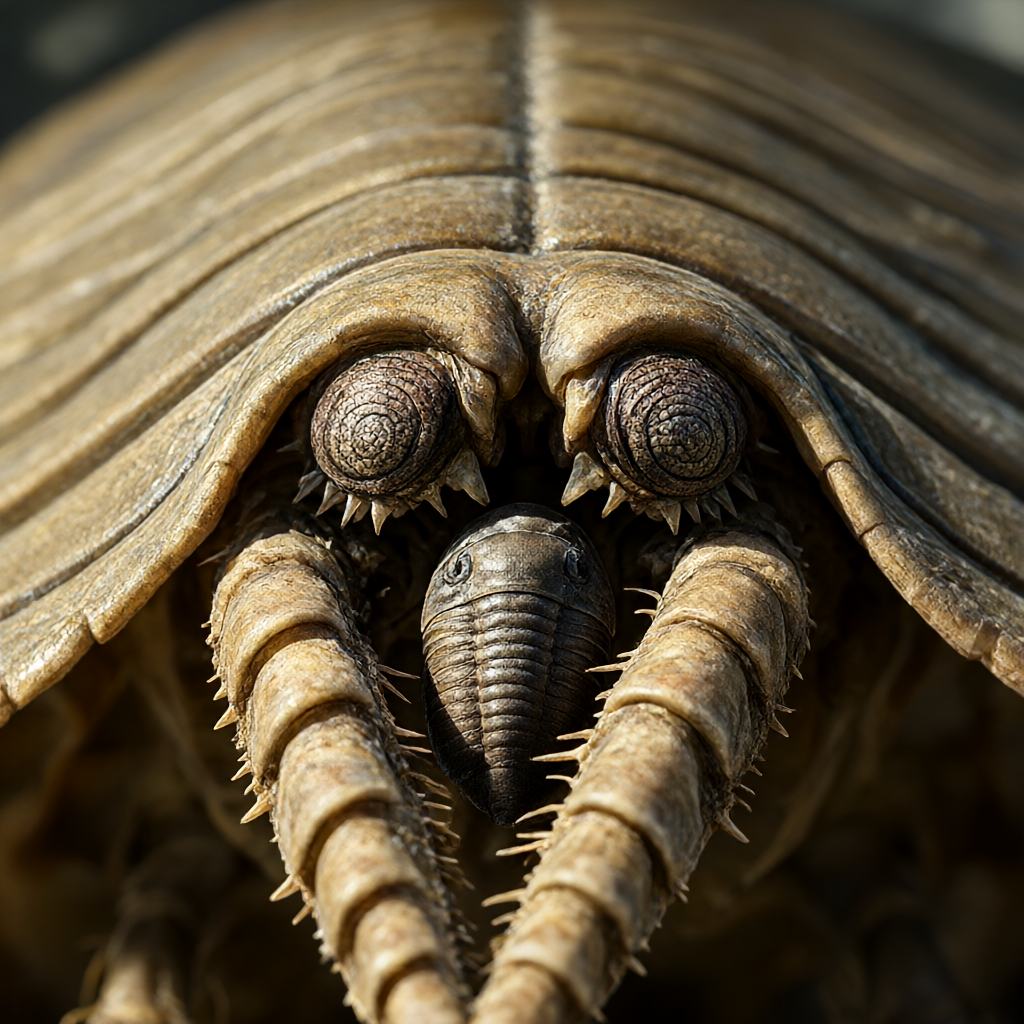
Soft prey, no shell
The breeding cycle
Movement came from the flaps, which beat in a wave from front to back. Hovering, turning and reversing all came easily. Most of its time went into slow swims near the sea floor. Eyes on stalks gave a wide view in dim water. Nothing faster lived in that sea.
Fossils show no sign of group living. Adults may have met only to breed. Young ones are almost unknown, and the larvae have never been found. Growth came in several moults. Moulting left the soft body bare for a time, which made it easy prey.
That risk shaped a short life, although the fossils cannot show how short. Breeding may have come in open water, although nothing in the fossils confirms it. Each moult left a few plates behind, and those scraps fill old drawers.
Gone before the first crab
Conservation
Nothing in the group survived the Cambrian. Radiodonts faded through the period, and none of them reached the next era. Rivals may explain the loss, since armoured arthropods grew larger and faster. Digging animals also changed the sea floor, and the soft mud crowd broke up. This species vanished about 500 million years ago.
Its line stopped there. Fossils remain the best record of an early hunter, since no living animal matches it. Prepared slabs fetch high prices, and illegal digging harms the sites. Parks in British Columbia guard the main beds. Fossil trading goes on, although the law now limits it.
Every new fossil adds detail. Nothing like this animal lives today, although the Atlantic Horseshoe Crab still shows the same flat, plated plan. Those crabs carry eyes of the same design, yet they are not close kin.
Side by side
How It Compares
| Trait | Anomalocaris | Atlantic Horseshoe Crab |
|---|---|---|
| Length | about 38 cm | up to 60 cm with the tail |
| Age | over 500 million years | about 450 million years |
| Eyes | 16,000 lenses on each stalk | compound eyes of about 1,000 lenses |
| Mouth | a round ring of plates underneath | a small mouth between the legs |
| Home | mud slopes of the Cambrian sea | sandy shallows of the Atlantic coast |
| Status | Extinct | Vulnerable |
Common misreadings
What People Get Wrong
- Many people picture a hard shell, yet the animal carried no covering at all.
- A popular claim makes it a shell crusher, although its arms bent under trilobite armour.
- Some books still show three animals, yet one animal had been split into three parts.
Going further
Sources and Further Reading
Quick hits
Five things to remember
- The name means strange shrimp.
- Two eyes held about 16,000 lenses each.
- Its mouth looked like a slice of pineapple.
- The arms could not crush trilobite shell.
- The group died out before the first crabs.