 By Iris
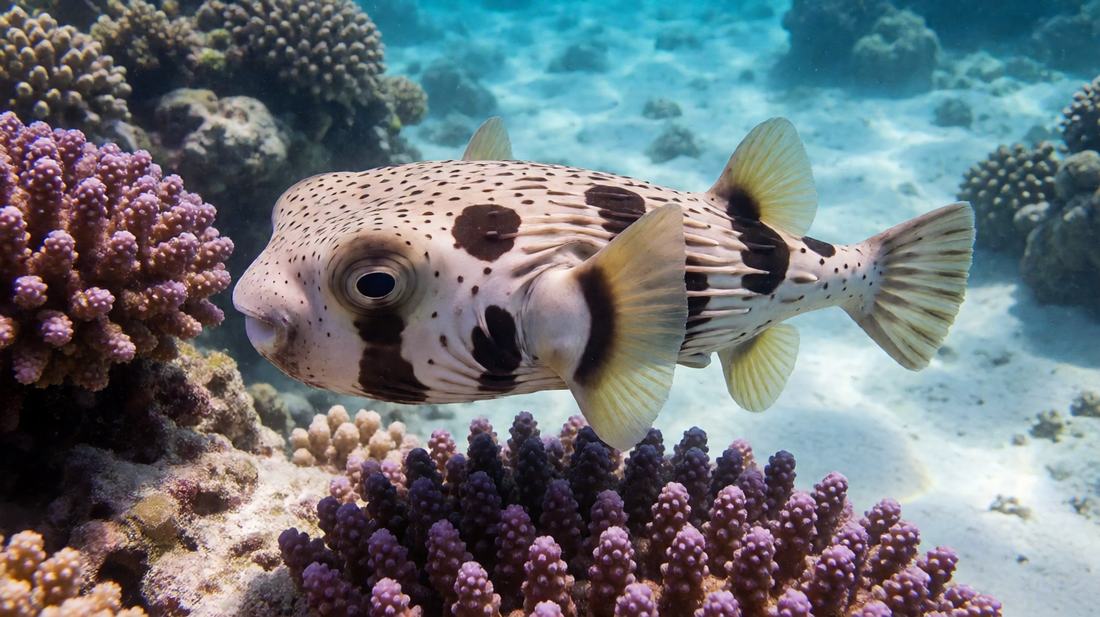
Diodon holocanthus | Porcupinefish
Species Profile · Diodontidae
Porcupinefish
A round fish that turns itself into a spiny ball, then goes back to hunting after dark.
Least Concern
Body length
Inflation
Spines
Beak
Hunting
Rating
A ball of spines on the reef
The fish that becomes a ball of spines
Porcupinefish are round, slow fish of warm seas. They drift over coral. By day they hide. Nothing about them looks fast. Long sharp spines cover the whole body.
Most of the time those spines lie flat against the skin. When a hunter comes close, the fish gulps water. It swells up fast. The spines lock outward and the small mouth shuts. Few predators can swallow a spiny mouthful, so most give up quickly.
That is the whole trick. These fish live in tropical and subtropical waters around the world. They appear on reefs, in lagoons and in muddy estuaries. Divers often find one hanging still beneath a coral shelf.
Family tree
Diodontidae, the porcupinefishes
Scientists know this fish as Diodon holocanthus. It belongs to the porcupinefish family, a small group inside the pufferfish order. Its closest kin is the Pufferfish, a softer relative that carries the same fused beak and the same poison. Pufferfish swell up too, although their skin carries small prickles rather than long spines.
Both groups have teeth fused into a single hard plate. That beak cuts through shell and coral without chipping. Its genus name means two teeth. The species name means blotched.
Early naturalists filed these fish with the globe fish, until later work moved them into a family of their own. Fossils from warm seas show that this same rounded body plan has lasted for millions of years without much change.
50 cm of spines and beak
How to tell one
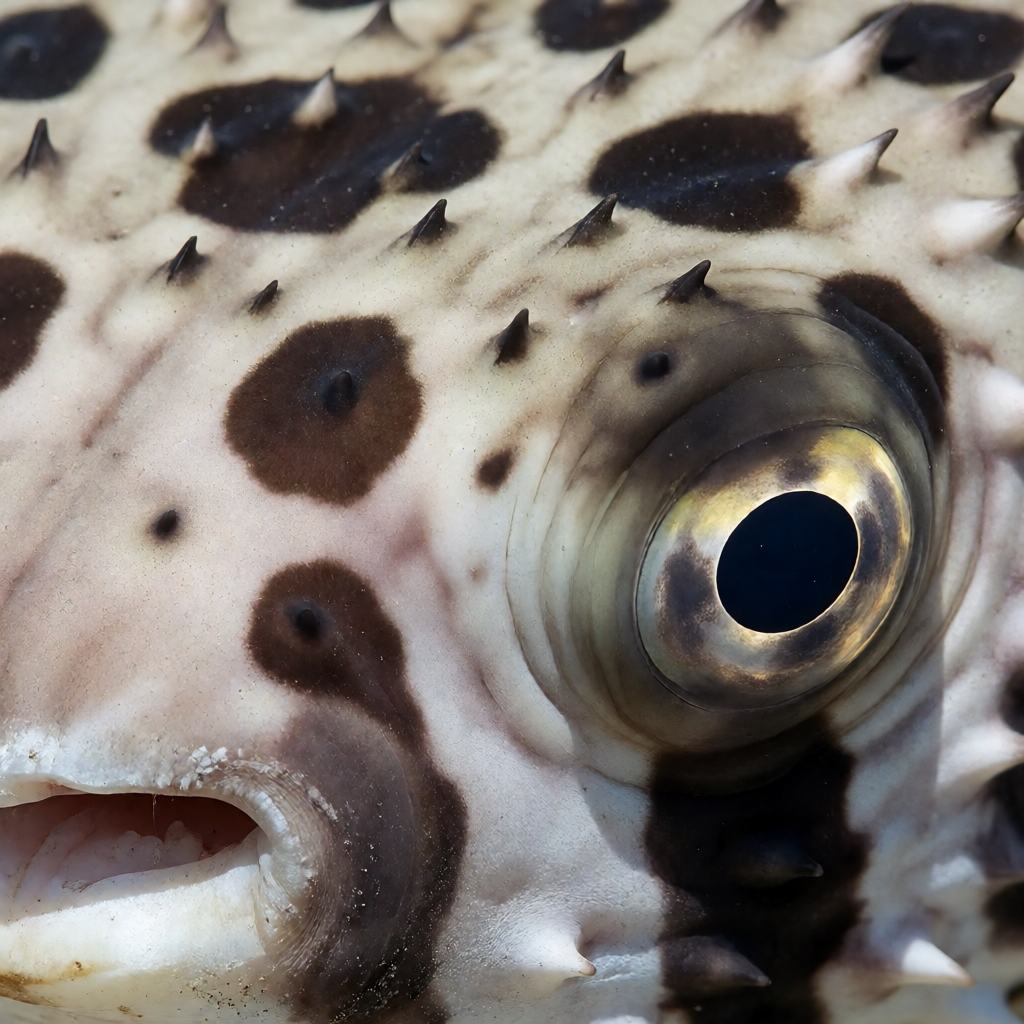
Adults reach about 50 cm, roughly the length of a forearm. Its body is oval, with small dark blotches. Each spine has two roots, which is why it stays upright when the fish inflates. Skin and organs carry tetrodotoxin, the same poison that protects pufferfish.
Big round eyes sit high on the head, above a blunt beak. There are no scales and no gill cover, only a small round opening behind the eye. The tail is short and stiff, and it gives a slow steady push rather than a burst of speed. Because the fins are small, it cannot swim away from trouble.
Instead it relies on armour, and on a shape that is hard to grip. Colour varies with age, and older fish carry fewer spots than young ones.
1
2
3
Warm reef sand and seagrass
Where it lives
The species ranges across the tropical Atlantic, Indian and Pacific oceans. Reefs, seagrass beds and sandy bottoms all hold them. Most sightings come from shallow water, yet a few fish range below 170 m.
In lagoons they drift among turtle grass, and in estuaries they tolerate muddy water that would choke most reef fish. Juveniles float in open water far from any reef. They stay pelagic until they reach about 7 cm long.
Only then do they settle. Because adults move so little, the same cave is often used night after night. A diver who returns to one ledge may meet the same fish for weeks, because adults move so little.
Shells crushed after dark
What it eats
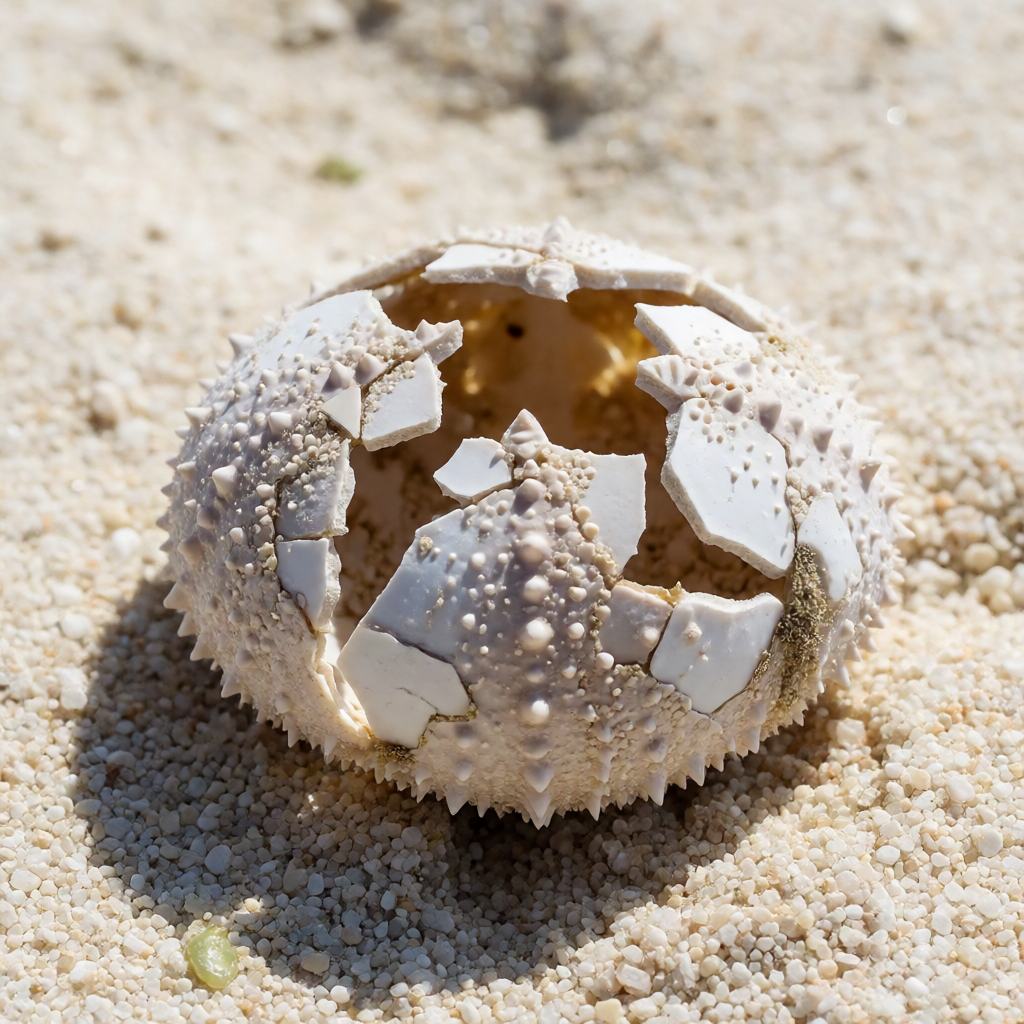
At night the fish works the sand with its beak. Sea urchins, crabs, hermit crabs and snails are its main food. Shells break easily under a beak that never stops growing.
Bare sand marks the spot. Prey is crushed rather than chewed, and the fragments are swallowed whole. Because urchins graze algae, these fish help keep reef surfaces open for coral.
A hungry fish may spend hours on a single patch of rubble. Few other reef fish can eat an urchin that large, so competition stays low.
Larvae drift before they settle
The breeding cycle
Spawning happens near the surface at dawn or dusk. Males gather around a female and press against her flank. Eggs and sperm are shed into open water, where they meet by chance.
A single female may shed thousands of small eggs in one season. The eggs float with the plankton, and most of them are eaten by small fish before they ever hatch. Larvae drift for weeks before they develop spines and settle.
Because so few young survive, adults spawn many times each year. Young fish look like small castles of spines, and they swim clumsily.
Least Concern, but often caught
Conservation
Red List officials place these fish in the least concern class. The species is widespread and no major decline has been recorded. Fishing pressure exists, yet it is mostly bycatch rather than a directed fishery.
Reef damage is a quieter threat, since these fish depend on coral and rock for shelter through the whole of their long lives. Pollution and coastal building remove the shallow nurseries where juveniles settle. In parts of Asia these fish are eaten, although the flesh must be prepared with care.
Because tetrodotoxin is not destroyed by cooking, careless kitchens kill people every year. Marine parks protect some reefs, yet most shallow habitat remains open to fishing.
Side by side
How It Compares
| Trait | Porcupinefish | Pufferfish |
|---|---|---|
| Home | tropical Atlantic, Indian and Pacific oceans | warm seas worldwide, mostly tropical |
| Length | 50 cm | 30 to 60 cm, a few to 1 m |
| Build | round body set with long spines | smooth leathery skin, almost free of spines |
| Colour | pale with small dark blotches | mottled brown above, pale below |
| Defence | spines stand up when it swallows water | swells too, but relies on poison in the flesh |
| Standing | Least Concern | Not Evaluated for most species |
Common misreadings
What People Get Wrong
- A common tale says a porcupinefish fires its spines at attackers, yet it cannot shoot anything. The spines are fixed in the skin and only stand upright when the body swells with water.
- Many people think the fish dies after it inflates, yet it simply pumps the water out and swims away. Inflation costs time and energy, so the animal uses it only when cornered.
- Divers often call every inflated fish a puffer, yet the two groups differ in one clear way. A porcupinefish carries long visible spines and a heavier jaw, while a puffer stays smooth.
Going further
Sources and Further Reading
Quick hits
Five things to remember
- A porcupinefish can double in width by drinking water.
- The spines stay folded flat until the body swells.
- Its beak grows for life, like the front teeth of a rodent.
- Young fish drift in open ocean until they reach 7 cm.
- Its poison is the same one found in pufferfish.