 By st20113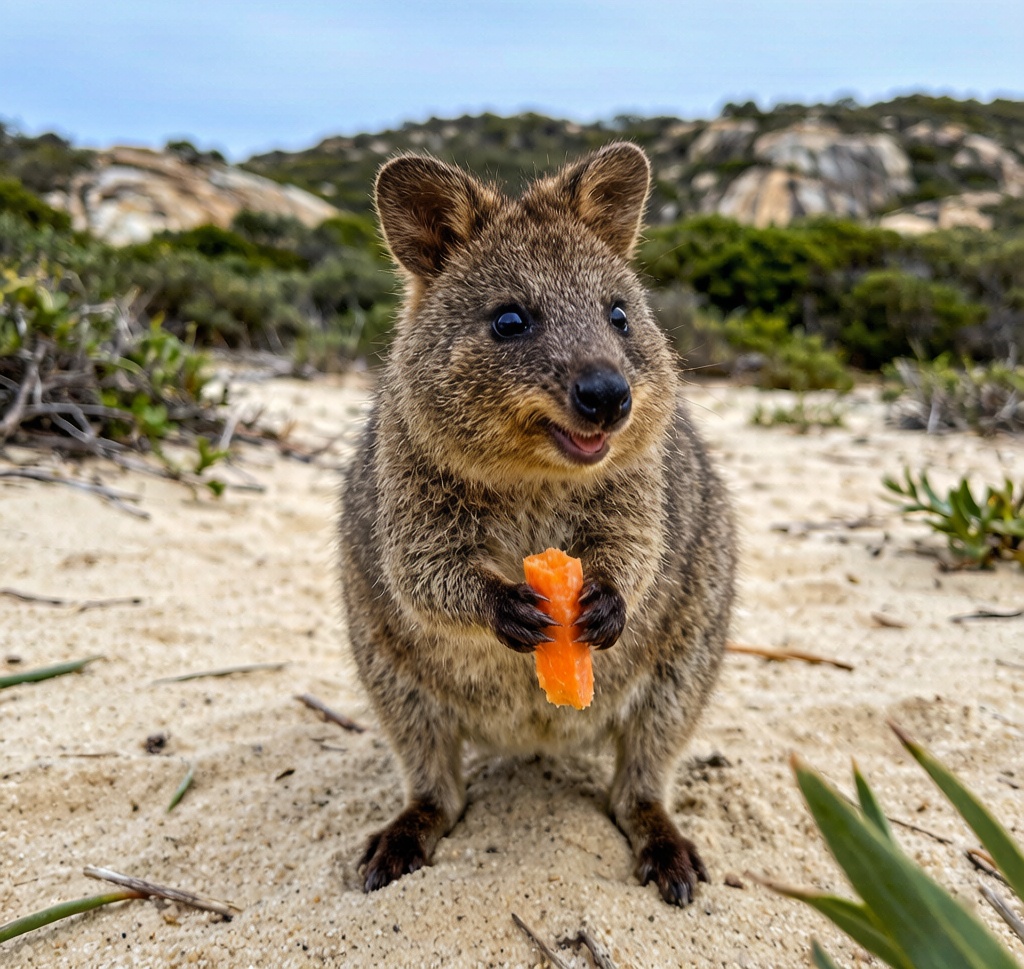
The quokka (Setonix brachyurus) is a small, round-faced marsupial from Western Australia whose perpetually cheerful expression has made it one of the most famous animals on the internet and a must-see attraction for tourists visiting Rottnest Island. Despite its fame as the “world’s happiest animal,” the quokka is a resilient and adaptable survivor: a nocturnal and crepuscular herbivore that has persisted in a landscape shaped by fire, drought, and introduced predators for millennia. Found primarily on Rottnest Island near Perth and on the mainland in southwestern Australia, the quokka plays an important ecological role as a seed disperser and grazer that shapes the structure of the understory vegetation in the banksia and woodland ecosystems it inhabits.
## Physical Characteristics
The quokka is a relatively small marsupial, with a body length of 40 to 54 centimeters and a weight of 2.5 to 4.5 kilograms. Its body is compact and thickset, covered in coarse, brownish-grey fur with a lighter, creamy-white underside and throat. The face is short and rounded, dominated by large, round, dark eyes set wide apart, and small, rounded ears. The quokka’s most distinctive feature is its seemingly smiling expression — a quirk of facial anatomy created by the shape of its mouth, which is permanently curved upward. The tail is relatively short compared to other wallabies, measuring 25 to 30 centimeters, and is semi-prehensile.
## Habitat and Distribution
The quokka is endemic to southwestern Western Australia. The largest and most well-known population inhabits Rottnest Island, a 19-square-kilometer nature reserve in the Indian Ocean off the coast of Perth. Smaller populations are found in select areas of the mainland, including the southern forests around Manjimup and the Stirling Range National Park. Quokkas inhabit dense, scrubby vegetation — typically banksia woodland, heathland, and swampy areas — that provides both food and shelter from predators. On Rottnest Island, the absence of foxes and the presence of abundant, year-round vegetation make conditions ideal for quokkas, which have been isolated on the island for approximately 7,000 years.
## Behavior and Diet
Quokkas are primarily nocturnal and crepuscular, resting during the heat of the day in dense vegetation or in burrows. Their diet consists primarily of grasses, herbs, succulents, shrubs, and the leaves and stems of various plants, including many toxic species that other animals avoid. Like many marsupials, the quokka has a low metabolic rate, which allows it to survive on a relatively poor-quality diet and to conserve water during periods of drought. On Rottnest Island, quokkas have become remarkably habituated to humans and will approach visitors, though touching or feeding them is prohibited by law.
## Reproduction
Quokkas breed year-round, with peaks in births during the Australian summer months of December to February. After a gestation of approximately 27 days, the female gives birth to a single, highly underdeveloped joey, which immediately crawls into the pouch and attaches to a teat. The joey remains in the pouch for approximately six months. Quokkas have one of the shortest active breeding windows of any marsupial of comparable size, with females capable of producing only one or two offspring per year. Sexual maturity is reached at approximately 18 months of age. Wild quokkas typically live five to 10 years.
## Conservation
The quokka is classified as Vulnerable on the IUCN Red List. While populations on Rottnest Island appear relatively stable, mainland populations have declined dramatically due to the introduction of predators — particularly the red fox and feral cats — as well as habitat clearing. Conservation efforts include fox and cat control programs, the protection and restoration of quokka habitat, and ongoing research into the genetic health of isolated mainland populations. Fire management is particularly critical, as hot wildfires can destroy the dense vegetation that quokkas depend on for shelter and food.