 By st20113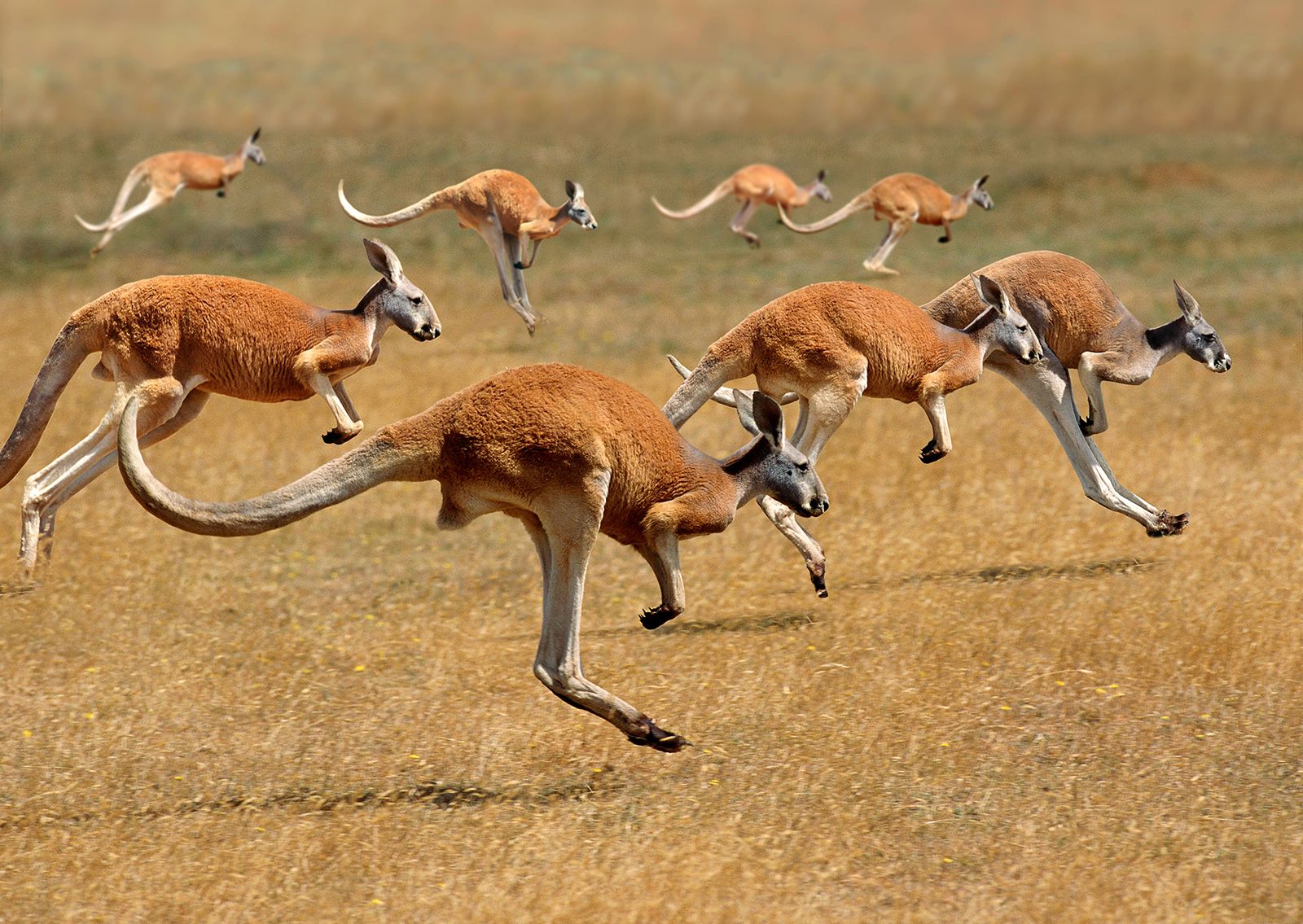
The kangaroo is a marsupial mammal native to Australia and New Guinea, belonging to the family Macropodidae (“big-footed”). Famous worldwide for their remarkable hopping gait and pouched young, kangaroos are central to Australia’s identity and play a key ecological role in their ecosystem as dominant grazers of open landscapes.
Physical Characteristics
Kangaroos have short forelimbs, enormously powerful hind legs, and a thick, muscular tail used as a “fifth limb” for balance and support. The largest species, the red kangaroo, can stand over 2 meters tall and weigh up to 90 kilograms. Their long feet and elastic tendons store energy like springs, making hopping an extraordinarily efficient way to travel-larger kangaroos actually use less energy the faster they hop.
Movement and Speed
Kangaroos cannot walk backward easily; instead they hop, reaching speeds of 20-25 km/h in sustained travel and up to 70 km/h in short bursts. The tail provides thrust during slow “pentapedal” movement, where the forelimbs and tail act together to propel the body forward while the hind legs swing.
Reproduction and the Pouch
Like all marsupials, kangaroos give birth to tiny, underdeveloped young that crawl into the mother’s pouch to nurse and continue developing. A female can simultaneously support a tiny newborn in the pouch, a older joey at foot, and a dormant embryo paused until conditions improve-a process called embryonic diapause that lets populations respond quickly to rainfall and food.
Diet and Habitat
Kangaroos are herbivores that graze on grasses and shrubs, mostly feeding at dawn, dusk, and night to avoid heat. They inhabit diverse environments from arid outback to coastal woodlands. Their selective grazing influences plant composition and helps recycle nutrients across the landscape.
Conservation and Human Interaction
Most kangaroo species are abundant, though some smaller relatives are threatened by habitat loss and introduced predators such as foxes and cats. Kangaroos are managed through regulated harvesting and protected in national parks. As climate shifts bring longer droughts, understanding their water and food needs grows ever more important.
Kangaroos are a flagship of Australian wildlife, blending evolutionary ingenuity with ecological importance. Their continued presence across the continent reflects the health of some of the world’s oldest grassland and woodland systems.