 By Iris
Janthina janthina | Violet Sea Snail
Species Profile · Epitoniidae
Violet Sea Snail
A small violet snail that sails the open ocean on a raft of its own bubbles.
Not Evaluated
Shell width
Colour
Raft
Food
Sex
Rating
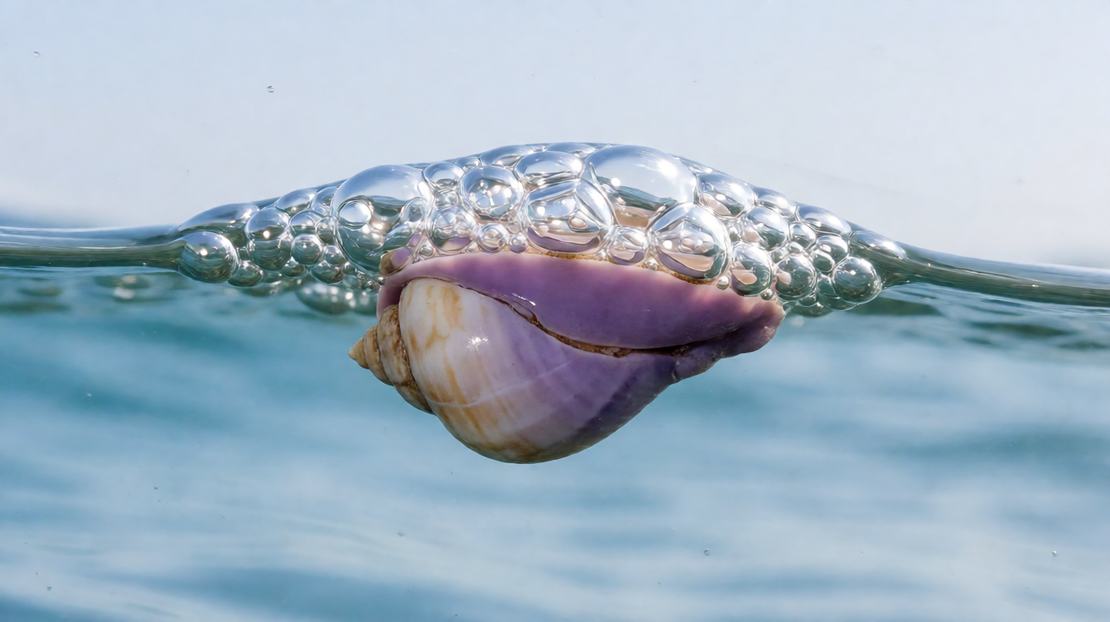
A raft of bubbles at the surface
The snail that sails on a raft of bubbles
A violet sea snail floats upside down. The snail never swims. Instead it builds a raft of bubbles. That raft holds the shell at the surface. Below, the shell shines.
Above, it is pale and almost white. That split colour hides the animal from both sides. It rides the current for its whole life, and it cannot steer or swim against any flow. Wind and tide carry it onto beaches, where the empty shells collect in long purple drifts. Most people meet the species as an empty shell lying on wet sand.
Few realise the animal was a hunter of floating jellies. Such a snail is small, fragile and easy to miss. Nothing about it looks dangerous, yet it feeds on animals that carry stinging cells.
Family tree
Janthinidae, the violet snails
Science knows the snail as Janthina janthina. It belongs to a small group of floating sea snails. Its closest kin here is the Portuguese Man o War, a drifting colony that also rides the wind and stings anything it touches. Both animals live at the surface, yet they are built very differently.
One is a colony, while the other is a single animal in a shell. Its genus name comes from a Greek word for violet. Early naturalists placed the group near the whelks and the slipper shells, and that view held for well over a century. Modern genetic work moved them into the wentletrap family, which surprised many people.
Its shell is thin and breaks easily, and the animal cannot repair a crack of any size. No shell can be repaired.
3 cm of thin violet shell
How to tell one
Its shell is a flat coil of two or three whorls. Adults measure about 3 cm across, though most stay smaller. Males stay smaller still. That lip is paper thin and chips at a touch. Violet covers the base, while the top fades to white.
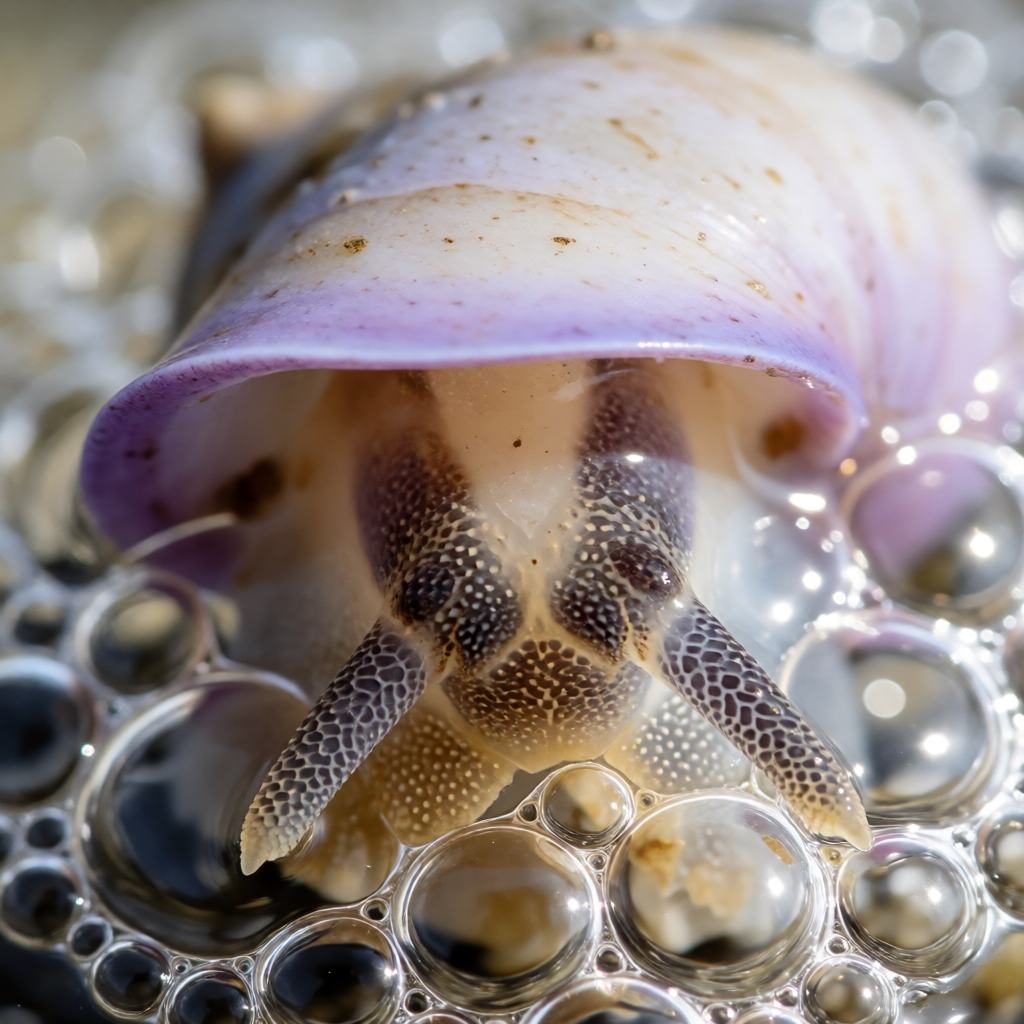
Its body is soft and pale, with a small head. A wide foot makes the mucus that holds the bubbles. This raft grows as the snail adds bubbles from below, and it can be as long as the shell is wide. Each bubble is coated in mucus, so the foam lasts for days. Because the animal hangs beneath the raft, its violet shell points straight down.
It has no way to paddle, since it has no fins and no muscles for swimming. It can only drift where the water and the wind send it, so every storm is a risk. Stranded snails die within hours. Once dead, the raft collapses and the shell washes away on the next tide.
1
2
3
Warm seas, drifting with the wind
Where it lives
This species lives in warm and tropical seas. Drifting takes it through the Atlantic, the Indian and the Pacific oceans. The Mediterranean also holds a population, although numbers there are small. Drift is their only travel.
Animals stay at the very surface, where the air and the water meet. Calm weather suits them best, since a rough sea breaks the raft. They gather where floating jellies collect, often along current lines. Onshore winds push them ashore in hundreds, and the shells line the tide mark.
A single storm can strand a whole generation on one stretch of beach. Colonies of floating jellies act as a moving food supply, so the snails follow them across open water. Few of these snails ever touch rock or sand while alive.
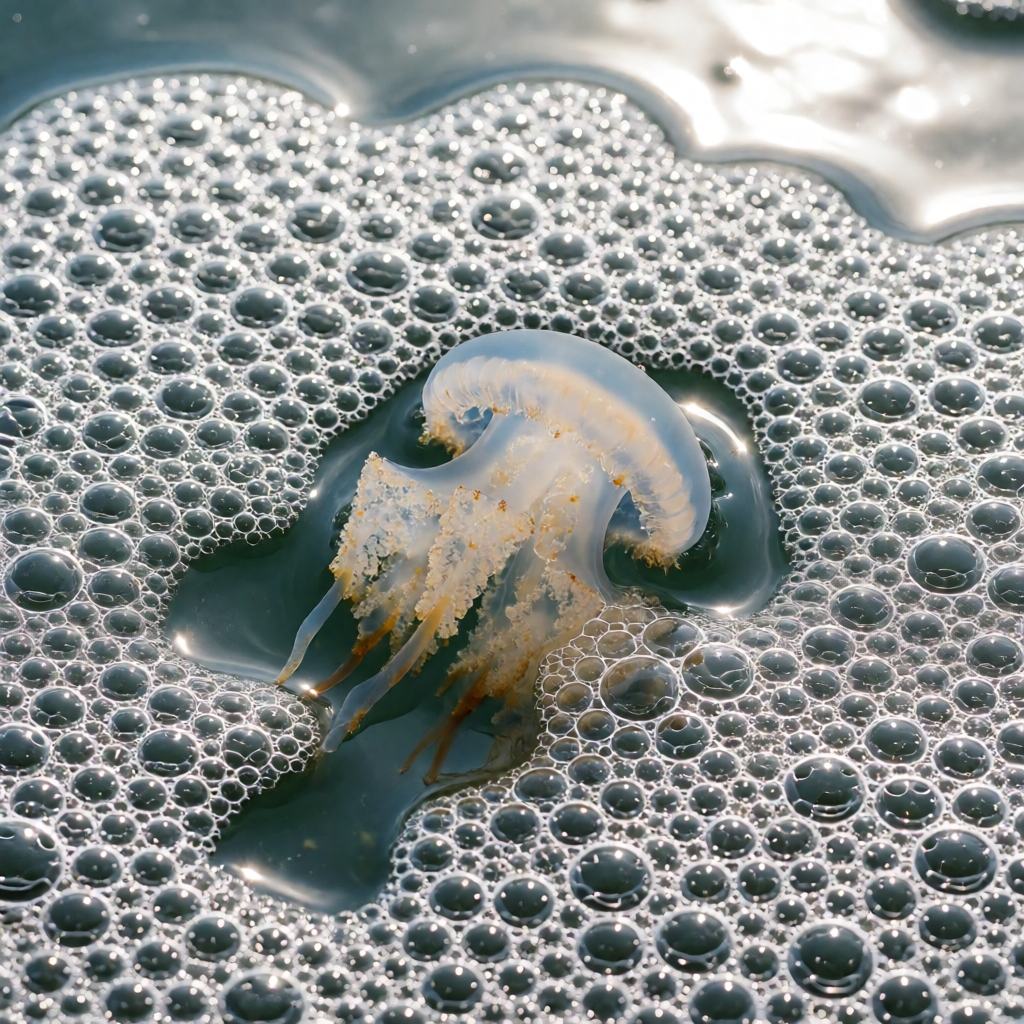
Jellies caught at the surface
What it eats
This hunter eats floating jellies. It takes by-the-wind sailors, blue buttons and the man o war. These prey animals sting, but the snail seems to feel nothing at all. A long proboscis reaches into the prey and cuts out soft tissue.
The snail eats the flesh and leaves the stinging threads behind. The meal is soft. Because the meal drifts, the hunter never has to chase it. A large jelly can feed the snail for several days, and the shell grows during that time.
Some prey defend themselves with long tentacles, yet the snail works around them and takes only what it needs. When food is scarce, growth stops and the animal simply waits for the next bloom.
Eggs brooded under the raft
The breeding cycle
Each snail begins life as a male. Later it becomes female, since the male organs fade first. That change happens once, and it cannot be reversed.
Eggs are laid in capsules under the raft. A female may carry hundreds of capsules at one time. Larvae hatch into open water and drift with the plankton for weeks before they build a raft of their own.
Because the young are so small, most are eaten long before they grow a shell. Survivors build their first raft within weeks, and the cycle begins again. No parent cares for the young after hatching, and most never reach a second year.
Not Evaluated, but common
Conservation
No Red List entry covers the species. Its range is huge and its numbers are hard to count. Plastic is a growing problem, while warming water shifts the whole food web. The shells are light.
Beads and fragments collect in the same current lines as the rafts. A snail that swallows plastic gains no food and may starve. Warming water is shifting the range of its prey, and the snail must follow. Because the animal drifts, no reserve can protect it.
Shells on a beach are the main record that scientists have, and volunteers now count them each year. This species is still common, yet its future depends on the health of the open sea and its drifting prey.
Side by side
How It Compares
| Trait | Violet Sea Snail | Portuguese Man o War |
|---|---|---|
| Size | 3 cm across the shell | float about 30 cm, tentacles many metres |
| Body | one snail in a coiled shell | a colony of many small animals |
| Colour | violet below, white above | blue and pink, pale on top |
| Food | floating jellies | small fish stunned by stings |
| Floating | a raft of bubbles it builds itself | a gas filled float it cannot steer |
| Danger | harmless to people | stings that send swimmers to hospital |
Common misreadings
What People Get Wrong
- A common tale says the snail steals its raft from weed, yet it makes the bubbles itself. The snail traps air in mucus, and the raft drifts with wind and current.
- Many people think the violet colour is a warning, yet the shell is paler on top. Seen from above it fades to white, so a hunting bird has less to notice.
- Beachgoers often blame the snail for a sting, yet it cannot sting at all. It eats floating jellies that do sting, and it takes nothing from them.
Going further
Sources and Further Reading
Quick hits
Five things to remember
- Its shell is violet on the bottom and white on top.
- A raft of bubbles can hold the snail for weeks.
- Blue dragons eat these snails and reuse their prey’s stings.
- Its name comes from the Greek word for violet.
- Empty shells often wash up in drifts after gales.