 By st20113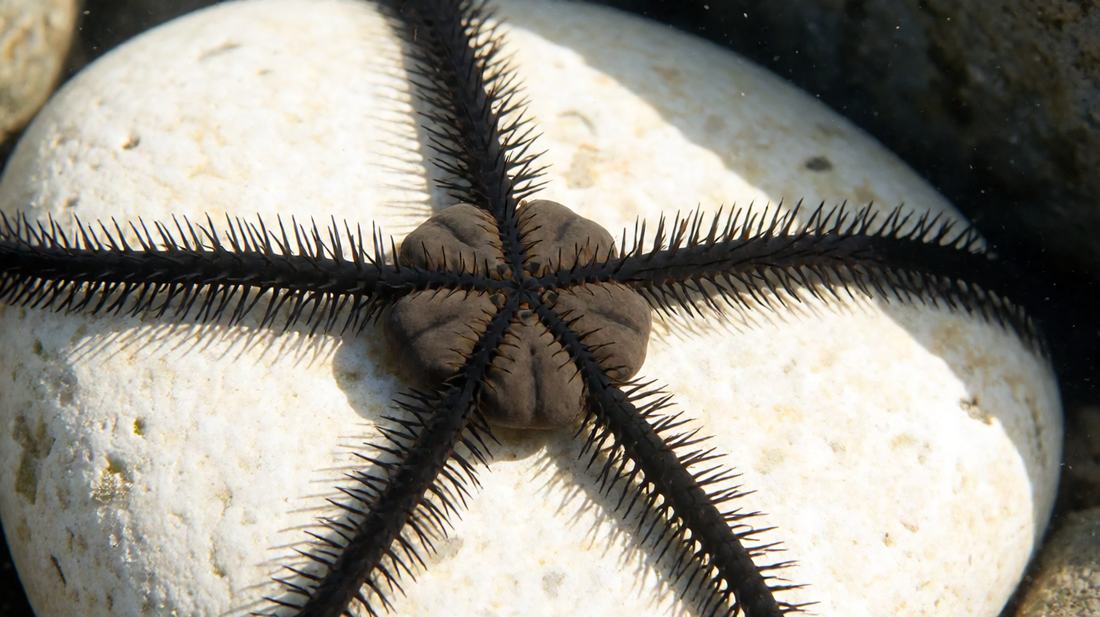
Ophiocomina nigra | Black Brittle Star
Species Profile · Ophiocomidae
Black Brittle Star
A dark star of rock and gravel that has no head and no brain, and that catches drifting scraps on a net of spines held up in the current.
A black brittle star that catches food on the spines of its arms
Disc
Arms
Colour
Spines
Brain
Depth
The black brittle star
A dark star of rock and gravel
The Black Brittle Star is a dark, spiny animal of rocky ground. It is 1 of the brightest light makers of the shallow sea. It shares the seabed with other brittle stars. The animal has a small round body and 5 long arms.
The arms carry fine spines, and the animal rows them to move. It can climb over rock, and it can also swim a short way. Its arms break off with ease. A predator often gets only 1 of them.
The animal then grows a new arm. Few people know it, but the seabed is full of it.
Family tree
Ophiuroidea, Ophiocomidae
The Black Brittle Star is an echinoderm, and it sits in the class Ophiuroidea. Its order is the Ophiurida, and its family is the Ophiocomidae. Brittle stars are close kin of the starfish. They share the same 5 part body plan.
It shares the seabed with the Common Brittlestar of the same waters. That animal is far lighter in colour. The 2 species feed in much the same way. The brittle stars are an old group.
Their fossils lie in rock of the Palaeozoic era. More than 2000 species of the group live in the sea today.
5 long arms and a grainy disc
How to tell one
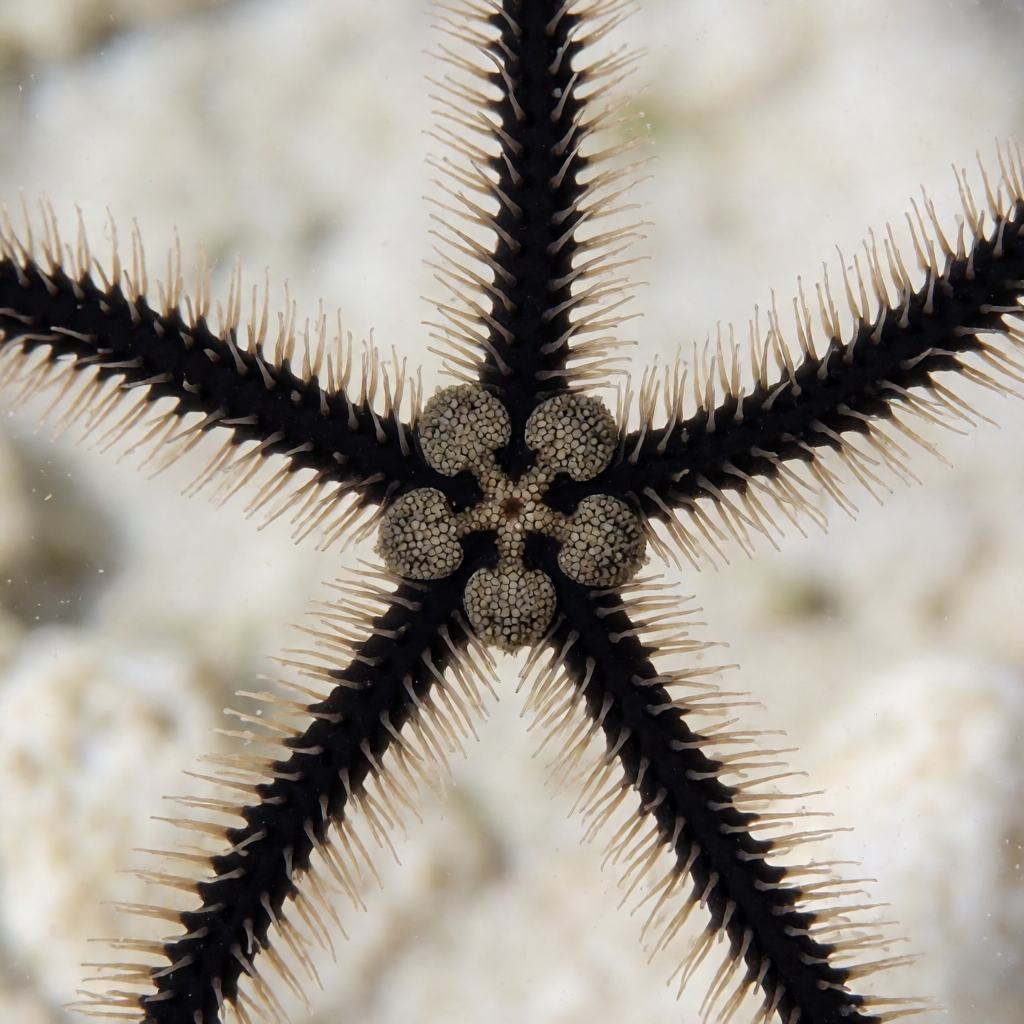
The disc is small and round, and it measures up to 3 cm across. The 5 arms are long, and one arm may reach 12 cm. The colour is dark brown or black. The disc carries a grainy cover of small plates.
Each arm carries a comb of pale spines. Those spines work like a net on drifting food. The animal has no head, and it has no brain. The mouth lies on the underside of the disc.
The body holds a set of water filled tubes. The feet are short, and the animal uses them to smell.
1
2
3
Under stones and in gravel
Where it lives
The species lives on rock, on gravel and on kelp holdfasts. It keeps to shallow water. It is common from the low tide line down to about 100 m.
It is found from Norway down to the Mediterranean. It hides by day under a stone or in a crack. At night it climbs out and feeds.
The species gathers in dense groups, and one stone may carry many animals. It needs a steady current, because the current brings food. Cold water suits it, and it avoids estuaries.
Scraps caught on the spines
What it eats
The Black Brittle Star is a feeder of chance. It eats almost any small animal or scrap that it can reach. It also takes fine organic matter from the bottom. It raises its arms into the current.
It catches drifting food on the spines. Mucus on the arms holds the food. The feet then move it to the mouth. The animal also feeds on dead animals.
It feeds at night, and it hides again before dawn. The species helps to clear dead matter from the seabed.
Cells released into the sea
The breeding cycle
The sexes are separate in this species. In summer the animals shed eggs and sperm into the sea. The eggs are fertilised in the water.
The larva drifts with the plankton for several weeks. It then settles on the seabed, and it takes the shape of a small brittle star. The young animal grows slowly.
If an arm is lost, a new one grows in its place. The new arm is often smaller than the rest. The animal may live for several years.
Trawls and dirty water
Conservation
The Black Brittle Star has not been assessed by the IUCN. It is common over much of its range, and no one counts it. It has no legal protection, and it is not fished.
Most of the risks come from the seabed itself. Trawls and dredges crush the groups. Pollution and low oxygen also harm the animal.
The species does well on rough ground, because gear cannot work there. Scientists study its light, and the work may help medicine. For now the animal is safe, and its future needs watching.
Quick hits
Five things to remember
- It gives out a bright green light when it is disturbed.
- Its disc measures up to 3 cm, and its 5 arms may reach 12 cm.
- Its arms break off with ease, and the animal then grows new ones.
- It lives from the low tide line down to about 100 m.
- More than 2000 species of brittle star live in the sea today.