 By Iris
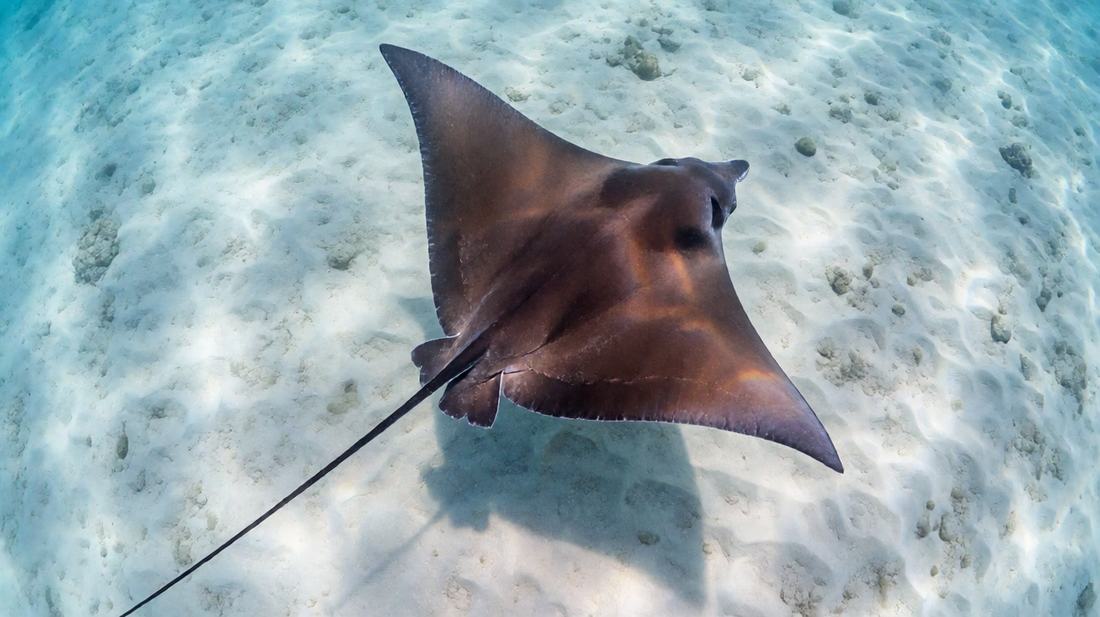
Myliobatis aquila | Common Eagle Ray
Species Profile · Myliobatidae
Common Eagle Ray
The ray that swims like a bird — a broad diamond with a head that stands clear of its wings, and flat crushing plates built for shellfish.
Near threatened in the Mediterranean
Range
Disc
Head
Depth
Young
The ray that flies through water
A kite, with a beak
The Common Eagle Ray is the most graceful swimmer among the rays of European waters. Its shape is unlike that of any of its relatives. Most rays are flat, rounded animals that ripple along the seabed. The eagle ray is built like a kite with wings. Its body forms a broad diamond. The 2 pectoral fins make up the sides of that diamond. They are long, angular and sharply pointed.
The head is the key to the whole design. In most rays the head is merged into the flat disc of the body. In the eagle ray the head stands out in front of the wings. The eyes sit on the sides, so the animal has a distinct snout. It has a beak-like profile, and that is what gives the family its name. The ray swims by beating its great wings up and down. The strokes are slow and powerful.
It moves through the water like a bird rather than like a fish. A full-grown female can reach a disc width of 180 cm. She can weigh more than 15 kg, though most of the animals seen are much smaller. The species lives in the eastern Atlantic and the Mediterranean. It lives over sand and mud in shallow coastal water. It feeds on the shelled animals that live buried in the seabed.
Family tree
Myliobatidae, the eagle rays
The Common Eagle Ray sits in the family Myliobatidae, the eagle rays, and in the genus Myliobatis. Linnaeus named it in 1758, when it was placed among the skates. The family holds about 40 species. It is defined by the shape of the body and by the way the animals feed. The pectoral fins are joined to the head, and the head itself stands clear of the disc. The teeth are not pointed but flat. They are set in a row of plates that works like a paving stone. Those plates are made for crushing shells.
The family sits in the great group of cartilaginous fishes. Their skeletons are made of soft gristle rather than bone. That group also holds the sharks, the skates and the other rays. Nearly all of its members give birth to live young rather than laying eggs. The genus Myliobatis holds the eagle rays of the world’s warm and temperate seas. The Common Eagle Ray is the species found in European waters. Its genus name comes from the Greek words for mill and ray. The flat crushing teeth look like a millstone.
The species name aquila is Latin for eagle. It refers to the pointed wings and the beak-like head. The Common Eagle Ray shares its group with the Common Stingray. That is a much flatter animal of the same coasts. The 2 swim in very different ways and eat different things. But they belong to the same broad group of rays.
Diamond disc, clear head
How to tell one
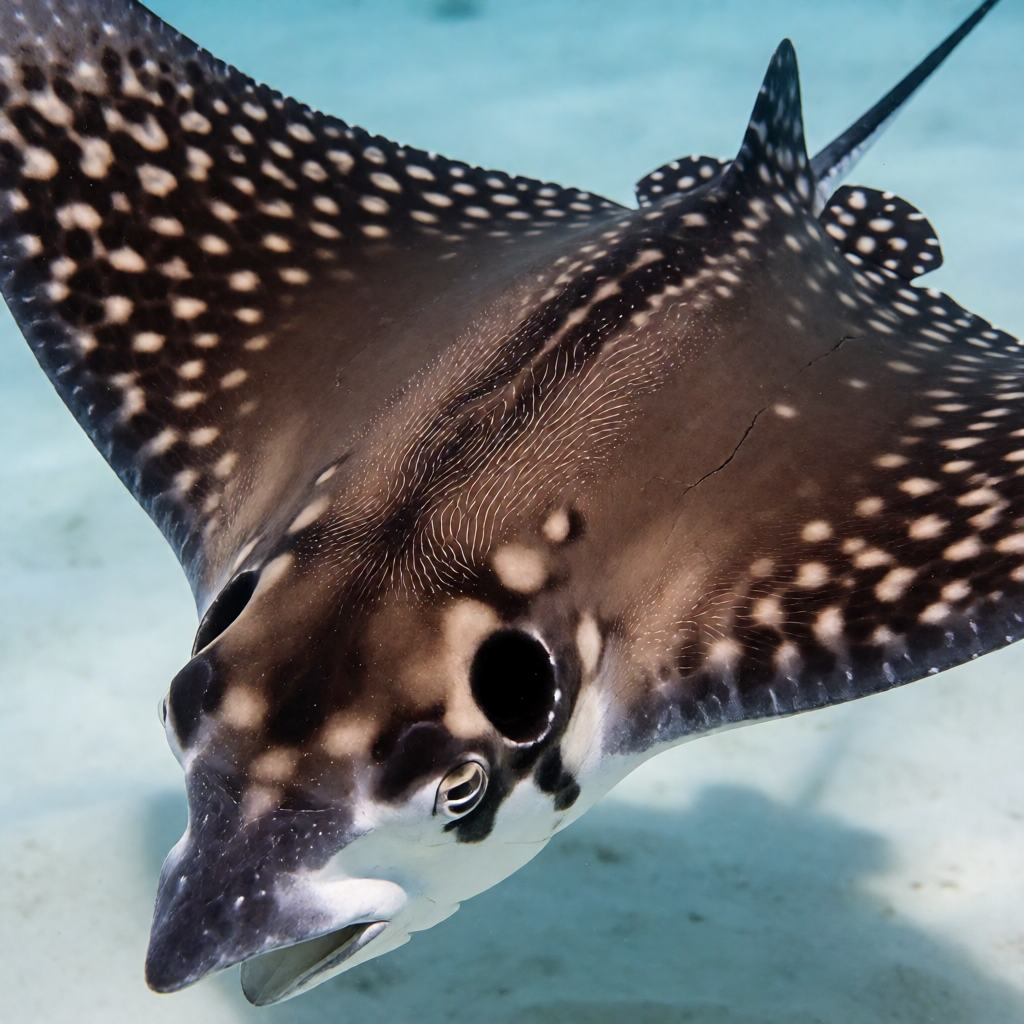
The Common Eagle Ray has a body built as a broad diamond. The disc can reach 180 cm across in a large female, and males stay smaller. The wings are long, angular and pointed at the tips. Their front edges run straight back from the head rather than curving. The head stands forward of the wings. The eyes and the large openings behind them sit on the sides of the head rather than on top.
Under the snout is the mouth, and inside it are the flat crushing plates. The colour of the upper surface is a dark brown, olive-brown or grey-brown. It is often scattered with small pale spots that are different in every animal. The underside is white or cream. The tail is long, thin and whip-like. In a large animal it is longer than the body.
Near the base of the tail sits a small fin. Most animals also carry a small serrated spine, which can be used in defence. The skin of the upper surface is smooth. That smoothness has always made the species valuable to leather workers. The ray has no swim bladder. It keeps itself off the bottom by the lift of its wings, and by the oil stored in its large liver.
1
2
3
Bays, estuaries and the shallow shelf
Where it lives
The Common Eagle Ray lives in coastal water. It is found from the shoreline down to about 200 metres, and it is most often seen in the top 100 metres. It prefers a bottom of sand, muddy sand or fine gravel. It is a common animal of bays, estuaries and the shallow shelf. It is found along the eastern Atlantic from the British Isles and the southern North Sea south to South Africa. It is also common throughout the Mediterranean.
In southern Britain and Ireland it is a rare visitor, and most records come from the south-west. The species is a strong swimmer. It is often seen cruising a metre or 2 above the seabed rather than resting on it. It travels alone or in small groups. Shoals of several dozen animals have been reported in the Mediterranean in summer. The ray is a warm-water animal at heart.
It moves into shallower water in spring and summer, and back into deeper water in winter. Young rays live in very shallow bays, and those nursery areas are important to the species. The eagle ray is a shy animal. It usually swims away from a diver at a steady pace rather than darting off. It is also known to leap clear of the surface. A ray that falls back with a slap can be heard from some distance away.
Shellfish, crushed flat
What it eats
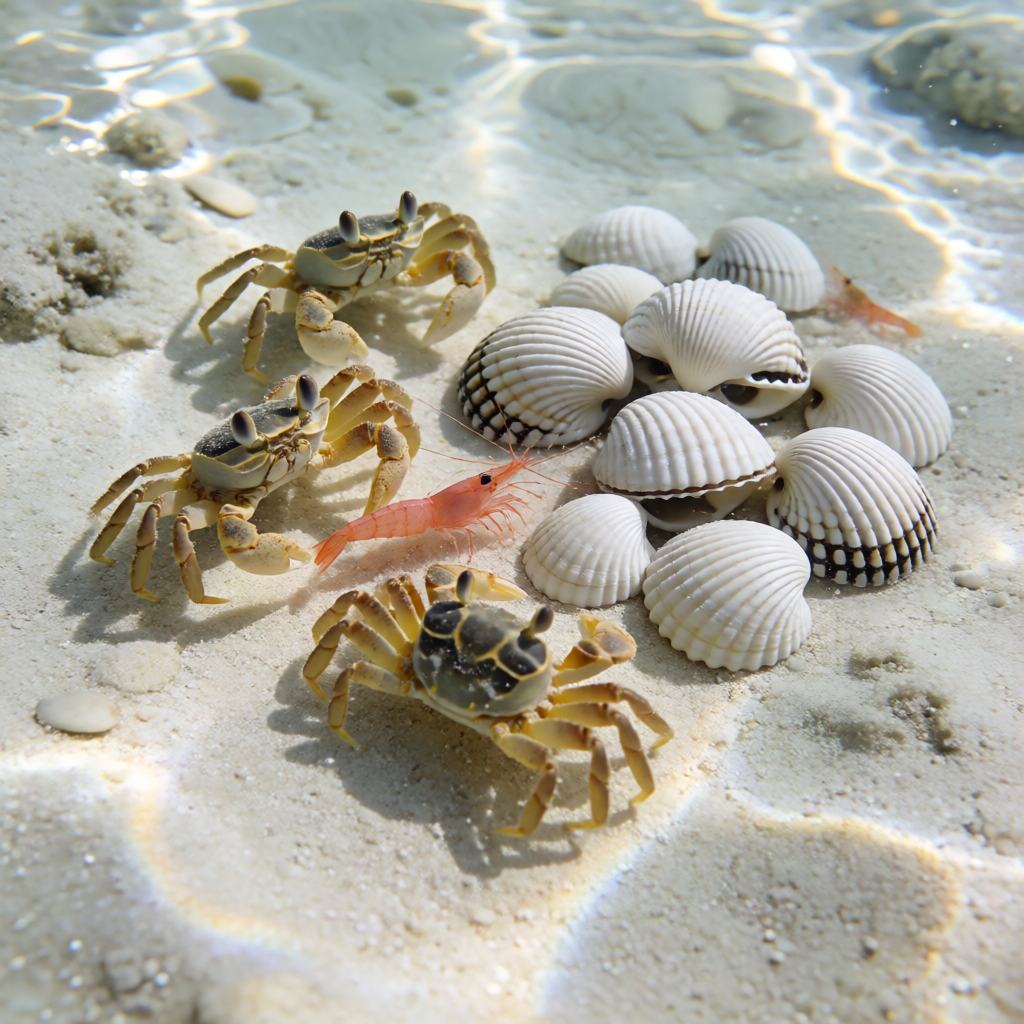
The Common Eagle Ray feeds on animals that live in or on the seabed. It is particularly fond of shelled prey. Crabs are the most important food. The ray also takes shrimps, prawns, hermit crabs, mussels, cockles and marine worms. It has 2 ways of finding a meal. It can swim slowly over the sand and press its snout into the surface.
That lets it feel for buried animals. It can also blow a jet of water into the sand. The jet washes a buried animal out of its hiding place. Once the prey is uncovered, the ray settles over it. Then it crushes the prey between the flat plates in its mouth. Those plates are strong enough to break the shell of a crab or a cockle.
The broken pieces pass through the gut and out again. Because the ray feeds on the bottom, it spends much of its time close to the sand. Its mouth points downward, so it can take food from just below the body. The ray feeds mainly at night and in the early morning. It can go for long periods without food. Its teeth are replaced constantly as they wear down against the shells it eats.
A milky feed in the womb
The breeding cycle
The Common Eagle Ray gives birth to live young. The whole process takes place inside the body of the female. The eggs are fertilised inside her, and they hatch there. Each young ray begins life feeding on the store of yolk in its own egg. When that is used up, it is fed by a special milky fluid. The mother makes that fluid in her womb.
This way of feeding the young is found in several groups of sharks and rays. It allows a large young animal to be grown inside the mother. The pregnancy lasts about 6 to 9 months. In the Mediterranean the young are born in the summer. A litter holds 3 to 7 pups. Each one is a small copy of the adult, about 20 to 30 cm across the disc.
Females become mature at a disc width of about 60 to 80 cm. Males mature at a slightly smaller size. The females are large and slow to mature, and they raise only a few young at a time. So the species cannot replace its numbers quickly. That is the key fact for anyone thinking about its survival. Young rays spend their first months in very shallow water, where the sand is warm and there is plenty of small prey.
Near threatened in the Mediterranean
Conservation
The Common Eagle Ray has not been assessed for the whole world. There is not enough information to say whether the global population is falling. The picture is clearer in the Mediterranean, where the species has been assessed as near threatened. The main problem is fishing. The ray is caught in trawls, in gill nets and on long lines. It is taken both as a target and as an unwanted catch.
In many places it is kept and sold. In others it is thrown back, usually dead. The species grows slowly and matures late. It produces only 3 to 7 young at a time. So a population that is fished hard takes a very long time to recover. Bottom trawling also damages the sandy ground and the shallow bays where the young are raised.
It removes the crabs and molluscs that make up the diet. There is no management plan aimed at the Common Eagle Ray anywhere in its range. The most useful measures would be the protection of nursery bays and a limit on the numbers taken. The species should also be recorded separately in the catch. Only then can the decline actually be seen.
Quick hits
Five things to remember
- The head stands clear in front of the wings, which is why the family is called the eagle rays.
- Its teeth are flat crushing plates rather than points. They work like a paving stone to break open crabs and cockles.
- The mother feeds her unborn young with a milky fluid made in her womb. A litter holds only 3 to 7 pups.
- It breathes through the openings behind its eyes while its mouth is buried in the sand.
- The species is strong enough to leap clear of the surface. The slap of a large one falling back can be heard from far off.