 By st20113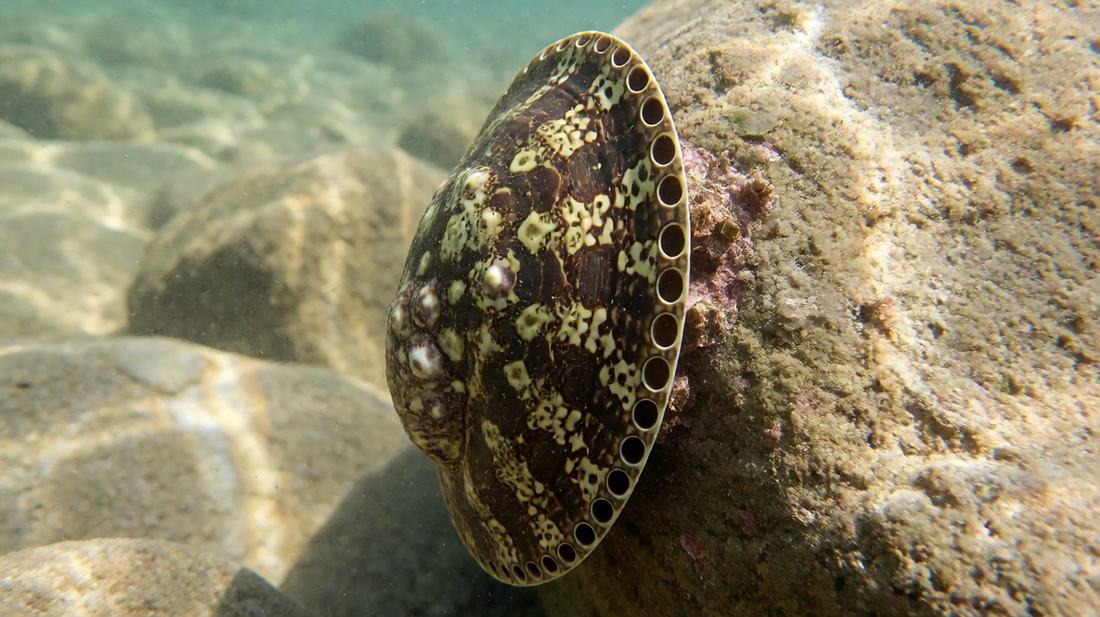
Haliotis tuberculata | Green Ormer
Species Profile · Haliotidae
Green Ormer
A flat sea snail with a row of holes along its shell, prized as food for centuries and now Vulnerable across its range.
IUCN: Vulnerable
Range
Shell
Holes
Diet
Status
The holey sea snail
A flat shell with a row of holes
The green ormer is a large sea snail with a shell shaped like a flattened ear. In the Channel Islands. Where it has been eaten for centuries. People call it the ormer, from the French for sea ear. In France it is the ormeau. And one of the dearest shellfish on the Atlantic coast.
The animal is a big muscular foot that clamps to a rock with a force no hand can match. The shell is mottled red-brown or green outside and is usually coated in weed. So the animal is hard to see. A neat row of small holes runs along one edge. Those holes set the ormers apart from almost every other snail. They are part of the breathing system.
And water flows out through them. Inside the shell lies the iridescent material trade calls mother of pearl. The species grazes seaweed on rocky shores and shallow reefs. And it has been fished hard for its flesh. That pressure, with disease and weak rules. Has moved it into the threatened classes of the Red List.
Family tree
Haliotidae, the abalones
The green ormer belongs to the family Haliotidae and the genus Haliotis. The family is small and very distinct. All its members share the ear-shaped shell and the row of holes. And no other gastropods do. Linnaeus named the species in 1758. The genus name Haliotis comes from Greek words for sea and ear. About 60 to 70 living species are recognised worldwide. In cold and temperate seas on every continent but the polar ones.
Most live in Australia, Japan, South Africa and the eastern Pacific. The green ormer is the only Haliotis in European waters and the only one on the Atlantic coast of Africa. It belongs to the class Gastropoda, the snails and slugs. The green ormer sits in an old lineage whose fossil kin go back more than 100 million years. Two subspecies are named. Haliotis tuberculata tuberculata covers the Atlantic and western Mediterranean. Haliotis tuberculata lamellosa covers the eastern Mediterranean. Some treat the Mediterranean form as a full species.
The species is not close to the limpets. Though the two live side by side on the same rock. The green ormer shares its grazing habit and rock-clinging foot with the common limpet. The conical snail of the splash zone. The limpet has a simple cone shell with no holes and scrapes film from rock in a fixed home scar. The ormer has a flat spiral shell with a row of openings. And it roams further for seaweed. The two are easy to separate.
Holes, shell and nacre
How to identify one
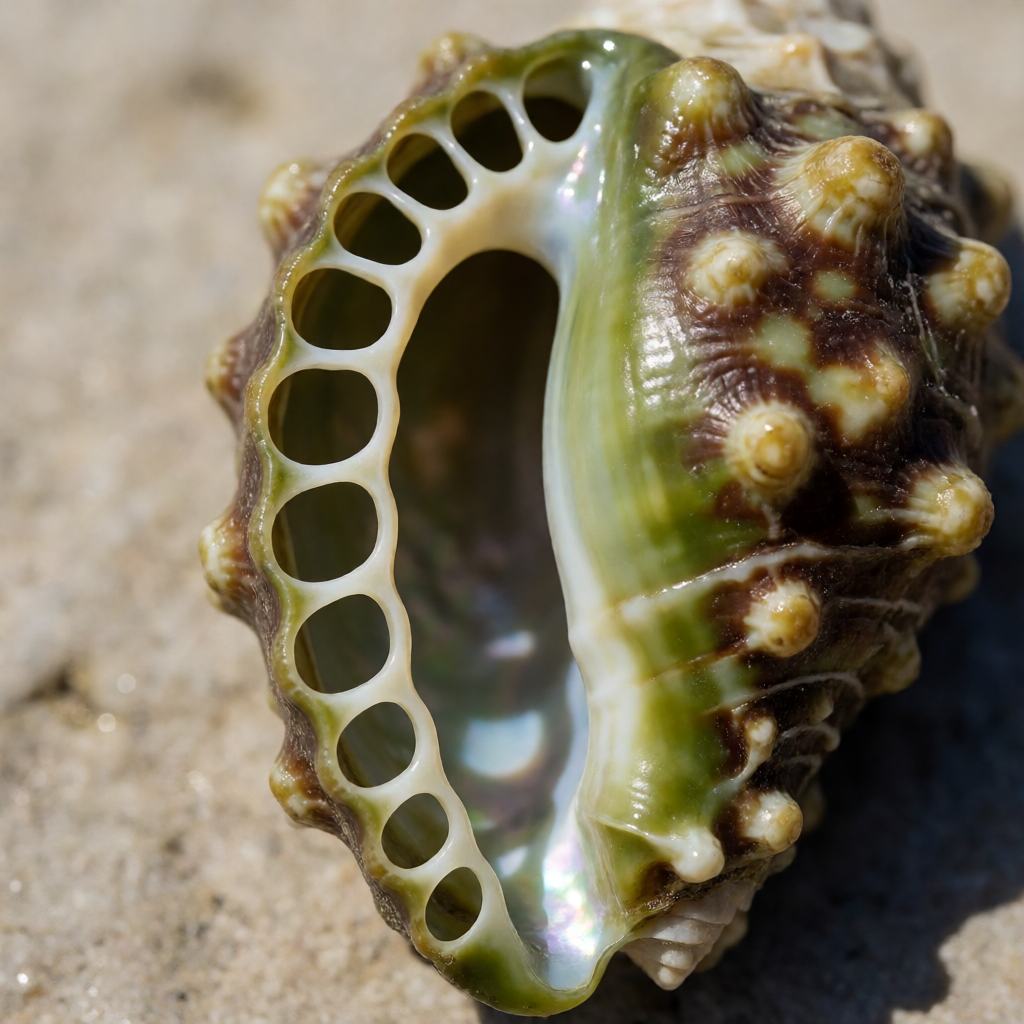
The green ormer has a flat. Oval shell that measures 6 to 12 cm in length. With a common length of about 8 cm. The shell is wider at the front than the back. So its outline is a rough ear. The spire, the coiled part at the back. Is low and small, near the rear edge. That gives the shell a flat profile. Unlike the tall cone of a limpet. Six to nine openings sit in a row along the left edge on a raised ridge. Those openings are the animal’s key feature. And their number and order name the species.
In the living animal only the last few stay open. Older holes are plugged from inside as the shell grows. The outer surface is rough and dull. Usually red-brown, olive or green. And is almost always coated in coralline algae. That coat is real camouflage and hides a resting ormer. The inner surface is the opposite. It is smooth, glossy and iridescent, with pale blue. Green, pink and silver in changing light. That layer of nacre is the same stuff that gives mother of pearl its worth. The foot is enormous, fills the whole shell opening. And is pale and muscular.
The edge of the foot carries a fringe of small tentacles that act as sense organs. Two eyes sit on short stalks at the front. Each at the base of a tentacle. The mouth carries a radula. A ribbon of tiny teeth that rasps seaweed. The animal has no operculum, the hard lid many snails use. It relies on the suction of the foot. That foot resists a strong pull. And the animal must be levered off the rock. The blood holds the pigment haemocyanin. This makes it colourless or bluish rather than red. Males and females look the same from outside.
1
2
3
Shallow rocky shores
Where it lives
The green ormer lives on rocky ground in shallow. Clear, well-oxygenated water. It is most common between the low water mark and about 20 m. With records down to 40 m. It wants hard surfaces with some cover. Boulders, ledges, gullies, overhangs and surge channels all suit it. It also lives on gravel and shell ground next to rock. And now and then on muddy bottoms. It avoids soft mud and low salinity. So it is absent from estuaries and the inner Baltic. Young animals live hidden under stones.
In crevices and among kelp holdfasts. They come out at night and return before dawn. Older animals are more often on open rock. Its range runs from the Channel Islands and Brittany south along the Atlantic coast of France. Spain and Portugal. And on to Morocco, Western Sahara and Guinea. It also lives around the Azores. Madeira, the Canaries and Cape Verde. And through the Mediterranean and Adriatic. It is absent from the North Sea and from Britain north of the Channel. Apart from a few western records.
The best grounds are exposed reefs with strong water movement and rich red seaweed. Wave action keeps the rock clear of sediment and brings food. Depth matters because the animal is sensitive to temperature. It prefers cooler water than the Mediterranean mean. And does better in the Atlantic part of its range. In the Mediterranean it tends to be found deeper. Where the water is cooler. Its density on good ground can be high. With dozens of animals in a few square metres.
A grazer of seaweed
What it eats
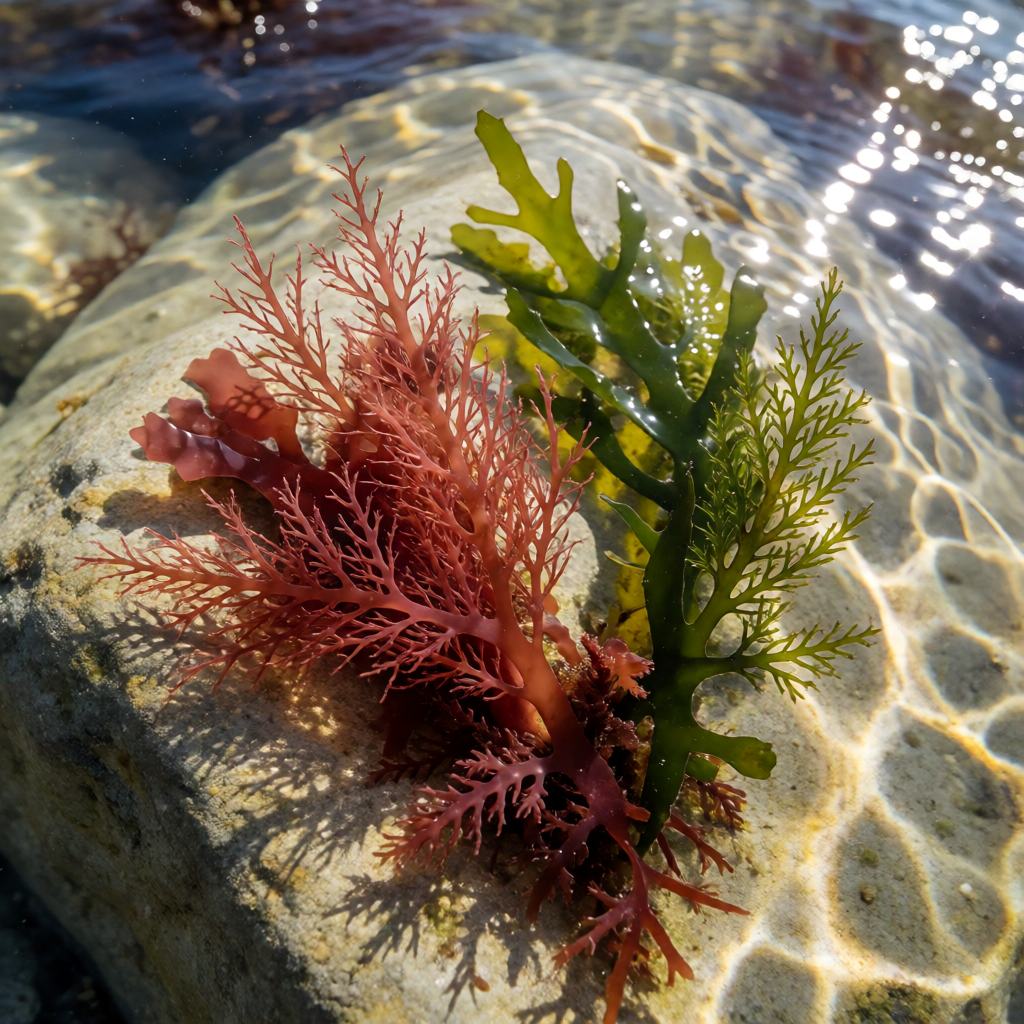
The green ormer is a grazer. And its diet is mostly seaweed. It feeds above all on red algae. And also takes green algae. Brown algae and the fine film of diatoms on the rock. It does not eat the large kelps, which it cannot cut. It prefers the softer, finer growths and grazes them close. Feeding happens mostly at night. Night reduces the risk of fish and crabs.
And lets the animal avoid strong light. It moves a limited distance from its resting place. Usually a metre or two. And returns to a similar spot. It finds weed by touch and by chemical sense. The tentacles on the foot and mantle carry many chemical sensors. It holds the weed with the front of the foot and rasps it with the radula. The radula is long and carries many rows of small teeth coated in a hard mineral. The teeth are replaced as they wear.
Its main problem is not finding food but avoiding being eaten while it grazes. Its shell is its only guard. And its camouflage and its habit of hiding do most of the work. It grows slowly on this diet. And growth depends on the food supply and the water temperature. An animal on rich red-algae ground grows much faster than one on bare rock. Slow growth and late maturity are why the species cannot recover fast when overfished.
Tiny larvae, wide drift
The breeding cycle
The green ormer has separate sexes and releases its eggs and sperm straight into the water. There is no courtship and no pairing. The whole population on a stretch of shore spawns at about the same time. This is vital for a species with this method. If the animals spawned at random. Most eggs would never meet a sperm. The trigger for spawning is water temperature. Day length and, in some populations, the phase of the moon. Spawning runs from spring to late autumn, and peaks in summer. Males release first.
And the sight of sperm in the water stirs the females to release eggs. A large female can release well over a million eggs in a season. The eggs are small and sink slowly. They hatch within a day or two into free larvae that live on their own food for several days. The larva drifts with the current for about a week. During that time it can be carried far. This is how the species reaches new ground and how distant shores stay linked. When ready to settle. The larva needs a chemical cue from the rock. It settles on coralline algae.
The pink and purple crusts in shade. That cue is vital. A larva on the wrong surface will delay. And many never settle at all. Once settled it changes into a tiny snail and begins to graze. Growth is slow. An animal takes about 4 to 5 years to reach the 5 cm length at which fishing becomes worthwhile. And it may live to 15. Females mature at about 4 to 5 cm. That slow path to maturity is the heart of the species’ conservation problem.
Vulnerable, and over-collected
Conservation
The green ormer is listed as Vulnerable on the global Red List. With a decreasing trend. That is a high class for a species once abundant over a large stretch of coast. The reason is commercial fishing. The flesh is a luxury. And demand has been heavy for well over a century. In France, the Channel Islands, Spain, Portugal and Italy. The species supports a small but valuable inshore fishery. Catch limits. Minimum sizes and closed seasons exist in most of those places. The problem is enforcement.
Over much of the range the rules are widely broken. The animal is easy to find once a fisher knows the ground. Stocks in Brittany. The Mediterranean and along the Atlantic have fallen sharply. And the Red List singles out weak enforcement and wide poaching as the main cause. Other pressures add to the trouble. Disease has killed large numbers of abalone worldwide. And bacterial and parasitic infections are a real risk on farms and in the wild. Coastal pollution, loss of algal habitat. Dredging and construction all harm the rocky grounds. Because the animal must be levered off rock.
Careless collecting harms those left behind. Aquaculture is now part of the answer. Ormers are farmed in France, Spain, Ireland and elsewhere. Good farming can take pressure off wild stocks. But only with real protection on the shore. The species responds well to protection when applied. Closed areas and enforced size limits have produced visible recoveries in a few places. The animals are long-lived and produce huge numbers of eggs. What they cannot do is rebound from constant removal across their whole range. The trend on the Red List stays decreasing. And that is the figure that matters.
Quick hits
Five things to remember
- The English name ormer comes from the French oreille de mer, meaning sea ear, and the shell really is shaped like a flattened ear.
- Its shell has a row of 6 to 9 holes, and only the last few stay open as it grows.
- It is the only abalone in European waters and the only one on the Atlantic coast of Africa.
- An ormer clamps onto rock so hard that it cannot be pulled off by hand and must be levered away.
- The iridescent inner layer of the shell, known as nacre, is the same material as mother of pearl.