 By st20113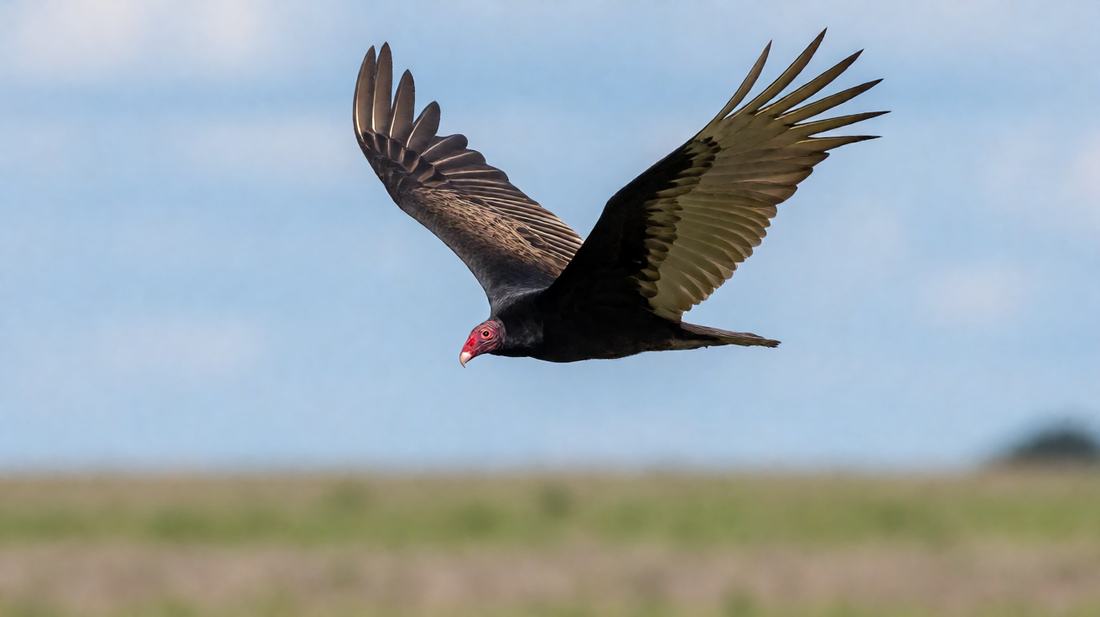
Cathartes aura | Turkey Vulture
Species Profile · Cathartidae
Turkey Vulture
The only common large bird that smells its food, a soaring scavenger of American roads and farmland whose numbers have risen with the landscape that we cleared.
IUCN: Least Concern
Range
Length
Weight
Nest
Incubation
The vulture that smells
A scavenger with a sense of smell
The turkey vulture is the most widespread of the vultures of the Americas. It is also one of the most familiar of the large soaring birds of the western hemisphere. It is a bird of the open country and of the road and of the farmland. Millions of people see it on the long journeys of the summer. It crosses the plains of the United States and the south of Canada. The bird is one of the very few birds of the world that relies on smell. It uses that sense as the main tool in the search for food. A dead body releases gases into the air. The bird can detect those gases. That ability is one of the most remarkable sensory adaptations of any bird. The bird belongs to the family of the vultures of the New World. That group is quite unrelated to the vultures of the Old World.
The likeness of the 2 groups is one of the classic examples of convergent evolution. The 2 arrived at the same heavy body and the same bare head. They also arrived at the same broad wing. They share the habit of soaring and of feeding on dead animals. Yet they came from 2 very different ancestries. The turkey vulture is the commonest and the most adaptable of the 7 or the 8 species of the family. It ranges from the south of Canada to the south of South America. The bird is a partial migrant. Its northern groups make the long journey south in the autumn. They return to the north in the spring. That migration runs over the land bridges of Central America. It is one of the greatest movements of soaring birds in the world.
Hundreds of thousands of birds pass in a single season. The bird is assessed as Least Concern on the global Red List. The world population is very large. It is probably increasing in the north of the range. The bird has gained from the changes that people have made in the landscape. Roads and farmland and cleared forest give it 2 things. They give it the dead animals and the open country that the species needs. The bird is protected by the law of the United States and of the other countries of the range. Shooting was once widespread. It has been cut a great deal.
Family tree
Cathartes, the New World vultures
The turkey vulture was described by Linnaeus in 1758. Modern work places it in the genus Cathartes. That genus sits in the family Cathartidae. That family is the group of the vultures of the New World. It holds the 2 or the 3 species of the genus Cathartes. It also holds 2 species of the genus Coragyps. Two more sit in the genera Sarcoramphus and Vultur. A further 2 sit in the genus Gymnogyps. The relationships of the whole group have been one of the hardest problems of avian taxonomy. Different authorities have placed the vultures of the New World with the storks. Others have placed them with the birds of prey.
Others have given them a group of their own. Modern genetic work puts the family with the birds of prey of the order Accipitriformes. Older studies of the body structure had put the group closer to the storks. The bird is a close relative of the Griffon Vulture (Gyps fulvus). The 2 are the classic elements of the comparison of the vultures of the 2 hemispheres. They share the same heavy body and the same broad wing. They also share the same bald head. Both play the same part in the ecosystem as the eater of dead animals. Yet the griffon vulture of the Old World finds a body with its eyesight alone. The turkey vulture of the New World finds it with smell. The 2 are the clearest illustration of the different answers that the 2 groups found for the same way of life.
The species name comes from the name of the bird in the language of the native people of Mexico. The name of the genus comes from the Greek word for the purifier. That name refers to the part the bird plays in clearing dead animals from the landscape. Modern work accepts 5 or 6 subspecies. They differ chiefly in size and in the tone of the plumage. They also differ in the extent of the white and the grey of the head. That difference separates the immature birds from the adults. The birds of the north of the range are the largest and the palest. The birds of the tropics and of the south are smaller and darker. Those differences change gradually across the enormous range. So separating the subspecies in the field is very hard.
Red head, silver wing
How to identify one
An adult turkey vulture is between 62 and 81 centimetres long. Its wingspan is between 160 and 183 centimetres. Its mass runs from about 0.8 kilograms in the smaller birds of the tropics. The heaviest birds of the north reach 2.4 kilograms. Those birds are in full condition. The bird is a large and light-bodied soaring bird. Its proportions belong to a glider rather than to a hunter. The wing loading of the species is one of the lowest of all the birds of prey. That explains its very great efficiency in the soaring flight. The plumage of the adult is a dark brown-black. The whole of the body and the upper surface of the wings carry that colour. The underside of the flight feathers is a silver-grey. That grey contrasts very strongly with the black of the rest of the bird.
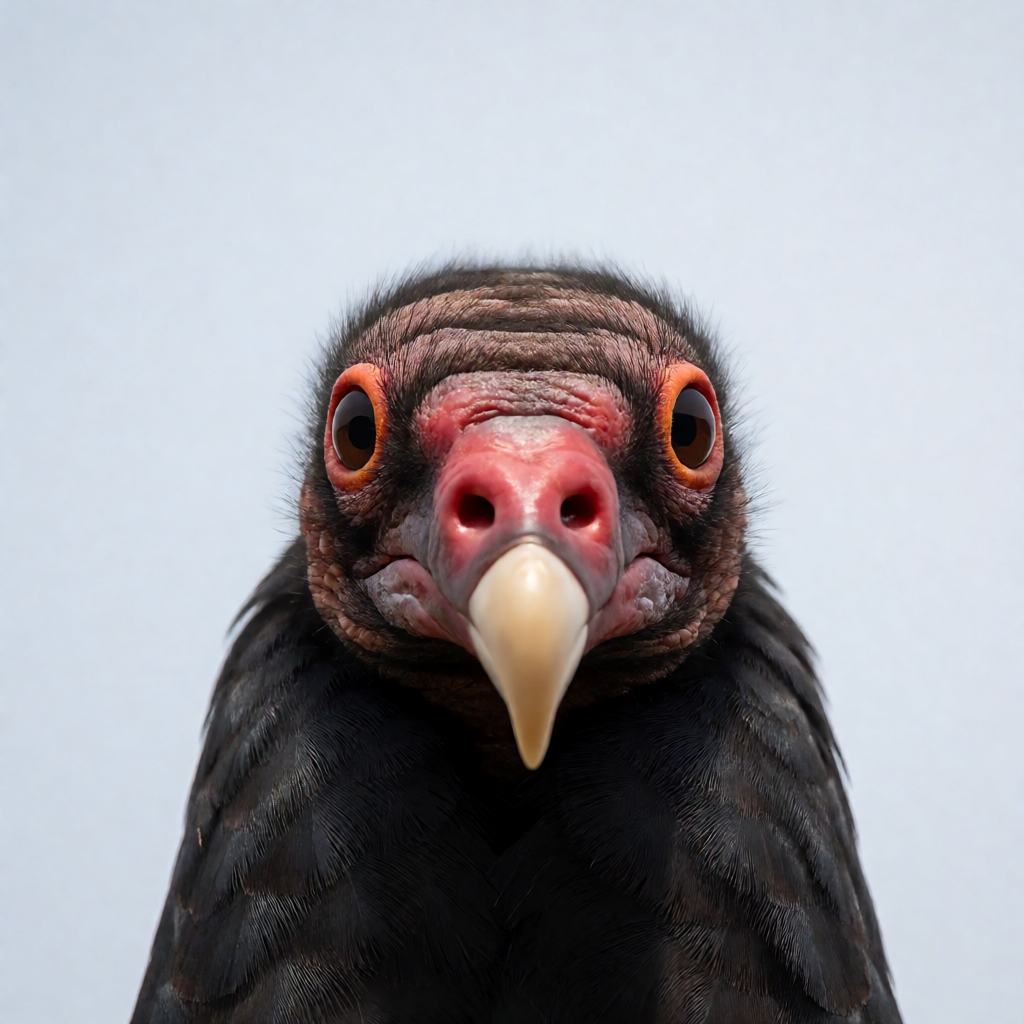
So the wing has a 2-toned pattern. It is the single most useful field mark of the species. The pale silvery panel of the underside of the wing shows at an enormous distance against the sky. It lets you identify the bird from the ground as it flies. The head and the neck of the adult carry no feathers at all. They are a vivid red with wrinkled and warty skin. That naked red head is the second of the great marks of the species. It is the feature that gives the bird its likeness to the head of a turkey. That likeness is the origin of the common name. The head is very small in proportion to the body. The bill is a pale ivory with a hooked tip. The bill of a vulture of the New World is a much weaker tool than the bill of a vulture of the Old World. So the bird cannot tear the thick hide of a large body.
It must wait for other animals to open the body. It can also enter through the natural openings. That limit is one of the reasons that the species is so often the second scavenger to arrive. The tail is long and slightly rounded. The bird uses it as a rudder for very fine control of the flight. The legs are short. The feet are the weak and poorly developed feet of the family. The bird cannot grasp prey with them. It uses the feet only for walking and for standing. The young bird is duller and browner than the adult. Its head and neck carry dark greyish down for the first months of the life. The red of the head is not complete until the bird is more than a year old.
1
2
3
Road, farm and open country
Where it lives
The turkey vulture needs open country and an abundance of dead animals. It is a bird of the woodland edge and of the cleared land. It also uses farmland and desert and road. It is not a bird of the deep forest. It is not a bird of the high mountain either. The species has increased very greatly over the last 2 centuries. The forest of the east of the United States has been cleared. Roads have been built. Farmland has spread. That cleared and open landscape gives the bird 2 things. It gives the dead animals. It also gives the thermals that a soaring bird needs.
The bird is a partial migrant over the north of the range. The groups of the north of the United States move south in the autumn. So do the birds of the south of Canada. That movement is one of the greatest migrations of the soaring birds of the world. Very large numbers pass through the bottlenecks of the coastal plain of Mexico. They also pass through the isthmus of Central America. The birds rise on the columns of warm air that the sun heats off the land. They glide the whole of the length of the day. They roost in the trees in very large numbers at night. The species does not cross the water in great numbers. Thermals do not form over the sea. The bird roosts in shared groups through the whole of the year.
The roost often sits in tall dead trees. It also sits in the pylons of a power line and in other high places. The roosts of the winter may hold hundreds of birds. Resident birds use the same roost for the whole of the year. They return to it year after year. The species puts up with people. It nests and roosts near a settlement and near a farm. The bird is one of the most obvious of the large birds of the rural landscape of the Americas. It is often seen with the black vulture. That bird belongs to the same family and lives in the same way. The black vulture finds a body by eyesight. It often follows the turkey vulture to the food.
A hunter of the dead
What it eats
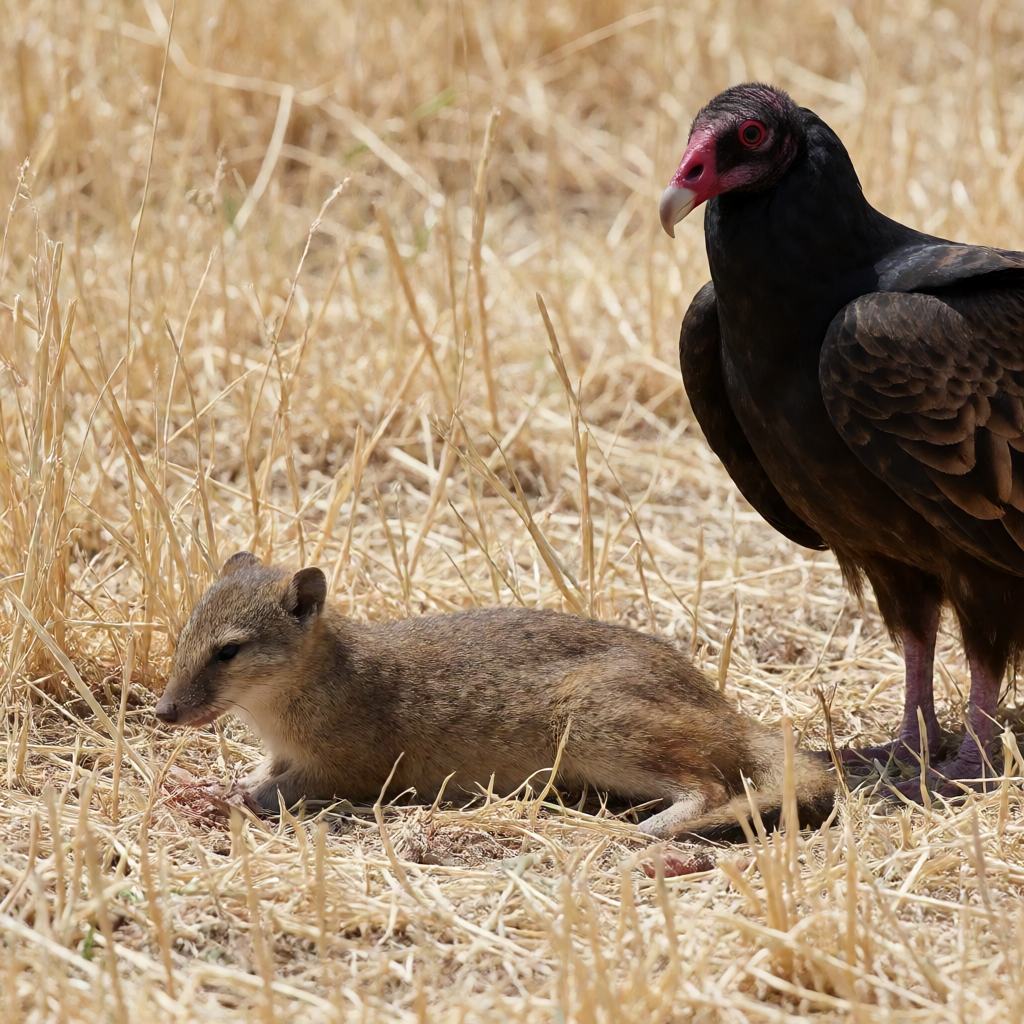
The turkey vulture feeds only on dead animals. The diet holds the bodies of mammals and birds and reptiles. Fish and invertebrates are eaten too. The species is one of the most important of the scavengers of the western hemisphere. It plays a very large part in the clearing of dead animals from the landscape. It also cuts the spread of disease. The bird finds its food with the sense of smell. That ability is one of the most developed of its kind of any bird. The bird can detect the small quantities of gas that decay releases. So it can find a body that is hidden under the canopy of the forest. Such a body cannot be seen from the air. The other vultures of the same region have no sense of smell. They include the black vulture and the king vulture. Those birds depend on the turkey vulture to find the food. They follow it to the body.
So the turkey vulture has the advantage of the discovery. It has the disadvantage of a smaller size. Larger and heavier birds often drive it off the food. Mammals do the same. The bird feeds on the softer parts of a body. It enters the body through the natural openings and does not tear the hide. It prefers an animal that is recently dead to one that is far gone. The bird has a remarkable tolerance of the toxins of botulism. It also tolerates the other poisons of decaying meat. Studies of the diet have shown something striking. The bird can feed on bodies that would kill most other animals. The bird feeds in groups at a large body. The social order of the feeding group is a strict one. The larger and older birds take the food. The younger birds wait at the edge.
A single body may hold several birds. The bird drinks very little. The whole of the water it needs comes from the food. The bird has developed a remarkable habit. It defecates on its own legs. The liquid then evaporates. That behaviour is thought to do 2 jobs. It cools the bird. It also removes bacteria from the surface of the legs. The habit is one of the most curious adaptations of the family. The bird needs a very large quantity of food for its size. It has been shown to go for several days without food. Then it gorges very heavily when it finds a body.
No nest at all
The breeding cycle
The turkey vulture has very simple needs in the breeding season. It builds no nest at all. The bird lays the eggs on the bare surface of the ground. It also lays in the cavity of a log or of a rock. It will use an abandoned building as well. The site is chosen for shelter from the weather. Concealment from predators matters too. The bird puts up with disturbance to a remarkable degree. It will nest in a barn or in a shed. It will nest in an unused building on a farm. The courtship is a flight display. The birds circle together and tumble. One bird chases the other. The 2 may touch in the air. They perform the display over the place of the future nest.
The pair bond lasts at least in part for the life. The clutch holds between 1 and 3 eggs. The usual clutch is of 2. The eggs are a dull white or a cream. Heavy blotches of brown and black cover them. That pattern hides them well against the ground. The laying takes place in the spring in the north of the range. It takes place in the dry season in the tropics. The bird lays a single clutch in the year. It lays a second clutch only if the first is lost. Both parents sit. Incubation lasts for between 30 and 40 days. The sitting bird is very unwilling to leave the eggs. It performs a threat display instead. It hisses and it spits.
It also brings up foul carrion material at the intruder. That display is a very effective defence for a bird of this size. It is also the origin of the very poor reputation of the species in the folklore of some parts of the range. The chick is covered in white down. Both parents feed it by bringing up carrion for between 60 and 80 days. The young bird can fly at the age of between 70 and 80 days. It stays with the parents for a considerable period. It does not breed until the age of 3 or 4 years. The bird is long-lived. Individuals are known to have survived for more than 16 years in the wild. Some have lived for more than 20 years in captivity. So the species shows a pattern of low output and high survival of the adults. That pattern matches the greater part of the large birds of prey of the world.
A bird that has prospered
Conservation
The turkey vulture is assessed as Least Concern on the global Red List. The world total is very large. It runs into the millions of birds. The species is one of the most abundant of the large birds of the Americas. Numbers in the north of the range have risen very considerably over the last century. Three things explain that rise. The landscape has been opened. The road network has been extended. The numbers of the large mammals and of the deer have recovered. The bird is not threatened by the loss of the habitat. The removal of the forest has if anything increased the area that suits the species. The greatest threat to the bird is poisoning of 2 kinds. The first is direct.
The second is indirect. Lead from ammunition remains in the bodies of animals that are shot. The bird feeds on the remains of deer and of other game. So it takes fragments of the lead into the body. Lead poisoning is one of the most serious causes of death for this species. It also affects the whole group of the vultures. So the restriction of the use of lead ammunition has become one of the most important measures for the group. The bird is also killed in collisions. It hits vehicles on the roads and it hits power lines. Traffic is one of the commonest causes of death. The bird feeds on the bodies of animals killed by traffic. Then the following vehicle strikes the bird. Shooting and trapping are older pressures.
People regarded the bird as vermin for a very long time. Vultures are still shot in some parts of the range. The bird is now protected by the law of the United States and of most countries of the range. Better education of farmers and hunters has cut the persecution a great deal. The species is also affected by changes in the abundance of the food. The number of large wild mammals has fallen. Free-ranging livestock has fallen too. That has removed part of the food supply. The bird has compensated in other ways. It now uses road kill. It also uses the waste of the abattoir and other sources of food that the modern landscape provides. Networks of volunteer observers watch the species over the whole of the range. So the bird is one of the best known of the large birds of the Americas.
Quick hits
Five things to remember
- The turkey vulture finds its food by smell. It can detect a body that lies hidden under the canopy of the forest and cannot be seen from the air.
- The other vultures of the region cannot smell at all. They include the black vulture. They often follow the turkey vulture to a body and then drive it off the food.
- The head and the neck of the bird carry no feathers at all and are a vivid red. That bare head looks like the head of a turkey. The likeness is the origin of the common name.
- The bird cannot tear the thick hide of a large body. It must enter through the natural openings or wait for other animals to open the body. So it is often the second of the scavengers to arrive.
- The bird has the habit of defecating on its own legs. The liquid then evaporates. That is thought to cool the bird and to remove bacteria from the surface of the legs.