 By st20113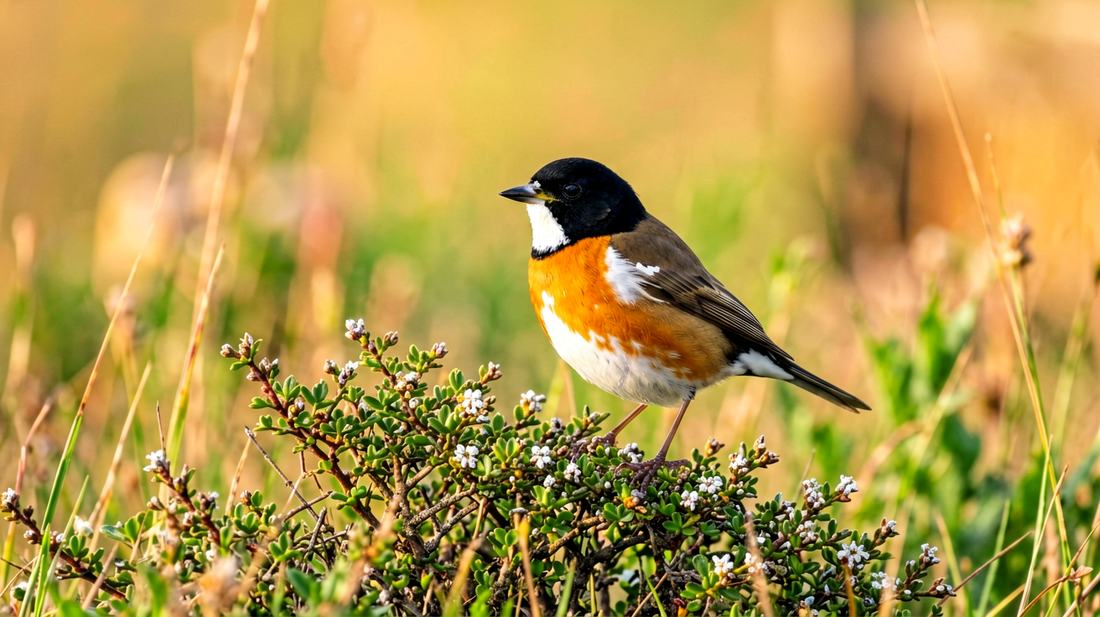
Saxicola rubicola | European Stonechat
Species Profile · Muscicapidae
European Stonechat
A small restless chat of lowland scrub whose dry ticking call sounds like two pebbles struck together.
IUCN: Least Concern
Range
Length
Weight
Clutch
Broods
Two pebbles knocked together
The stonechat
The stonechat is a small, compact, restless chat. It lives in lowland scrub and rough grass. It is one of the most typical birds of open coastal and heath country in western Europe. It perches on the topmost twig of a gorse bush. It also uses fence wires. Its call is hard and dry. It sounds like two pebbles struck together. That makes it far easier to find than its size suggests.
The breeding male is a fine bird. It has a jet-black head and throat. A broad white patch on each side of the neck forms an incomplete collar. Its breast is rich orange-red. Its back is dark brown mottled with buff. The female looks quite different. She is a sober brown bird with a pale throat and a buff eyebrow stripe. Her upperparts are heavily streaked.
The two look so unlike that they were once taken for different species. The species was split into three in the 2000s. That matters for conservation. The African and Asian birds no longer support the European one. Stonechats in western Europe are partly resident. A hard frost can kill very many of them.
Family tree
Saxicola, a dweller among stones
The stonechat is in the family Muscicapidae, the Old World flycatchers and chats. Gene work greatly widened that family. It now absorbs the thrushes and their allies, among them the common redstart, as a subfamily. Within it sits the genus Saxicola. That genus holds about 15 species of open-country chats. They live in Europe, Africa and southern Asia. Its genus name joins the Latin saxum, a rock or stone, with colere, to dwell in.
It points to the bird’s habit of living among stones and perching on them. Its species name rubicola repeats the same two Latin words. Two authors made the two names on different continents. Neither knew of the other. Until about 2010 the European bird was part of Saxicola torquatus. That species covered Europe, Africa and southern Asia. Gene work showed the groups were distinct enough to be separate species.
They are now the European, Siberian and African stonechats. The European and Siberian birds are split by the pale rump patch, the white in the tail and the breadth of the collar. Where the two meet in the Urals they behave as full species. That is the main sign for the split. Two subspecies of the European bird are usually known. One lives in continental Europe and the British Isles. A smaller, more heavily streaked form lives in Iberia, North Africa and the Mediterranean islands.
Black, white and orange-red
How to identify one
An adult stonechat is 11.5 to 13 cm long. Its wingspan is 18 to 21 cm. It weighs 13 to 17 grams. Males are a little heavier on average. Birds at the northern edge of the range are heaviest in late summer. They are laying down fat for their journey. The build is compact and rather straight up. The head is large for the body and the tail is short. Its pose on a perch stands out. The body is held nearly vertical with the head high. The tail is slightly depressed. From there it makes short, quick dashes to the ground.
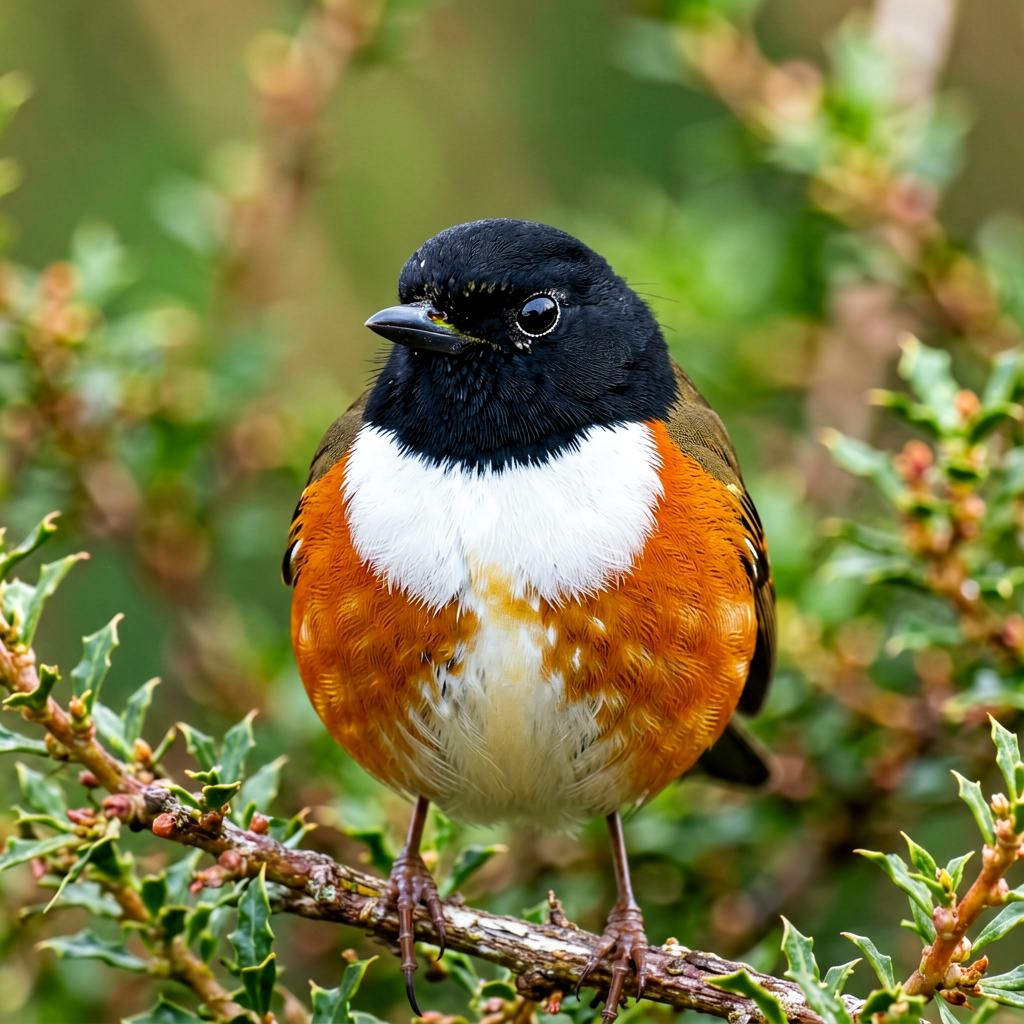
The bill is short and slender, about 12 mm, and black in both sexes. The legs and feet are black and quite long for the size of the bird. That suits dropping to the ground from a perch. It also helps it perch on thin stems. The breeding male is unmistakable. The head, throat and upper breast are jet black. In some birds the black runs over the mantle. In others the back is dark brown with pale buff mottling. A large white patch sits on the side of the neck. It runs from below the ear coverts to the shoulder. In many males it forms a broad half-collar. The lower breast, belly and flanks are rich orange-red or chestnut.
A white rump patch shows in flight. The tail is black all through. The female is quite different. She is pale brown above with dark brown streaks. She is buff below, with a paler throat and belly centre. Her head is grey-brown with a bold pale eyebrow. Her throat and breast are washed with pale rufous. She never matches the male’s colour. She has no black head and no white neck patch. Juveniles look like the female but are more heavily spotted.
1
2
3
Gorse, heath and rough grass
Where it lives
The stonechat lives in early-stage, open habitats. It needs scattered tall perches above low, uneven turf. Within that broad brief it uses a wide range of spots. It occurs on coastal sand dunes and shingle. It uses heathland and the edges of lowland commons. It lives in rough pasture with gorse and hawthorn scrub. It uses reedbed fringes and saltmarsh edges. It also uses railway embankments and roadside verges. Wood clearings suit it, as do young conifer plots before the tops close. Gravel pits and quarry floors are used too.
So are dry stone walls and upland stubbles. All these places share three things. There is short plants for hunting over. There are scattered tall stems, posts or bushes for perching and nesting. There is a supply of surface and litter invertebrates. The bird does not have to push into a closed canopy. So it goes when scrub grows up into wood. It also goes when rough ground is ploughed or left to grow thick. It is a classic bird of the short-lived stages of plant growth. Across western Europe the winter range is coastal and low.
Most inland breeding birds move down to the coastal strip. They also use milder river valleys and the south-western counties. Birds in warm parts of Iberia and the Mediterranean stay put. Ring studies show most British stonechats move less than 100 km. That makes the species a partial migrant, not a full one. Its choice of winter home explains how open it is to harm. Birds that winter on exposed coastal marsh have no food during a frost. They fall back on the few seeds and berries such spots give.
Insects, then berries
What it eats
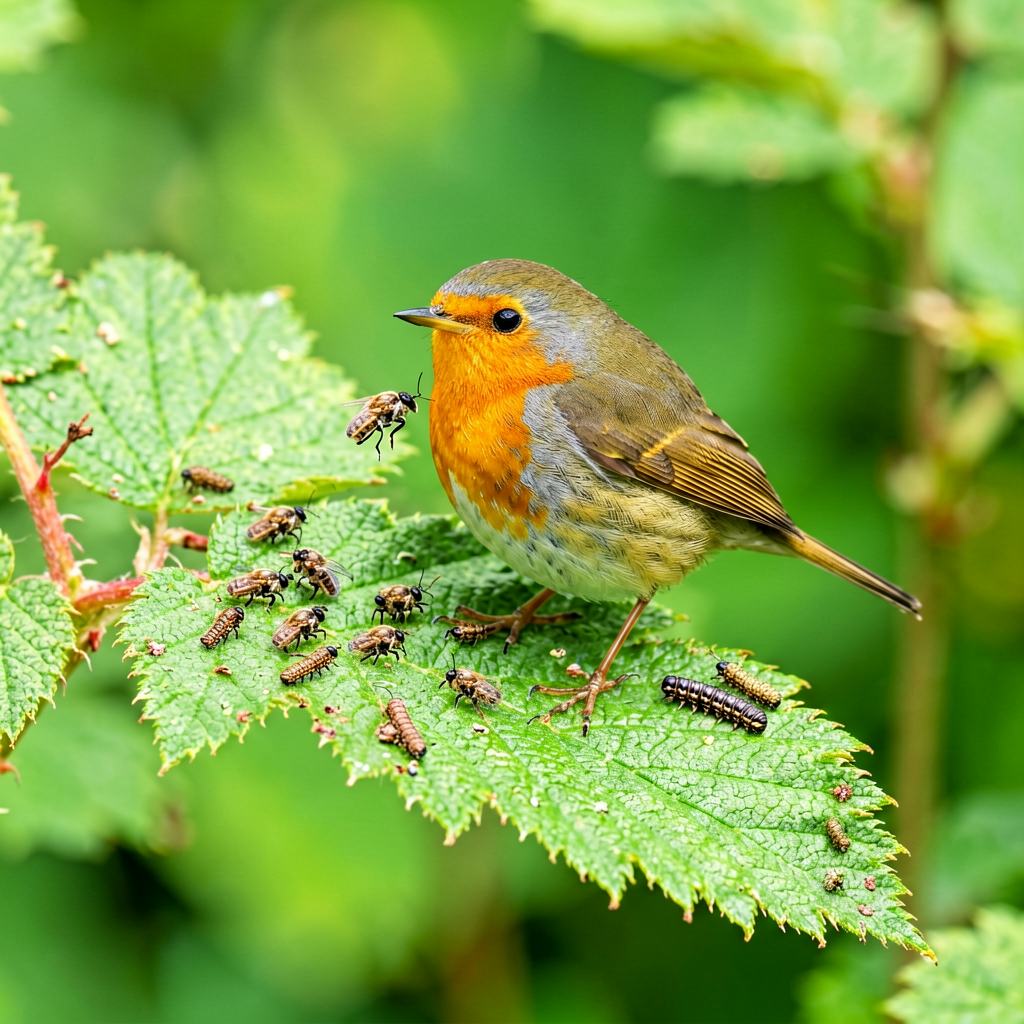
The stonechat eats insects for most of the year. In deep winter it also eats seeds and berries. Its hunting method is typical. From a low perch it watches the ground and the plants around it. When it spots prey it drops or darts down. It takes prey from the ground, from a leaf or in a short chase in the air. It usually returns to a perch to eat. Flies of many kinds dominate in most samples. Beetles come next.
The rest varies with habitat and season. Small moths and their grubs are taken freely in summer. Grasshoppers and bugs matter on dry grass. Ants are eaten in large numbers when they swarm. Spiders, harvestmen, millipedes, snails and earthworms appear in smaller amounts. Earthworms are pulled from wet fields as a thrush would. In late autumn and winter the supply of bugs drops. A hard frost makes what remains impossible to reach. The birds then switch diet.
They eat the seeds of grasses, sorrel and chickweed. They take the berries of ivy, hawthorn, elder, sea buckthorn and bryony. They also take whatever animals they can still find in the litter. That skill at switching is what lets the species winter here. Chats that eat only insects, such as the whinchat and the wheatear, must leave. The stonechat calls almost continuously as it feeds. It gives its hard, clipped note at every change of position. Its chosen perches show up well. Together these make it one of the surest signs of good habitat for a naturalist.
A second clutch before the first flies
The breeding cycle
European stonechats pair in spring. In the south this happens in March or early April. It is later in the north. The bond seems to last the season. Birds pair again in later years by holding a patch rather than by knowing each other. The same pair has at times been found together in later years. The female builds the nest alone over three or four days. It is a deep, rather untidy cup of dry grass, moss and stems. It is lined with finer grass, animal hair and feathers. The site is on or very close to the ground.
It sits in a dense tussock, at the base of a gorse bush, among heather roots or in a thick tangle. It is very hard to find. The normal clutch is 5 or 6 eggs. They are laid daily. They are pale blue-green with reddish-brown speckles. The speckles cluster at the broader end. The female sits alone for 13 to 15 days. The male feeds her at or near the nest. He warms the young for the first few days and both parents feed them after that. The young fledge at 12 to 14 days.
Second broods often begin before the first has fledged. The female leaves to attend the second clutch while the male keeps feeding the first brood. Pairs raise two broods a year over most of the range. In the warmest parts of Iberia they raise three. How many adults live turns on winter weather. Ring studies suggest about half live through the year. One severe winter can push it much lower. So the fate of the species turns on rare disasters rather than on slow change. The oldest ringed birds reach six or seven years. That is near the limit for a bird this small.
Hidden by a name change
Why the 2010 split mattered
The stonechat is Least Concern worldwide. Its world numbers are very large and its range is wide. The rating is not much argued over. National and local reviews are more mixed. This shows well why the split of Saxicola torquatus mattered. The European bird alone has world numbers ten times smaller. Falls in Britain and elsewhere in the west had been hidden by the large numbers of African and Asian birds. Those birds now sit in a group of their own. In Britain the species has fallen over the long term since the 1970s.
Its range has shrunk in the inland counties. Numbers have fallen sharply in the south-east. Two causes are involved. Lowland rough ground has got worse. Poor pasture has been ploughed and old grazing has been given up. Severe winters also struck in the early 1960s, the late 1970s and the mid-1980s. Numbers took several years to come back each time. There has been a modest comeback in some districts since the 1990s. The bird has also moved into new-made spots.
These include old gravel pits made good and coastal sites where saltmarsh has come back. Its skill at using the early stages of plant growth helps it. It comes back fast when the right habitat shows up. It is among the first to gain from schemes that make rough ground and scrub edges. Managers should keep a mix of short and tall plants. Scattered perches must be kept. Clearing scrub right off heathland in the name of saving wildlife does not help. Weedy field edges and rough corners should be kept on farms.
Quick hits
Five things to remember
- The English name is pure onomatopoeia: its call, a hard dry tack, sounds exactly like two stones knocked together, and it gives the call from almost every perch it visits.
- The scientific name repeats itself, since both Saxicola and rubicola are built from the same two Latin words meaning stone and to dwell.
- Until about 2010 the European, African and Siberian stonechats were treated as one species, and the split cut the European bird’s world numbers by about ten times.
- A single hard winter can kill most of the resident stonechats in a district, and the numbers the next spring are thin in turn.
- The female begins sitting on a second clutch before the first brood has left the nest, leaving the male to finish raising the first family alone.