 By st20113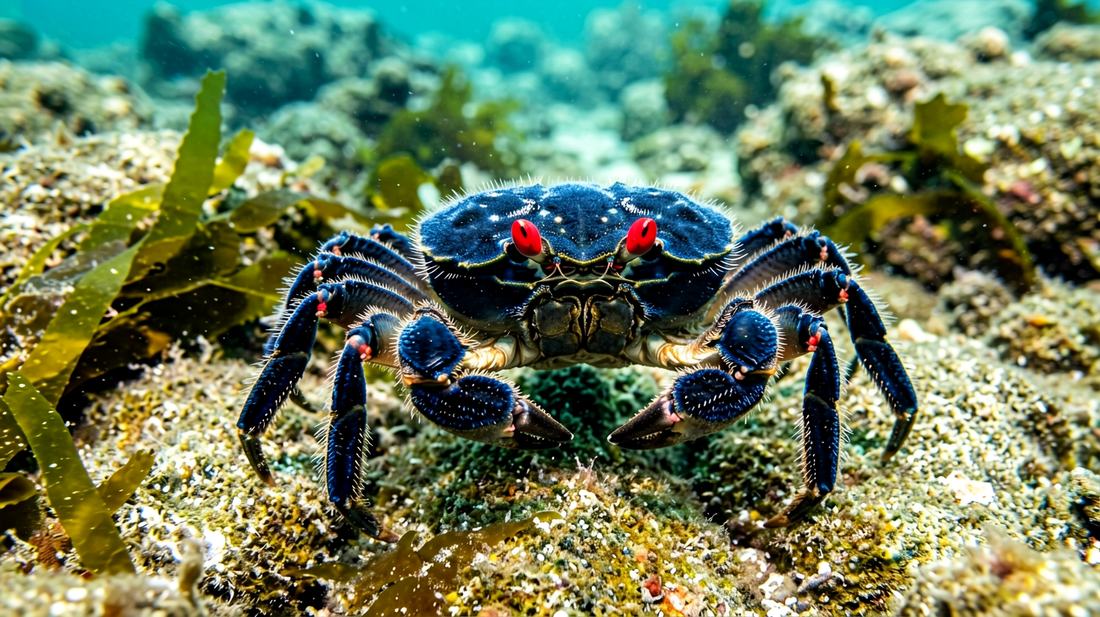
Necora puber | Velvet Swimming Crab
Species Profile · Portunidae
Velvet Swimming Crab
A blue-black shore crab in a coat of fine hair, with red eyes and a talent for swimming, hiding and fighting.
Not assessed by IUCN
Range
Carapace
Depth
Eggs
Assessed
The devil crab
The velvet swimming crab
The velvet swimming crab is a small, fierce shore crab. It wears a coat of fine, dark hairs. Two bright red eyes stare out from its head. People in the British Isles call it the devil crab. It earns that name every time it is handled. It lifts both claws and spreads its legs.
Then it jabs at anything that comes close. Its upper shell is deep blue-black or olive. The hairs trap a thin film of water and mud. This helps it blend into cracks and weed. Unlike most crabs, it can swim. It uses a pair of paddle-shaped rear legs.
It darts away through the water when in danger. These crabs live on rocky and stony ground. They range from the lower shore down to about 70 metres. They eat seaweed, mussels and barnacles. They are caught in France, Spain and Ireland. Their sweet flesh is highly prized there.
Family tree
Swimming crabs and their kin
The velvet swimming crab belongs to the phylum Arthropoda. Its class is Malacostraca. Its order is Decapoda. Its family is Portunidae. Its genus is Necora. Its best-known British relative is the Edible Crab. That crab is much heavier and rounder. It has a smooth reddish-brown shell and huge crushing claws.
It lives in the same rocky habitats. It belongs to a different family, the Cancridae. The two crabs often share the same boulder. The edible crab relies on bulk and brute force. The velvet swimming crab relies on speed and sharp claws. It also shows a will to fight. The family Portunidae holds around 500 species worldwide. It includes the blue swimmer crab of Australia.
It also includes the blue crab of the western Atlantic. All of them share flat rear legs that work as paddles. Fossil portunids are known from rocks over 100 million years old. The velvet swimming crab was first described in 1777. Its scientific name likely comes from a Mediterranean fisherman’s word. The species also occurs in the Mediterranean.
Hairs, claws and red eyes
How to identify one
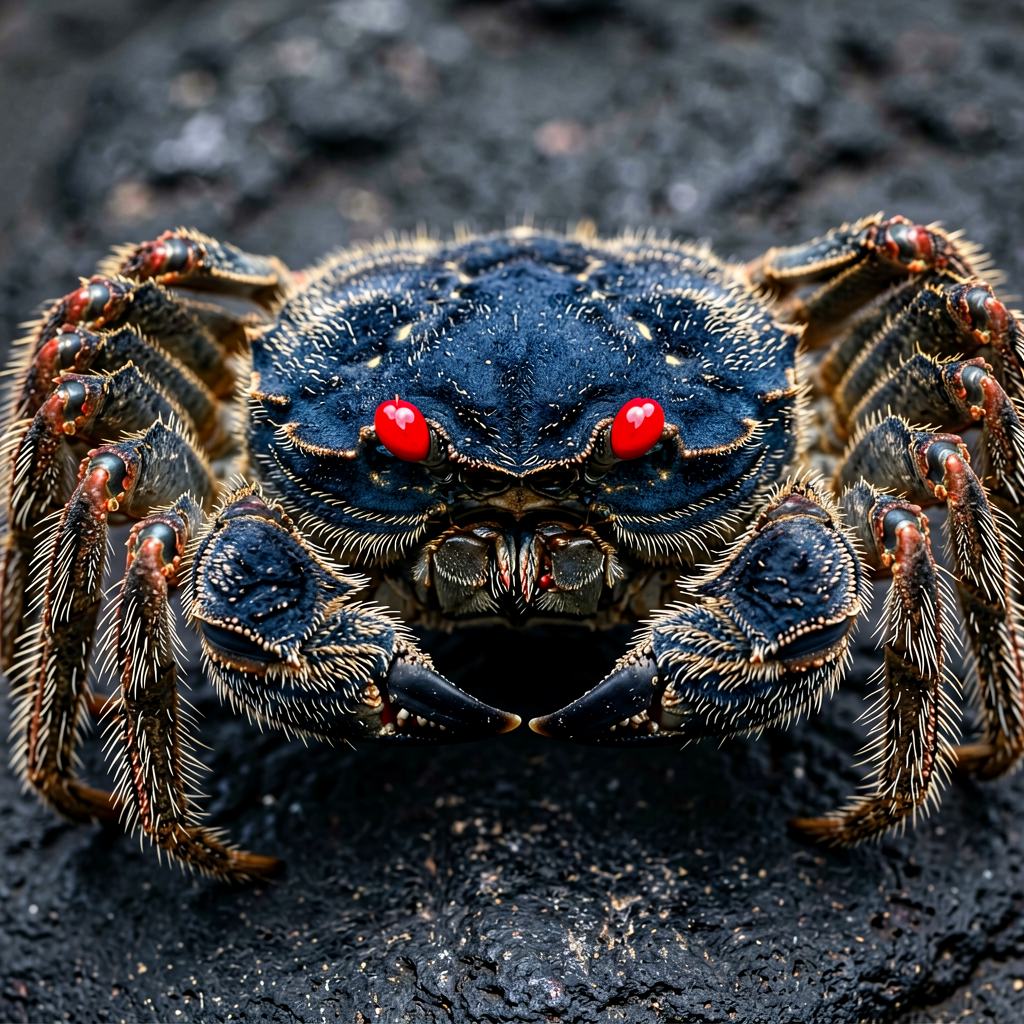
An adult’s shell measures up to about 8 centimetres across. Males grow larger than females. The shell is slightly wider than it is long. It is roughly hexagonal in shape. Its front edge is finely toothed. A few sharp spines line each side. A dense mat of short, hooked hairs covers it. This gives the animal its velvety feel. The hair also holds fine sediment.
Beneath the hair the colour is olive brown to deep blue-black. The eyes sit on short stalks. They hold a shiny layer. This layer glows bright red in torchlight. It makes the crab easy to spot at night. The claws are large. They carry sharp, dark-tipped fingers. The underside is often flushed with purple and orange. The fourth pair of legs is flattened into paddles.
The crab swims forwards, backwards and sideways. It beats those paddles to move. Like all crabs, it must moult to grow. It splits the old shell along a seam behind the eyes. Then it backs out of the shell. Right after a moult the body is soft. The animal hides until the new shell hardens. Growth slows after maturity. The species lives about three to five years.
1
2
3
Rock, weed and crevice
Where it lives
The crab lives on both sides of the north-east Atlantic. It ranges from Norway and the British Isles to Portugal and Morocco. It is found throughout the Mediterranean. It also lives around the Canary Islands. It prefers hard ground. It lives among rocks, boulders and cobbles. It also uses kelp holdfasts and maerl beds. It is common on the lower shore and in the shallow subtidal zone. It ranges from about the low water mark to 70 metres.
Occasional records place it deeper still. It is one of the most numerous large crabs in shallow water. It is often found under stones at low tide. This is especially true where weed cover is dense. It tolerates a wide range of conditions. It avoids very exposed shores and soft mud. Young crabs settle in shallow, sheltered nursery areas. They live among seaweed. As they grow they move into deeper, more exposed ground.
The crab is most active at night. It leaves cracks to hunt after dark. By day it hides in cracks and under stones. It also hides among the fronds of kelp. In winter it moves into slightly deeper water. It becomes less active then. In the coldest parts it may stop feeding for weeks.
What it eats
A hunter and a scavenger
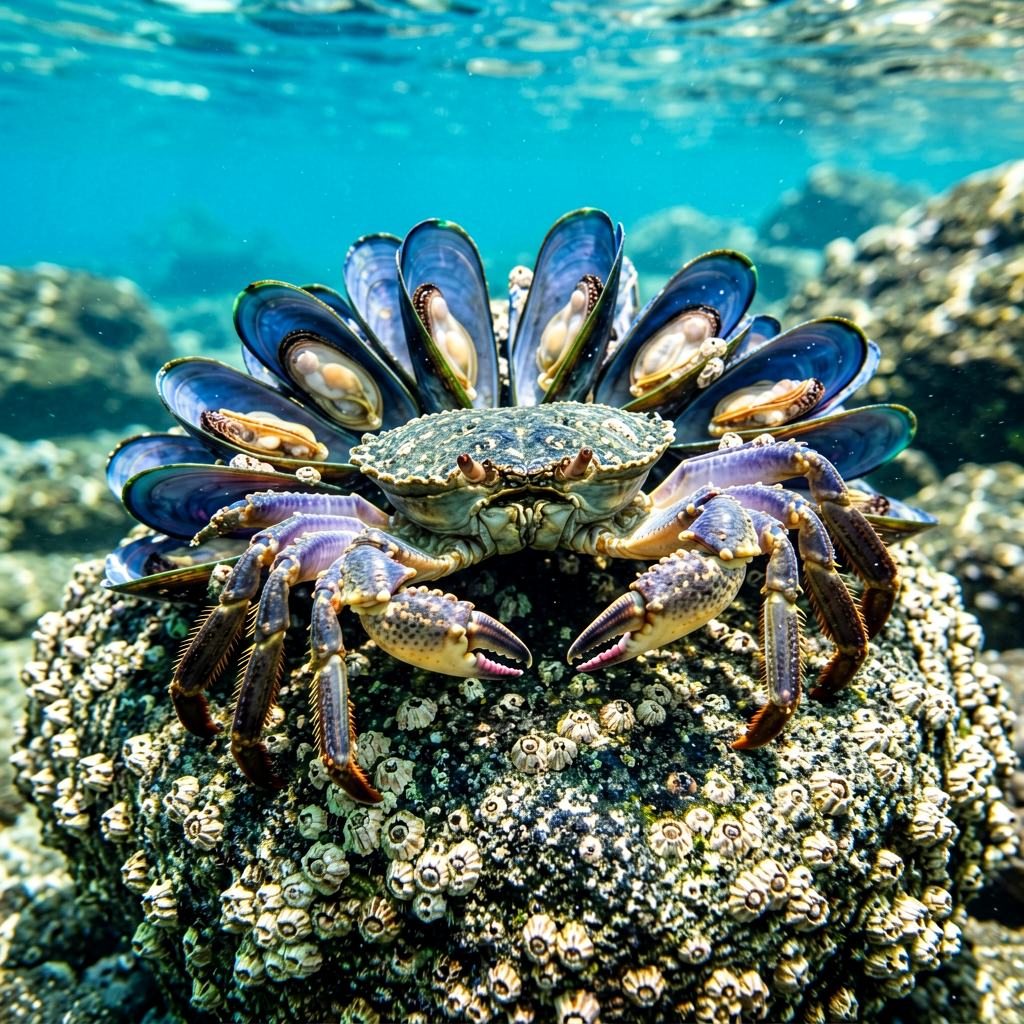
The velvet swimming crab is both an omnivore and a scavenger. It will eat almost anything it can overpower. Mussels, barnacles and limpets form a large part of its diet. So do small snails and other crustaceans. It uses sharp claws to chip open shells. It can also lever limpets from rocks. Seaweed makes up a large share of its food. It favours the fine, thread-like kinds.
It takes carrion too. This includes dead fish and the remains of other crabs. It is an active hunter, not a patient one. It chases small fish and shrimp through weed. Its swimming lets it attack prey in open water. The crabs are highly territorial. They fight each other over shelters and food. They lock claws and wrestle until one retreats.
Bad injuries are common. The species is eaten by octopus and cuttlefish. Conger eels and sea bass also eat it. So do larger crabs and herring gulls. Gulls are skilled at finding crabs on the shore at low tide. By eating dead material, the crab cleans the shore. It removes carcasses that would otherwise rot in place.
A guarded courtship
Mating and 200,000 eggs
Mating takes place mainly in summer and autumn. It depends on the female’s moult. A male can only mate with a female that just shed her shell. He carries her beneath his body for a few days. He guards her against rival males before the moult. When she moults he passes sperm. The pair separates soon afterwards. The female stores the sperm for later use.
She may use it many months after mating. Then she produces a mass of eggs. A large crab can carry about 200,000 eggs. She glues them to the underside of her abdomen. She carries them for a few weeks until they hatch. The young larvae are called zoeae. They are tiny, spiny creatures. They drift in the plankton.
They pass through a few moult stages before settling. Plankton growth takes about a month in summer. Settlement happens in shallow, weedy nursery areas. Females raise one or sometimes two broods per year. They do not feed while carrying eggs. Growth is slow and breeding starts late. Crabs do not breed until they are two or three years old. Heavy fishing therefore causes slow recovery of stocks.
A valuable catch
Fishing the velvet crab
The crab has no threat status. It is regarded as common across most of its range. It is still heavily fished in parts of western Europe. France, Spain, Portugal and Ireland take it to sell. Most fishing uses pots and creels on rocky ground. The crab is sold as etrille, necora and velvet crab. Landings in the north-east Atlantic have grown since the 1980s.
In some areas it is the most valuable crab after the edible crab. The species grows slowly and matures late. It also produces relatively few eggs for its size. Heavy fishing can therefore cut populations quickly. Minimum landing sizes exist in several countries. So do closed seasons. Discarded undersized and damaged crabs are a concern.
Survival after release from pots is usually high. Climate change may shift the range northwards. It may also alter the timing of breeding. Rising sea temperatures have changed swimming crab numbers near Britain. There is no targeted plan to save this species. Management relies on the general rules of the crab fishery.
Quick hits
Five things to remember
- Its name comes from the dense mat of hairs on its shell. The hairs trap mud and help it hide.
- Its shiny eyes glow bright red in a torch beam. This earned it the nickname devil crab.
- Unlike the edible crab, it can truly swim. It beats its flat rear legs like paddles to escape.
- A male carries a female under his body for days. He guards her until he can mate.
- A large female can carry about 200,000 eggs. They are glued beneath her body for weeks.