 By st20113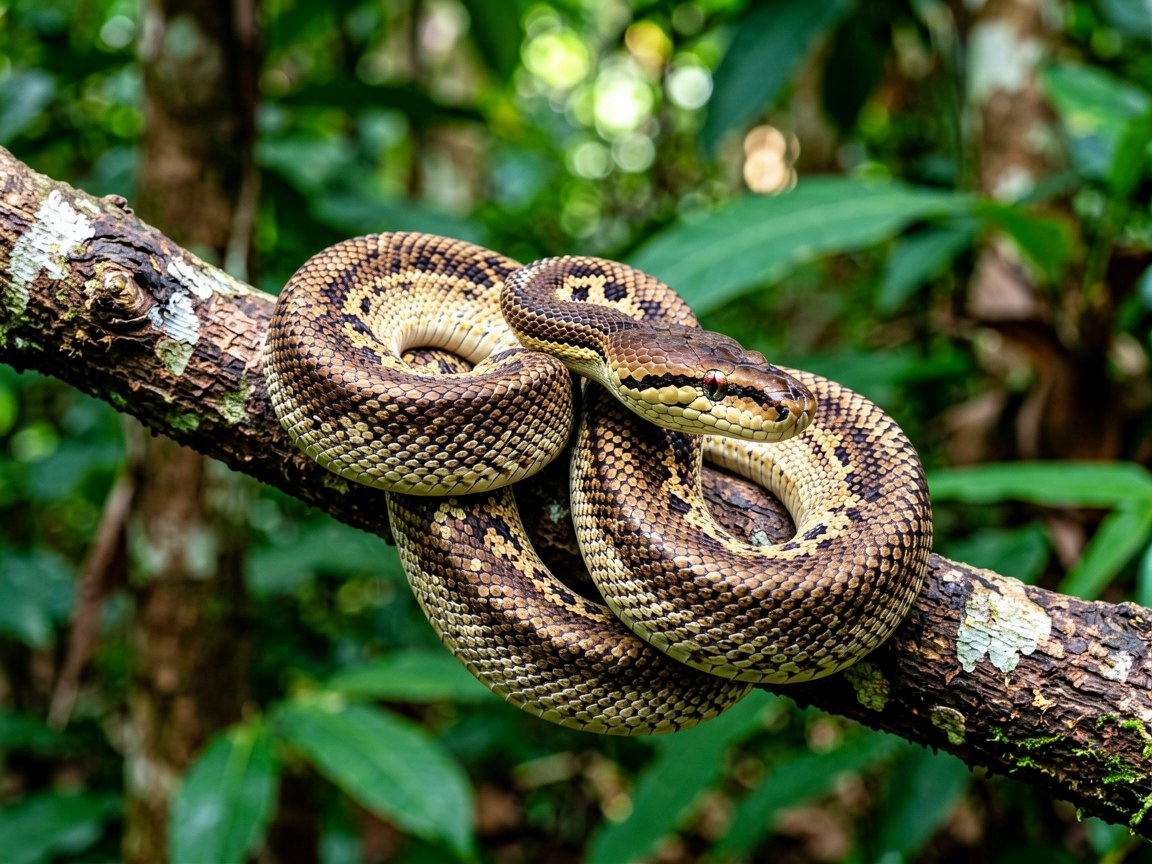
Python molurus | Indian Python
Introduction
The Indian python, Python molurus, is a large non-venomous constrictor of the family Pythonidae, native to the Indian subcontinent. Known as the Indian rock python, it inhabits grasslands, swamps, and rocky foothills from India and Sri Lanka to Nepal, Bangladesh, and Pakistan. Unlike the venomous cobras and kraits that share its range, it kills by constriction and poses little threat to people. Primarily nocturnal, it hides by day in burrows and dense cover and emerges at dusk to hunt. As an apex predator of small and medium vertebrates, it helps control rodents that damage crops and spread disease, and it holds a long place in South Asian folklore as a symbol of water and fertility.
Taxonomy
Carl Linnaeus first described the species in 1758 as Coluber molurus, and Francois Daudin placed it in the genus Python in 1803. The name molurus comes from the Latin for snout. Historically the Burmese python was treated as the subspecies P. m. bivittatus, but modern taxonomy recognizes it as a separate species, Python bivittatus, leaving P. molurus as the Indian form with a more restricted, fragmented range. Within Pythonidae it belongs to the Old World pythons, marked by vestigial hind-limb spurs, labial heat pits, and two functional lungs. For a comparison with another iconic Old World predator, see our article on the [Nile Crocodile](https://www.gloencyc.com/nile-crocodile-crocodylus-niloticus/). The Indian python is distinguished from the Burmese python by darker coloration, smaller size, and a more strongly marked head.
Genetic analyses of nuclear and mitochondrial markers consistently recover the Indian and Burmese pythons as sister lineages that diverged as rising seas and the Malay Archipelago isolated their ancestors. Within India, populations from the Western Ghats and the northeast show subtle morphological differences that some herpetologists have proposed as informal regional forms, although none are formally recognized. The species’ closest living relatives also include the African rock python, with which it shares the broad-headed, heavy-bodied body plan typical of large constricting pythons.
Physical Characteristics
The Indian python is heavily built, thickest at midbody and tapering to a prehensile tail. Adults usually measure two to three meters, with exceptional individuals over three and a half meters; wild weights commonly run fifteen to thirty kilograms, occasionally above fifty. Females are bulkier than males. The ground color ranges from tan and olive to creamy yellow, overlaid with dark, saddle-shaped blotches edged in black, plus a distinctive dark, tongue-shaped mark on the head. Small dark spots fill the gaps, giving superb camouflage. Like all pythons it has labial heat-sensing pits that detect infrared from prey in darkness, vertical slit pupils, and smooth iridescent scales that can shimmer blue or green in light.
The dorsal scale rows number roughly fifty to sixty at midbody and are smooth, while the ventrum is pale with faint markings. Albino and unusually dark or patternless individuals are occasionally reported but are rare in the wild. Hatchlings are paler than adults and show sharper contrast in their blotches, a pattern that fades with age. The jaw musculature is powerful enough to crush the skulls of large rodent prey during constriction, and the skull is highly kinetic, allowing the mouth to open wide enough to swallow animals far broader than the snake’s own head.
Habitat
The species occupies remarkable habitat diversity across the subcontinent, favoring areas near rivers, marshes, lakes, and canals because it swims well and often hunts by water. Grasslands, open forests, mangrove edges, and agricultural land such as sugarcane fields are all used. In dry western India it takes refuge in rocky outcrops and abandoned burrows, becoming largely nocturnal in the hot pre-monsoon. Along the wetter Western Ghats it persists in moist deciduous and evergreen forest. It ranges from sea level to about two thousand meters in the Himalayan foothills, avoiding true deserts and the coldest zones. Seasonal movements follow prey and shifting water as monsoon floods and droughts reshape the landscape.
In Sri Lanka the python occurs in dry-zone forests and lowland wetlands, while in Nepal it is largely confined to the Terai grasslands along the base of the Himalayas. Human-snake conflict is most acute where python habitat borders villages, and road mortality on expanding rural highways adds to localized declines. The snake’s tolerance of irrigation canals, temple ponds, and rice paddies has allowed it to persist near people, but such proximity also exposes it to poisoning campaigns aimed at pest rodents and to accidental capture in fishing nets.
Diet
As a constrictor, the python strikes, seizes prey in recurved teeth, and throws coils that prevent the victim’s exhalation until it suffocates, then swallows it whole, head first. The diet is dominated by warm-blooded vertebrates: rodents such as bandicoot rats and field mice, hares, mongooses, small deer fawns, and occasional wild piglets or langurs. Birds, including ground-nesters and waterfowl, are taken opportunistically, while young snakes start on lizards and frogs. A large meal sustains an adult for weeks or months, producing seasonal feast-and-fast cycles. In farmland the python is beneficial, eating crop pests, though conflict arises when it enters poultry houses or is mistaken for a venomous snake and killed.
Reproduction
The Indian python is oviparous. Breeding follows the monsoon, from late autumn into winter, when males track females by pheromones and engage in combat or courtship; females can store sperm. Clutches commonly number twenty to fifty eggs, with very large females laying over eighty. The female then coils around the eggs and shivers her muscles to generate heat, raising the clutch temperature several degrees above ambient to speed development, a form of parental care rare among reptiles. She may fast through the roughly two-month brooding. Hatchlings emerge with an egg tooth, measure about forty-five to sixty centimeters, and are independent immediately. Sexual maturity comes at roughly three to four years.
Conservation
Globally the species is Least Concern, but the nominate Indian form is Near Threatened to Vulnerable in parts because of hunting and habitat loss. It is listed under CITES Appendix I, banning commercial international trade in wild specimens. Main threats are the illegal skin and pet trades, traditional medicine demand, and wetland drainage and urbanization that shrink refuge and foraging areas. Because the python matures slowly and produces few offspring, populations rebound poorly once depleted. Positively, it survives in many reserves, and cultural reverence offers informal protection. Conservation focuses on enforcement against poaching, wetland and grassland restoration, and education to stop needless killing of snakes mistaken for venomous species. Captive breeding, if regulated, eases pressure on wild stocks.
In India the species is protected under the Wildlife Protection Act, and several range states run rescue and rehabilitation centers for confiscated snakes. Community-based schemes that train locals as snake-catchers rather than killers, and that publicize the python’s role in suppressing rats, have reduced retaliatory killings in key habitats such as the Western Ghats and the Sundarbans mangroves. Long-term monitoring using radio telemetry is improving understanding of home-range size and movement, which is essential for designing corridors that connect the fragmented populations on which the species’ future now depends.
Fun Facts
- The Indian python can go months between meals, surviving on a single large mammal thanks to an extraordinarily slow metabolism.
- Female Indian pythons are among the few reptiles that warm their eggs by shivering, raising clutch temperature through muscular heat.
- Despite their size, these snakes are strong swimmers and cross wide rivers and coastal mangrove channels.
- The spurs near the cloaca are vestigial hind limbs, remnants of the ancestors of modern snakes.
- In Indian mythology the python is linked to water and fertility and appears in temple art and folk stories.