 By st20113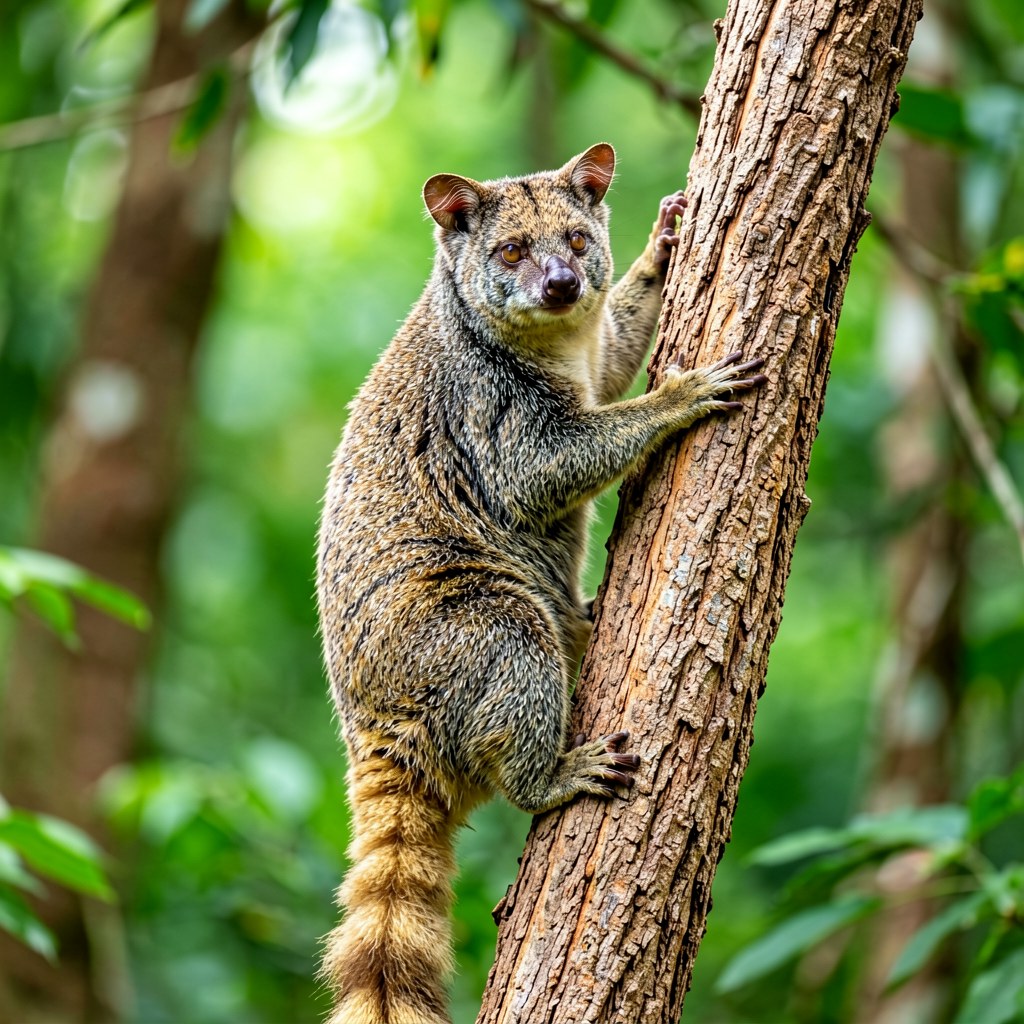
Tamandua tetradactyla | Southern Tamandua
Introduction
The southern tamandua (Tamandua tetradactyla) is a medium-sized anteater in the family Myrmecophagidae, native to the forests, savannas, and wetlands of Central and South America. Often called the lesser anteater or collared anteater, it is instantly recognizable by its slender body, long prehensile tail, and striking coat pattern in which the rear and flanks are dark—sometimes black—while the front, shoulders, and head are pale, giving the appearance of wearing a vest. Like all anteaters, it is a specialized myrmecophage, feeding chiefly on ants and termites with a long, sticky tongue and powerful claws. The southern tamandua is largely arboreal, spending much of its time climbing and foraging among branches, though it also feeds on the ground. It is solitary, mostly nocturnal, and remarkably strong for its size, able to rip open termite mounds and arboreal nests with its forelimbs. Widespread and adaptable, it ranges from Trinidad and the Guianas through Brazil, Peru, and Bolivia to northern Argentina, and while not currently endangered, it faces mounting pressure from habitat loss and road traffic.
Taxonomy
The southern tamandua was described by Carl Linnaeus in 1758, who gave it the binomial Tamandua tetradactyla, the species epithet referencing its four-toed forefeet (tetra = four, dactyl = digit). It belongs to genus Tamandua, which contains the two tamandua species of the Neotropics, within family Myrmecophagidae, the anteaters, part of the order Pilosa alongside the sloths. Anteaters and sloths together form the Xenarthra, a distinctive grouping of mammals also including armadillos, united by unique joint structures in their spines. The genus Tamandua sits between the tiny silky anteater (Cyclopes) and the giant anteater (Myrmecophaga) in both size and ecology. A close and informative relative is the giant anteater (Myrmecophaga tridactyla), described at https://www.gloencyc.com/giant-anteater-myrmecophaga-tridactyla/, which shares the tamandua’s ant-specialized lifestyle but is far larger and almost entirely terrestrial. Several subspecies have been named across its broad range, reflecting geographic variation in size and the darkness of the ventral “vest” marking.
Physical Characteristics
The southern tamandua measures roughly 50 to 65 centimeters in head-and-body length, with a tail of similar or slightly greater length, and weighs about 3.5 to 7 kilograms. Its coat is short and dense, and the hallmark pattern is a pale to yellowish anterior half—head, throat, chest, and forelimbs—contrasting with a dark, often black, posterior half and a dark stripe crossing the flank, so the animal looks clad in a saddle or vest. The head is narrow with a long, tubular snout and a tiny mouth opening at the tip; the eyes and ears are small. The forelimbs bear four large, curved claws, the third being especially enlarged and used to shred nests and defend against predators, while the hind feet have five claws and a partially prehensile grip. The tail is long, muscular, and prehensile, naked toward the tip and used for balance and anchoring while climbing. The tongue is slender, extends up to about 40 centimeters, and is coated with sticky saliva to collect insects.
Habitat
The southern tamandua occupies a remarkably broad set of habitats across its range, including tropical and subtropical rainforest, seasonally dry forest, gallery forest, savanna woodland (cerrado), caatinga, mangroves, and disturbed second growth. It is found from near sea level to elevations of around 2,000 meters and is as comfortable in the Amazon basin as in the drier landscapes of northeastern Brazil and the Gran Chaco. The species is chiefly arboreal, using trees and shrubs for foraging, resting, and traveling, and it sleeps in tree hollows, abandoned burrows, or leafy nests during the day. It also descends to the ground to raid terrestrial termite mounds and fallen logs. Its adaptability to altered habitats means it can persist in agricultural edges and plantation landscapes better than many forest specialists, provided some tree cover remains. The availability of abundant ant and termite colonies, plus enough vertical structure for climbing and denning, are the key habitat requirements, making continuous or semi-continuous woody cover important even where the species tolerates disturbance.
Diet
As a dedicated myrmecophage, the southern tamandua feeds overwhelmingly on social insects, especially ants and termites, which it locates by scent. Using its keen sense of smell, it finds arboreal and terrestrial nests and tears them open with powerful forelimb claws, then laps up the occupants with its long, sticky tongue. A single animal may visit numerous nests in a night, consuming thousands of individuals, but it typically feeds briefly at each colony to avoid arousing defensive soldiers and to limit the dose of formic acid and other chemicals the insects deploy. Although ants and termites dominate the diet, the tamandua is somewhat more generalist than the giant anteater and will also eat soft-bodied larvae, honeybees, and occasionally ripe fruit, and it readily takes insects attracted to carrion or sap. Its stomach is muscular and aids in grinding the tough exoskeletons of its prey, compensating for the lack of teeth.
Reproduction
Southern tamanduas are solitary and polygynous, coming together only to mate. Breeding can occur at various times of year depending on latitude and local conditions, with some populations showing a birth peak in the drier months. After a gestation of roughly 130 to 190 days, the female gives birth to a single offspring, though twins are occasionally reported. The newborn is tiny, weighing only a few hundred grams, and is born with a coat pattern already resembling the adult’s vest marking, providing camouflage in the dappled forest light. The mother carries the infant on her back for the first weeks to months, transporting it as she forages, and later parks it on a branch or in the den while she feeds. Weaning occurs at about two to four months, and the young becomes independent over the following months, reaching sexual maturity at roughly one to two years. Because females produce only one young per cycle and the species invests heavily in that offspring, population growth is relatively slow, so severe mortality—from roads, dogs, or habitat loss—can take a toll before numbers rebound. Still, the species’ tolerance of varied habitats helps buffer it against rapid decline.
Conservation
The southern tamandua is listed by the IUCN as Least Concern, owing to its extensive range, habitat flexibility, and apparently stable populations across much of the Neotropics. It is one of the more resilient members of the anteater family and can persist in mosaics of forest and farmland where some canopy remains. However, it is not without threats. Deforestation for cattle ranching, soy, and palm oil, together with the fragmentation of continuous forest, reduces the woody cover and termite resources it relies on, and isolated individuals face higher risks. Roadkill is a leading cause of death in developed areas, since the animal ambles across roads at night and is slow to react to vehicles. It is also sometimes killed by dogs or persecuted by people who mistake it for a pest, and locally it may be hunted for food. Because it adapts better than the giant anteater, targeted conservation is less urgent, but maintaining forest corridors, reducing road mortality, and curbing uncontrolled habitat conversion remain the best ways to keep this distinctive anteater common.
Fun Facts
- The southern tamandua’s dark “vest” pattern makes it look as though it is wearing a saddle or saddlecloth.
- Its tongue can extend up to about 40 cm and is coated in sticky saliva to trap ants and termites.
- It has four huge claws on each front foot, with the middle one enlarged for tearing open nests.
- Although it mostly eats ants and termites, it will sometimes snack on ripe fruit and bee larvae.
- Mothers carry their single baby on their back, keeping it close while they climb and forage.